Kamadeva Myth Meaning & Symbolism
The god of desire is incinerated for awakening love in Shiva, becoming the bodiless force of longing that connects all beings.
The Tale of Kamadeva
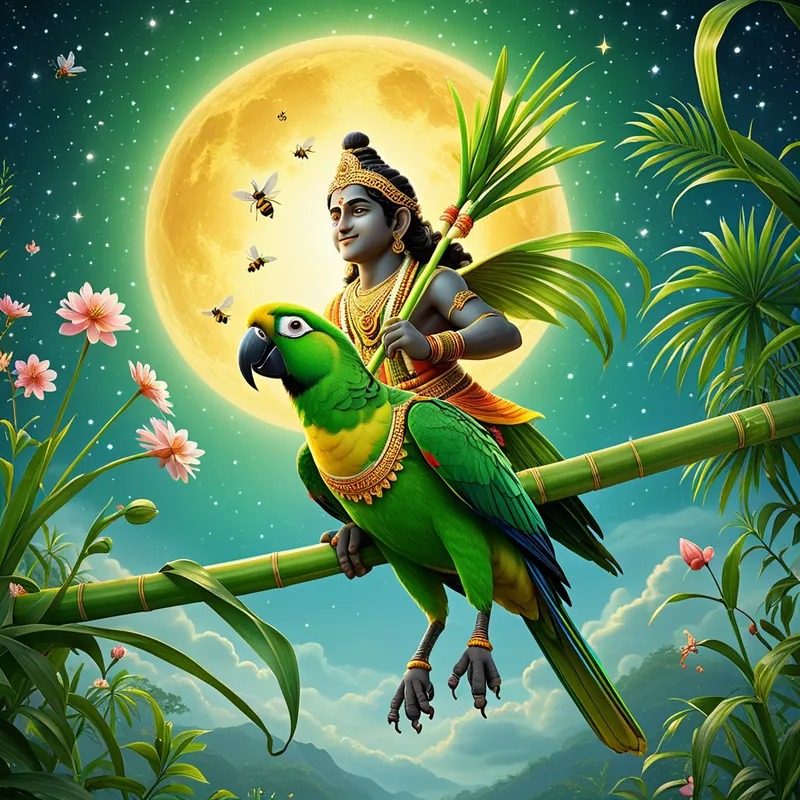
Listen. Before time hardened into history, when the cosmos was a tapestry still being woven, there existed a force so fundamental it was both a god and a sigh. His name was Kamadeva. He was not born of flesh, but of the first glance, the first longing that stirred in the void. He moved through the worlds on a chariot drawn by parrots, the air sweetening with the scent of spring blossoms where he passed. In his hands, he carried a bow of sugarcane, strung with a line of humming bees, and five arrows tipped with flowers. To be struck was not to be wounded, but to be awakened—to feel the delicious, terrifying pull of the heart toward another.
Yet, in a high mountain cave, wrapped in the silence of absolute meditation, sat Shiva. His consciousness was turned entirely inward, a still point around which the universe turned. His divine consort, Shakti, in her form as Parvati, longed for him. She performed austerities for centuries, her love a steady flame, but Shiva remained unmoved, a mountain of ice in the face of her sun.
The gods grew desperate. A demon, Taraka, terrorized the heavens, and the prophecy was clear: only a son born of Shiva and Parvati could defeat him. But how to stir the ascetic god? The council of deities turned to the one being whose essence was the antidote to indifference. They approached Kamadeva.
He understood the task. It was not mere mischief; it was a cosmic imperative. With a heart both heavy and resolute, he journeyed to Shiva’s Himalayan abode. The very air grew thin and still. There, he saw Parvati in her devotion, and before the immovable Shiva. Drawing a single arrow—tipped with the lotus, the flower of unfolding consciousness—Kamadeva took aim. The bowstring of bees hummed a primordial note. He let the arrow fly.
It struck Shiva’s heart.
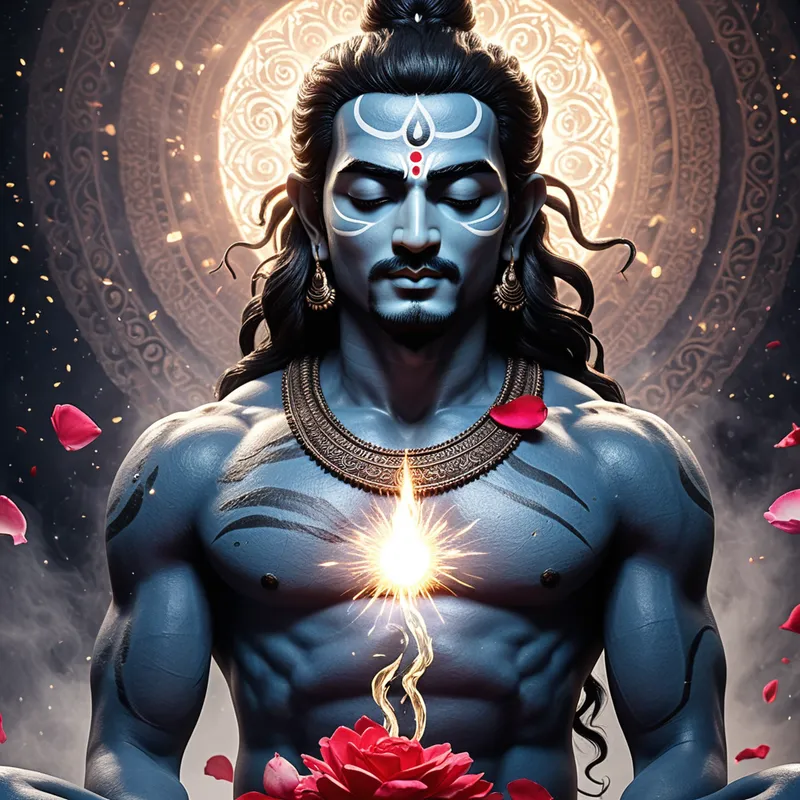
The effect was not immediate, but seismic. A ripple passed through the absolute stillness. Shiva’s inward gaze wavered. He opened his eyes and beheld Parvati, not as a distant mountain goddess, but as the radiant embodiment of the universe itself. The first flicker of attraction, of recognition, ignited within him. But in the next instant, Shiva realized what had happened. He felt the foreign heat of desire—a force that had breached his perfect autonomy. His wrath was not petty anger; it was the fury of infinity disturbed. The third eye on his forehead blazed open, and a beam of pure, annihilating light—brighter than a thousand suns—erupted forth.
It struck Kamadeva full in the chest.
There was no scream, only a great sigh. Kamadeva’s beautiful, tangible form dissolved. His body turned to ash and fragrant smoke, scattering on the wind. He was no more. Yet, in the very moment of his destruction, his work was complete. Shiva’s gaze remained on Parvati. The connection was forged. The universe held its breath.
And from the ashes of the god of form, something new arose. A plaintive cry echoed. It was Rati, his wife, whose name means "passion." Her grief moved the cosmos. Shiva, his purpose now aligned, promised that Kamadeva would live again—but not as he was. He would be Ananga. No longer a deity with a charming form, he would become the invisible force of attraction itself, the longing that moves between atoms and souls, present in all but seen by none.
Cultural Origins & Context
The myth of Kamadeva finds its roots in the ancient Vedic and early Puranic traditions, crystallizing in texts like the Mahabharata and the Shiva Purana. Unlike the later, more romanticized portrayals, the early Kamadeva is a serious cosmological principle. He is identified with Kama, the first seed of mind, mentioned in the Rig Veda. This was not trivial "cupid" love, but the primal urge towards creation, the force that propelled the One to become the Many.
The myth was preserved and transmitted by storytellers, priests, and poets. Its societal function was multifaceted. It explained the nature of desire (Kama) as a legitimate, powerful, yet dangerous force that must be integrated into the spiritual cosmos. It served as a foundational narrative for the concept of Kali Yuga, where desire is said to run rampant in the absence of its embodied lord. Furthermore, it established the theological framework for Shiva as the supreme ascetic who ultimately encompasses and transcends even desire, and for Parvati as the devoted power whose love can stir the universe into benevolent action.
Symbolic Architecture
At its core, the myth is a profound allegory for the nature of consciousness and connection. Kamadeva represents the principle of individuation through attraction. He is the spark of awareness that says, "I am here, and you are there, and the space between us is charged with potential."
Desire is not the enemy of spirit; it is spirit's first movement towards form, the ache that bridges the solitude of the absolute.
His weapons are symbolic: the sugarcane bow (sweetness that bends but does not break), the bee-string (the industrious, sometimes painful pollinator of experience), and the five flower-arrows (each targeting a different sense, representing the totality of sensual engagement). His destruction by Shiva's third eye—the eye of transcendental wisdom and annihilation—signifies the dissolution of the personal, grasping ego in the face of ultimate reality. Yet, his transformation into Ananga reveals the paradox: the personal form of desire dies, but the impersonal force of attraction becomes universal and eternal.
Shiva represents pure, undifferentiated consciousness. Parvati represents the dynamic, manifest world (Prakriti). Kamadeva is the necessary catalyst that allows the transcendent (Shiva) to recognize and unite with the immanent (Parvati), thus making the world not an illusion to be escaped, but a beloved expression of the divine to be engaged with.

The Dreamer's Resonance
When this myth stirs in the modern psyche, it often manifests in dreams of profound, transformative longing or sudden, devastating loss of a cherished aspect of the self. To dream of being struck by a flower-arrow is to experience the irresistible call towards a person, a creative project, or a life path—a call that feels fated and disruptive to one's current equilibrium.
Conversely, to dream of being incinerated by a beam of light, of dissolving into ash while feeling a strange peace, speaks to a psychological process of de-identification. It is the somatic recognition that an old identity—perhaps the identity of the "seeker," the "lover," or the "charming one"—is being burned away by a deeper insight or a life crisis. The dreamer is not being punished; they are undergoing the alchemy of becoming "bodiless." The grief of Rati in the dream represents the part of the psyche that mourns the loss of a familiar, tangible form of desire, even as a more subtle, pervasive connection is being born.

Alchemical Translation
For the individual, the myth of Kamadeva maps the journey of psychic transmutation, or individuation. We all begin, in a sense, as Kamadeva: identified with our desires, our attractions, our personal charm and strategies for connection. This is a necessary stage. But life inevitably brings us to our "Shiva moment"—a confrontation with a force (a loss, a failure, a deep meditation) that incinerates this personal complex.
The fire from the third eye does not destroy desire; it refines it from a want into a worship, from a hunger into a holy current.
The alchemical work is in surviving this incineration. It is the process of moving from Kama (personal, object-oriented desire) to Prema (impersonal, abiding love). The modern seeker must learn to become Ananga—to feel longing not as a lack to be filled by a specific other, but as the very connective tissue of existence. The love that remains is not attached to form; it becomes a quality of attention, a way of being in the world. One's creativity, relationships, and engagement with life are no longer driven by the need to acquire an experience, but by the joy of participating in the grand, desirous dance of Shiva and Shakti. The bodiless god whispers that our deepest fulfillment lies not in being the arrow, but in becoming the invisible arc it travels upon, connecting all points in a single, graceful, and eternal motion.
Associated Symbols
Explore related symbols from the CaleaDream lexicon: