Kama Myth Meaning & Symbolism
The god of desire is incinerated by Shiva's third eye, then reborn as Ananga, the bodiless one, teaching that love transcends form.
The Tale of Kama
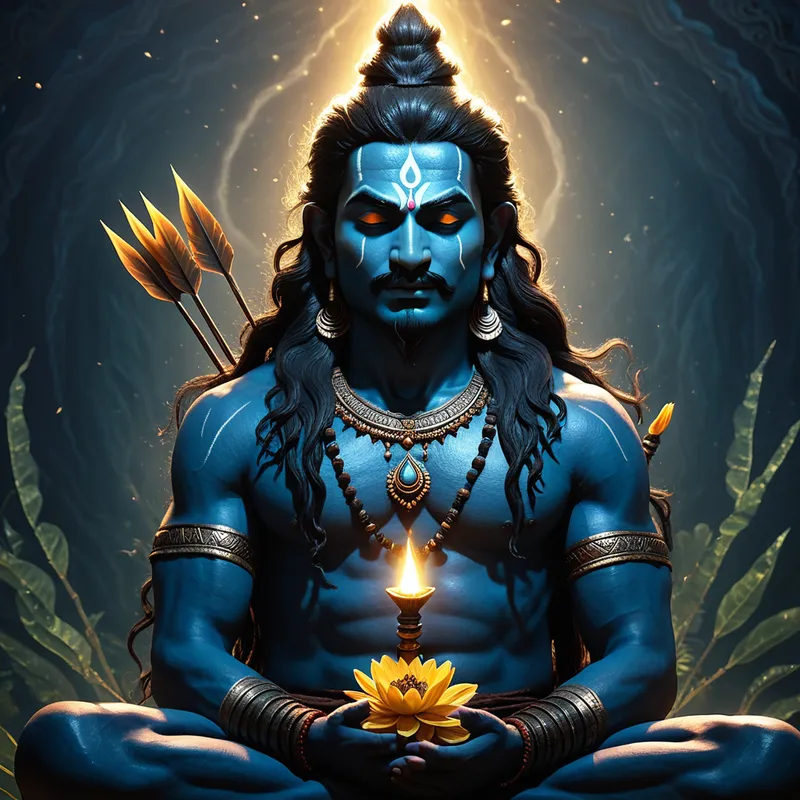
Listen, and hear the tale of the first longing, the first sigh that stirred the still waters of creation. In the high, cold reaches of the Mount Kailash, where silence was a kingdom and stillness a crown, sat Shiva. His form was clad in ashes, his matted locks coiled like serpents of renunciation. His eyes, closed in samadhi, saw only the infinite void within. Around him, the world held its breath. For as long as Shiva remained unmoved, the wheel of life could not turn. Creation was poised, but incomplete, a song without its final, resonant note.
In the celestial realms, a crisis bloomed. The gods trembled, for a mighty demon, Taraka, ravaged the worlds, and the prophecy declared only a son born of Shiva could defeat him. But Shiva, lost in eternal meditation, had no consort, no desire for one. The air grew thick with divine despair. Then, a whisper, a solution as dangerous as it was beautiful: only the arrow of Kama could pierce that perfect isolation.
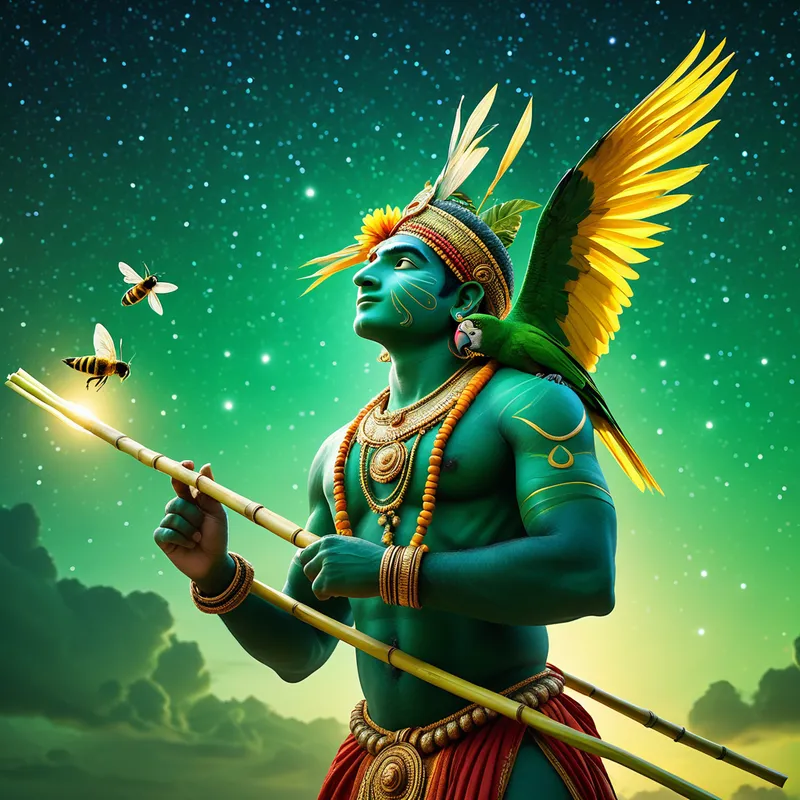
Kama was no mere cupid. He was the essential vibration, the fragrant pull that draws pollen to blossom, star to star, soul to soul. His body was the essence of spring, his bow a stalk of sugarcane, his bowstring a line of humming bees. His quiver held five arrows, each tipped with a different flower, each capable of igniting a unique flavor of longing. At the behest of the gods, accompanied by his consort Rati and the gentle spring wind, Vayu, he descended to the slopes of Kailash.
The air, once crisp with austerity, grew heavy with the scent of jasmine and mango blossom. The sound of distant waterfalls seemed to murmur of secret meetings. Kama took his position, a sculptor of emotion preparing to shape the unshapable. He saw his target: the heart of the world’s great ascetic. He drew back his bow, the bees buzzing a tense symphony. He selected the arrow tipped with the lotus, the arrow that stirs divine, all-consuming love. He let it fly.
The flower-tipped shaft cut through the sacred silence. It found its mark, not with a thud, but with the softest sigh. Shiva’s closed eyes fluttered. A sensation, foreign and ancient, stirred in the cavern of his heart—a warmth, a pull, a memory of connection he had long ago transcended. His meditation, the universe’s anchor, wavered. And in that moment of divine vulnerability, his gaze fell upon the goddess Parvati, who had been performing austerities nearby to win him as her husband. Her devotion, her beauty, now amplified a thousandfold by Kama’s magic, shone before him.
Then came the wrath. The interruption of his absolute state was an unbearable violation. His inner eye, the eye of transcendent wisdom and destruction, blazed open on his forehead. A searing, annihilating light, hotter than a thousand suns, erupted forth. It sought the source of this disturbance. It found Kama, the embodiment of that delicious, disruptive force. There was no scream, only a brilliant, terrible flash. Kama, the god of form, was instantly reduced to a pile of fine, smokeless ash. His beautiful body was no more. A wail pierced the heavens—the agonized cry of Rati, holding the ashes of her beloved.
But the arrow had done its hidden work. The seed was planted. Shiva’s gaze remained on Parvati, now seen with new eyes. The wheel of creation began, slowly, to turn once more.
Cultural Origins & Context
The myth of Kama is woven into the earliest poetic and philosophical strata of Hindu culture, primarily within the great epic the Mahabharata and the later Puranas. He is celebrated as a fundamental cosmic principle. In the Rig Veda, desire (kama) is itself identified as the first seed of consciousness, the primal force that initiated creation. Kama, the deity, personifies this force.
The story was not merely entertainment; it was a sophisticated theological and social discourse. It was recited by bards and elaborated upon by priests to explore the tension between two supreme dharmas (sacred duties): the path of ascetic renunciation (sannyasa) and the path of worldly duty and pleasure (dharma and kama as a purushartha). The myth served to validate both. It showed that even the supreme ascetic is not immune to the cosmic law of attraction, and that this attraction, when integrated with devotion (as embodied by Parvati), leads to the fulfillment of cosmic purpose—the birth of the divine warrior, Kartikeya, who would defeat the demon.
Symbolic Architecture
At its heart, this is not a story about a god being punished. It is an allegory for the transformation of raw, personal desire into universal, creative love. Kama represents the psychic energy of Eros—not merely sexual, but the fundamental urge to connect, to create, to move toward an object of affection or beauty. Shiva represents the psyche’s drive toward absolute transcendence, pure consciousness, and dissolution of the ego.
The incineration by the third eye is not an end, but the ultimate refinement. Personal, form-bound desire must be sacrificed to become impersonal, omnipresent love.
Kama’s destruction is the pivotal alchemical moment. His reduction to ash symbolizes the burning away of attachment, of selfish craving, of desire that seeks only to possess. From this ash, he is later reborn as Ananga. This is the core revelation: true love, in its highest sense, is bodiless. It is no longer dependent on physical form or personal gratification; it becomes a pervasive, invisible force that animates all of creation. Ananga is the sigh in the wind, the pull between electron and proton, the unspoken understanding between souls. Shiva, having “killed” personal desire, then marries Parvati—he integrates the transformed, universalized principle of connection (now as Ananga) with devoted, conscious partnership.
The Dreamer's Resonance
When this myth stirs in the modern unconscious, it often manifests in dreams of profound, transformative encounters with love or creative energy that end in a shocking loss or disintegration. You may dream of meeting a captivating lover or discovering a passionate new purpose, only to watch it be suddenly “burned away”—by a circumstance, a realization, or a powerful, judgmental figure (the Shiva archetype of inner authority or superego).
The somatic experience is key: a rush of euphoric warmth (the arrow’s strike) followed by a chilling, empty numbness (the incineration). This is not a dream of simple failure. It is the psyche’s dramatic enactment of a necessary death. The dreamer is undergoing the painful but sacred process where an old way of loving, creating, or desiring—one that may be ego-bound, needy, or possessive—is being dissolved by a higher aspect of their own consciousness (the third eye of insight). The subsequent feeling of grief (Rati’s wail) is authentic, for a real part of the self has been sacrificed. The dream signals a transition from a love that has an object to a love that simply is.

Alchemical Translation
For the individual on the path of individuation, the myth of Kama maps the terrifying and glorious transmutation of libido. Our initial creative and erotic energies are often tied to specific outcomes: this person, this achievement, this recognition. We aim our sugarcane bow with a personal target in mind. But the journey toward wholeness requires that this personal aim be surrendered.
The ash of Kama is the fertile void from which authentic creation is born. It is the state of being in love with the essence of love itself, rather than its temporary forms.
The alchemical process follows the myth’s sequence: Invocation (feeling the urgent, divine need to create or connect), Intervention (allowing that desire to aim for the highest target—the heart of one’s own spiritual core or deepest purpose), Incineratio (the inevitable, painful destruction of the desire’s immature form by the fire of self-awareness and reality), and Incorporatio (the rebirth of that energy as a subtle, formless, yet omnipresent force—Ananga—that now informs all actions with a quality of unattached beauty and grace).
One no longer “falls in love”; one becomes a loving presence. One no longer “makes art” from a need for acclaim; creativity flows as an intrinsic state of being. The demon Taraka—representing the stagnant, tyrannical forces of the unconscious that resist evolution—can only be slain by the child born from this union. That child is the new consciousness, the integrated Self, capable of action in the world that is both powerful and infused with the essence of bodiless, universal love. The myth assures us: what feels like the death of desire is, in truth, its apotheosis.
Associated Symbols
Explore related symbols from the CaleaDream lexicon: