Kalpa Myth Meaning & Symbolism
The myth of the cosmic Kalpa, an immeasurable cycle of world-creation, flourishing, dissolution, and void, mirroring the psyche's endless process of death and rebirth.
The Tale of Kalpa
Listen. Before the first thought, before the first name, there is the Breath of Time. It is not a breath you or I would know. It is the inhalation and exhalation of existence itself, a rhythm so vast it makes mountains seem like dust motes in a sunbeam. This rhythm is the Kalpa.
In the beginning of a great Kalpa, there is only wind. A whispering, circling wind in the featureless dark. For an age beyond counting, it turns. Then, from its motion, a fine, pervasive rain begins to fall—not of water, but of primal essence. It falls for another age, pooling into a vast, circular sea, deep and still. Upon this sea, a golden light dawns, not from a sun, but from the very substance of the world-to-be. From the essence-rain, a rich, fragrant earth congeals upon the waters, spreading like butter on a hot stone. This is the Vivarta-kalpa, the Kalpa of Opening.
Then comes the Vivarta-sthāyin, the Kalpa of Abiding. Here, the world flourishes. Continents rise, Sumeru, the axis of the world, pierces the heavens. Oceans settle into their beds. Beings of light and form come into existence, their lives spanning millennia. Great Buddhas arise one after another, their teachings like lamps lit in the long, glorious twilight of the world. Civilizations of gods and humans rise to dazzling heights. For an ocean of time, the world-system simply is, in all its splendor and suffering.
But the exhalation must come. The first sign is subtle: the lifespan of beings begins to shorten. Morality wanes. A faint, collective forgetting seeps into the fabric of things. This is the beginning of the Saṃvarta-kalpa, the Kalpa of Closing. Then, the rains cease. The earth dries and cracks. A second sun appears in the sky, then a third, until seven suns blaze in a merciless heavens. Rivers and lakes boil away. Forests ignite in global firestorms that burn not just trees, but the very continents, reducing all to ash and molten stone. The fires scorch up through the realms of the gods themselves. Finally, a great hurricane scours the ashes into the void. All form is dissolved back into the primordial elements.
What remains is the Saṃvarta-sthāyin, the Kalpa of Emptiness. An age of profound, silent, pregnant nothingness. No world, no beings, no time as we know it. Only the potential, the latent memory of the cycle, waiting in the dark. And then… a wind begins to stir. A whisper in the void. And the great inhalation starts once more.
Cultural Origins & Context
The concept of the Kalpa is not a single, unified myth but a profound cosmological framework woven into the earliest Buddhist texts, such as the Sutta Pitaka. It served a critical doctrinal function: to illustrate Anicca (impermanence) on the most macrocosmic scale possible. When a disciple might be attached to a kingdom, a life, or a moment of pleasure, the Buddha would invoke the Kalpa to provide a radical shift in perspective. Stories of Kalpas were teaching tools, often beginning with analogies to convey their unimaginable length—such as the time it would take to wear away a mountain of solid rock by brushing it with a silk cloth once every hundred years.
This cosmology was passed down by monastic communities and elaborated in later commentarial literature and Mahayana sutras. It was never meant as a literal astrophysical model, but as a psychological and philosophical map. Its societal function was to de-center the human ego from its own drama, placing personal struggles within a context so vast that attachment was revealed as fundamentally absurd, thereby creating the mental space necessary for seeking liberation (Nirvana).
Symbolic Architecture
Psychologically, the Kalpa is the ultimate symbol of the psyche’s own rhythmic, autonomous process. It is not a story with a hero, but a meta-pattern containing all possible stories. Each phase represents a core psychological state.
The Vivarta-kalpa (Formation) symbolizes the psyche’s capacity for spontaneous generation. From the unconscious void (Saṃvarta-sthāyin), psychic structures—complexes, identities, dreams, ambitions—coalesce. This is the birth of a new complex, a new phase of life, a new idea that begins to organize our inner world.
The Vivarta-sthāyin (Abiding) is the era of identification. We build our inner Sumeru—our ego, our career, our relationships—and believe it to be solid and permanent. We inhabit our psychic formations fully, enjoying their fruits and enduring their conflicts. This is the long summer of a psychological attitude.
The Saṃvarta-kalpa (Dissolution) is the necessary, often traumatic, phase of deconstruction. The "seven suns" are those searing insights, crises, depressions, or breakthroughs that burn away outmoded structures. It is the painful but purifying fire of disillusionment that destroys what we thought we were, so that we might become something else.
The Saṃvarta-sthāyin (Emptiness) is the fertile void. It is the psychic state after a great loss, failure, or completion, where the old is gone but the new has not yet formed. It is not nihilism, but a sacred, silent ground of pure potential.
The Kalpa teaches that the Self is not a monument to be built and maintained, but a process of endless world-making and world-releasing.
The Dreamer's Resonance
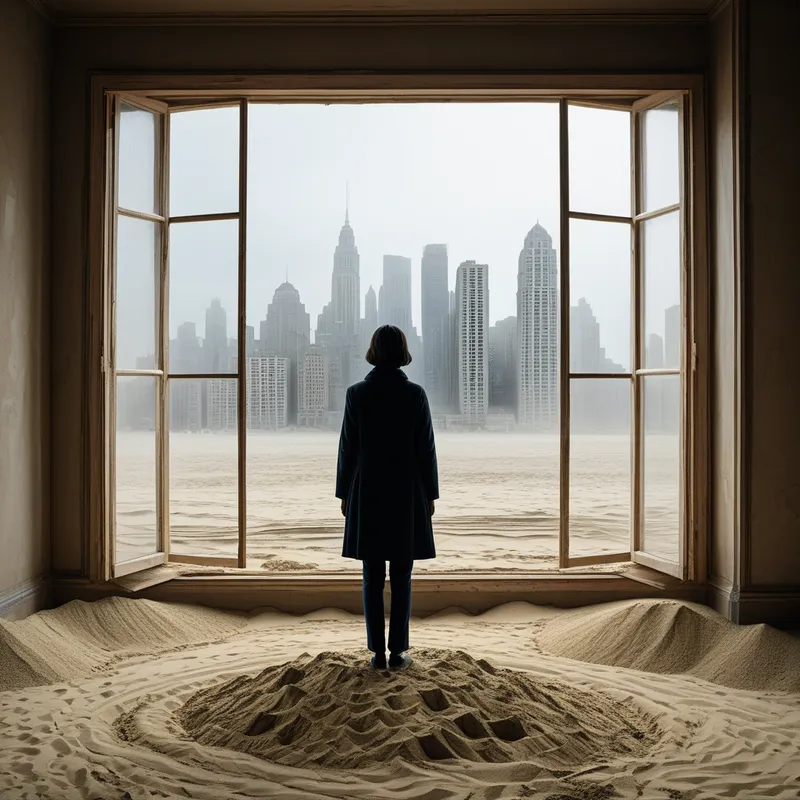
When the pattern of the Kalpa stirs in modern dreams, it rarely appears as a cosmic myth. Instead, it manifests as profound somatic and environmental symbolism. One may dream of their childhood home dissolving into sand, or of their workplace being slowly overgrown by a wild forest before crumbling. These are dreams of the Saṃvarta-kalpa—the psyche initiating a necessary dissolution of a long-held inner "world" or identity.
Dreams of vast, empty, yet peaceful landscapes—standing on a silent plain under a starless sky, or floating in a dark, warm ocean—resonate with the Saṃvarta-sthāyin, the void phase. The body may feel weightless or numb, not with fear, but with a profound sense of reset. Conversely, dreams of spectacular, intricate cities rising from mist, or of nurturing a tiny seed that grows into a vast, internal ecosystem, echo the Vivarta-kalpa, signaling a new psychic formation emerging from the unconscious. The dreamer undergoing this cycle is not "going crazy"; they are participating in the most fundamental rhythm of psychic life: death and rebirth at the soul's level.
Alchemical Translation
For the modern individual, the alchemical work modeled by the Kalpa is the transmutation of attachment into freedom through the conscious embrace of the cycle. Individuation is not a linear path to a fixed goal, but a series of Kalpas—the successive creation, dwelling-in, dissolution, and resting of various psychological selves.
The first step is Recognizing the Current Kalpa. Are you in a phase of building (a new project, relationship, self-image)? Of abiding (enjoying stability, but perhaps growing rigid)? Of dissolution (a breakup, job loss, existential crisis)? Or of void (burnout, grief, the "dark night of the soul")? Naming the phase removes its terror and places it in a meaningful, inevitable sequence.
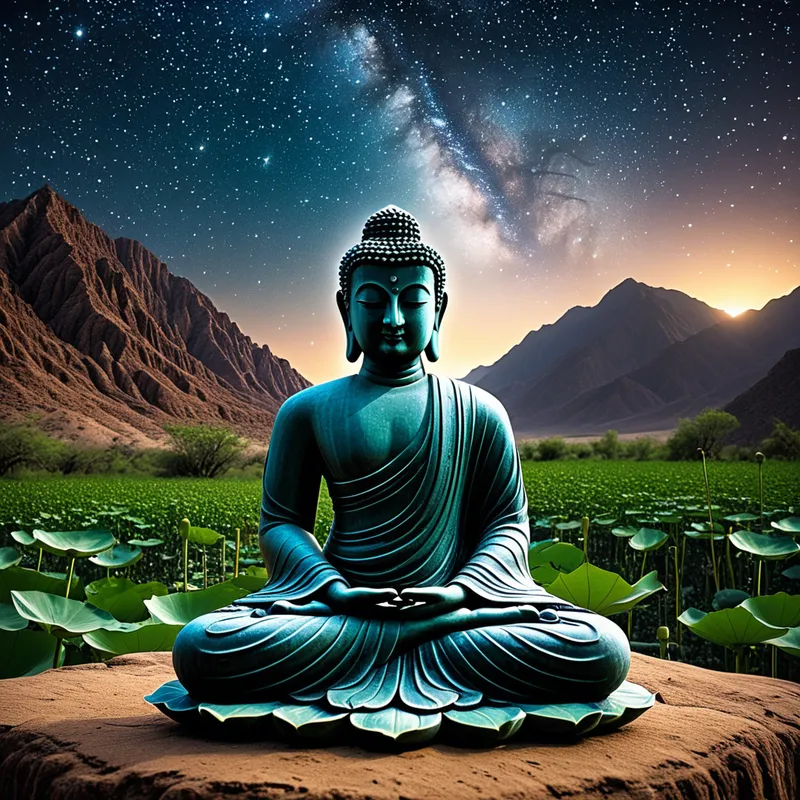
The crucial alchemical act is to Become the Witness of the Cycle, not merely its subject. This is the posture of the meditating Buddha amidst the world's birth and death. It means finding the still point within oneself that observes the formation of an anxiety without becoming it, that watches an old dream of oneself burn away without panicking, that rests in the emptiness without rushing to fill it.
The ultimate transmutation is to realize you are not the world that is born and dies, but the space in which all Kalpas play out.
This is the sage archetype in action: cultivating the wisdom that sees the beginning and end of all things, and thus finds an unshakeable peace that is not dependent on any phase of the cycle. By internalizing the myth of the Kalpa, we learn to hold our personal creations more lightly, meet our destructions with grace, and honor the creative potential of our own emptiness. We cease fighting time and become, instead, a conscious participant in its eternal, world-shattering, world-renewing breath.
Associated Symbols
Explore related symbols from the CaleaDream lexicon: