Kalki Myth Meaning & Symbolism
The prophecy of a future warrior-sage who ends a dark age, not with annihilation, but with the sword of discernment, clearing the way for a new dawn.
The Tale of Kalki
Listen. The air grows thick, heavy with the scent of decayed virtue and forgotten oaths. This is the Kali Yuga, the Age of Iron and Shadow. The sacred rivers run sluggish, choked with the silt of greed. Kings wear crowns of thorns made from broken promises, and priests chant hymns whose meanings have long been sold in the marketplace. The sun, a weary eye, watches over a world where truth limps and falsehood dances on a throne of bones.
In this twilight of dharma, a whisper begins. It stirs in the wind that moans through empty temples. It trembles in the hearts of the last few who remember the old ways. The whisper speaks a name: Kalki.
He will not arrive on a thunderbolt or from a lotus sprung from the cosmic ocean. His genesis is human, humble, almost forgotten. In the village of Shambhala, a child is born to a pious Brahmin named Vishnuyasha and his wife, Sumati. The child is named Vishnuyasha, after his father, but a strange light clings to him. He grows not with the boisterousness of youth, but with a quiet, unsettling gravity. He studies the Vedas, but his eyes see beyond the words. He practices with the bow and blade, but his movements are not those of a mere warrior; they are the precise, inevitable strokes of a principle made flesh.
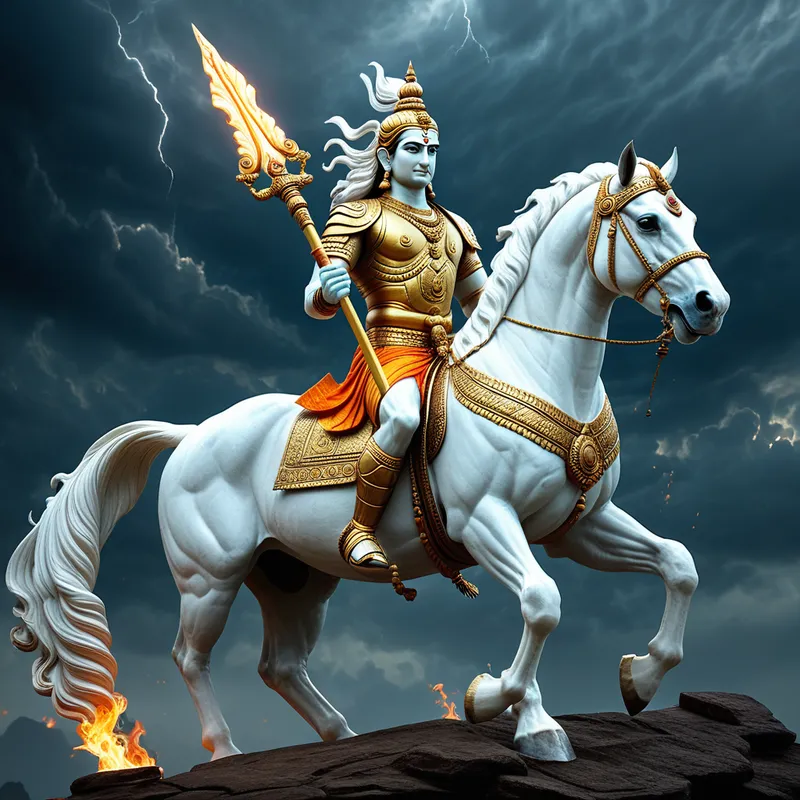
The corruption of the age thickens, a palpable fog of adharma. The time of whispering ends. On the day the last flicker of righteousness is nearly extinguished, the young man goes to the river to bathe. The water parts. From the luminous depths emerges a steed of impossible whiteness—Devadatta—snorting plumes of vapor that smell of ozone and dawn. A sword, blazing with a cold, clear fire that does not consume but reveals, appears in the youth’s hand. His simple garments fall away, replaced by celestial armor. The village boy is gone. In his place stands Vishnu’s final form, the tenth and culminating avatar: Kalki.
He does not raise an army. He mounts Devadatta. His campaign is not a war of conquest, but a surgery of the world-soul. Wherever the horse’s hooves touch the poisoned earth, the ground does not shake with violence, but is stilled with terrible clarity. Kalki rides. He confronts the demon-kings, the false teachers, the embodiments of decay. His flaming sword does not strike in anger, but in absolute discernment. It does not kill men; it severs the tangled, suffocating vines of illusion, greed, and cruelty that have choked their spirits. The wicked fall, not from wounds, but from the unbearable weight of their own falsehood being reflected in the sword’s pure light.
The ride is a storm of truth, clearing the psychic and moral landscape. When the last echo of adharma fades into a stunned silence, Kalki sheathes his sword. His work is complete. He does not claim a throne. He simply turns Devadatta towards the horizon where the first true sunrise in millennia is beginning to blush. The long, dark twilight of the Kali Yuga is over. The air is scoured clean, sharp with the scent of rain on stone. The earth, stripped bare of its corruption, lies fallow and waiting. The cycle is complete. The seed for the next golden age, the Satya Yuga, has been planted in the silent, fertile ashes of the old.
Cultural Origins & Context
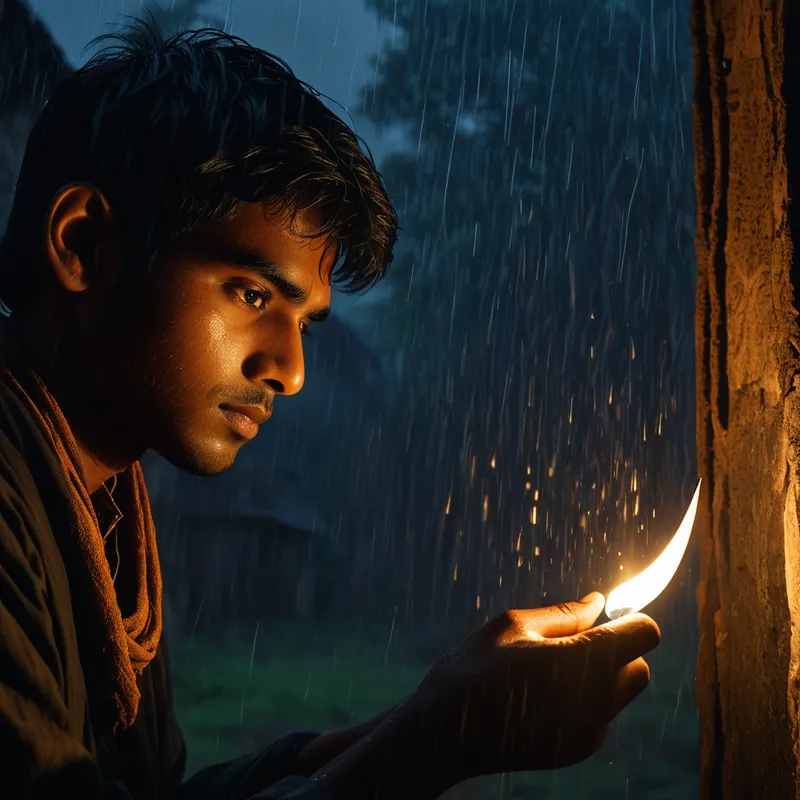
The prophecy of Kalki is found primarily in the Puranas, such as the Vishnu Purana, the Shiva Purana, and most notably, the Kalki Purana. These texts, composed and compiled over centuries (roughly from the 4th to the 15th centuries CE), serve as narrative encyclopedias of myth, ritual, and cosmology. The Kalki narrative functions as the eschatological capstone to the cosmic cycle of the four Yugas.
This myth was not a call to passive waiting, but a sophisticated cultural and psychological tool. Recited by storytellers and priests, it served a dual societal function. For the oppressed and those suffering under corrupt rulers, it was a myth of hope—a divine guarantee that injustice, no matter how entrenched, is not eternal. It affirmed that the universe itself has a self-correcting mechanism, a moral law (dharma) that will ultimately reassert itself. Conversely, for those in power, it was a potent warning: no tyranny, no spiritual bankruptcy, lasts forever. The myth placed the current moment within a vast, cyclical timeframe, offering both solace and a sobering perspective on the transient nature of any age, however dark.
Symbolic Architecture
Kalki is not a destroyer, but the ultimate purifier. He represents the principle of necessary, radical correction that emerges when a system—be it a society, a psyche, or a life—has strayed so far from its essential truth that incremental change is impossible.
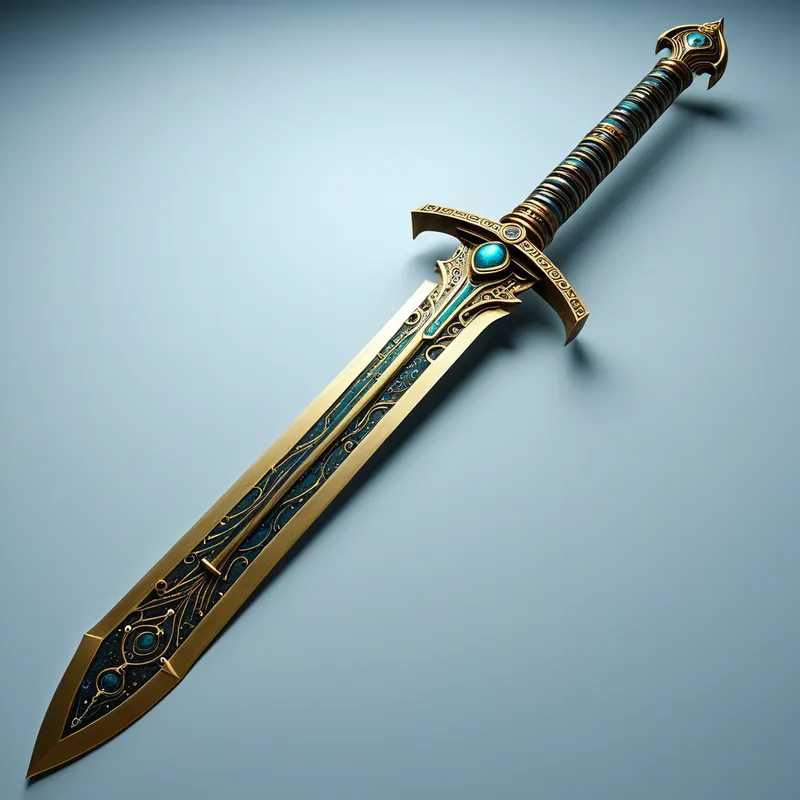
The sword of Kalki is not an instrument of vengeance, but of surgical discernment. It cuts away the dead tissue of the soul so that the living core may breathe again.
The white horse, Devadatta, symbolizes the unstained, dynamic power of consciousness itself, the vehicle that carries the transformative principle (Kalki) across the landscape of the corrupted psyche. The Kali Yuga is not merely a historical period but a psychological state: the inner "dark age" of cynicism, moral confusion, and spiritual sleep. Kalki’s birth in Shambhala—a hidden, pure land—signifies that the seed of renewal is always present, even if buried and forgotten, within the individual and collective unconscious. His action is not the end of the world, but the end of a world—a specific configuration of reality that has outlived its viability, making way for a new, more authentic structure to emerge.
The Dreamer's Resonance
When the archetype of Kalki stirs in modern dreams, it often heralds a profound and non-negotiable inner crisis point. The dreamer may not see a divine warrior, but they will feel the myth’s signature: an intense pressure for absolute truth, a visceral intolerance for personal "adharma"—the lies they tell themselves, the compromises that have poisoned their integrity, the outworn identities that no longer serve.
Somatic signs can include dreams of purifying floods or fires, of cleaning out impossibly cluttered houses, or of facing a formidable, silent figure who demands honesty. There is often a sense of an impending, inevitable "ride"—a life change that feels destined, terrifying, and necessary. Psychologically, this is the Self (in Jungian terms) mobilizing to dismantle a conscious attitude or life structure that has become oppressive to the totality of the psyche. The dreamer is in the Kali Yuga of their own soul, and the heroic principle of radical honesty is awakening to clear the ground.
Alchemical Translation
The journey of Kalki models the most demanding phase of individuation: the nigredo or mortification, where the old personality must be broken down for the new to be born. It is the alchemical "slaying of the dragon," not as an external battle, but as an internal dissolution of complexes and shadow material that have usurped the throne of the Self.
The prophecy is not about waiting for a savior, but about recognizing the Kalki within—the part of us that can finally say "no more" to our own inner corruption and complacency.
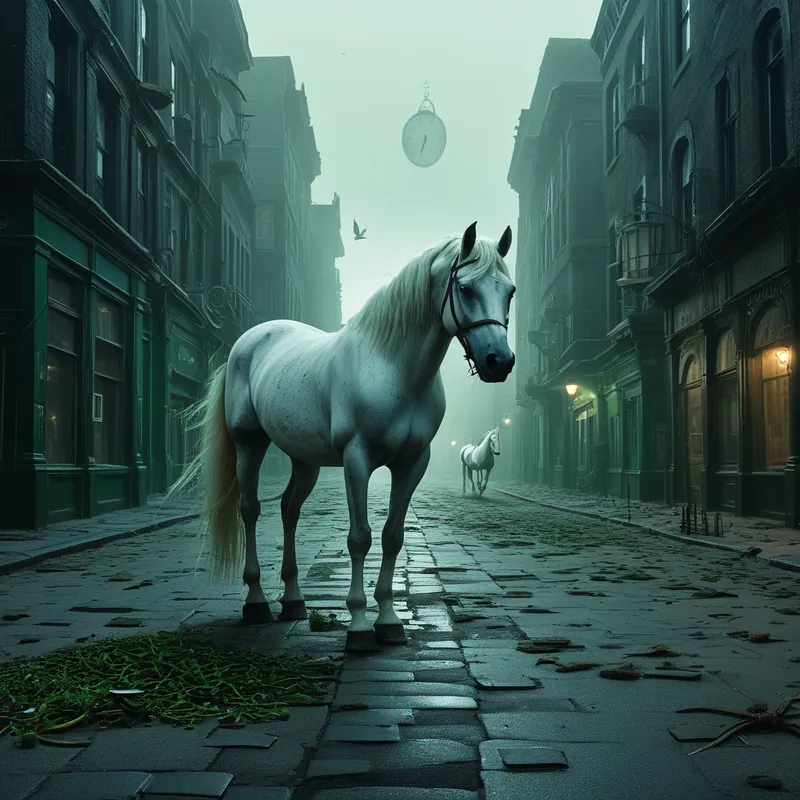
For the modern individual, this translates to the courageous act of "riding the white horse" of clear consciousness into the shadowed territories of one’s own life. It is using the sword of discernment to sever attachments to toxic relationships, dead-end careers, or narcissistic self-images. It is the terrifying, liberating decision to end a psychological "age" so that a new one can begin. The triumph is not in the destruction, but in the creation of an inner space—cleared, silent, and fertile—where the seeds of one’s authentic Satya Yuga, one’s golden age of integrated being, can finally take root and grow. The myth assures us that this devastating, renewing force is not a punishment, but the deepest wisdom of the psyche asserting its right to wholeness.
Associated Symbols
Explore related symbols from the CaleaDream lexicon: