Kali Yuga End Times Myth Meaning & Symbolism
A cosmic cycle of spiritual decay culminates in a final battle, leading to the dissolution and rebirth of the world, guided by a divine avatar.
The Tale of Kali Yuga End Times
Listen. The air grows thin, the light grows dim. We have entered the age of iron and rust, the Kali Yuga. The sacred thread of Dharma is frayed to a single, trembling strand. Kings are but thieves in gilded halls, their hearts hollow echoes. Priests chant empty words for coins of lead. The earth herself is weary, her rivers choked with poison, her forests whispers of memory. Fathers distrust sons, mothers abandon daughters, and truth is a forgotten language spoken only by fools.
In this long twilight, a shadow named Kali (not the Goddess, but the demon of discord) walks openly. He is not a monster of fangs and fire, but one of sly smiles and legal scrolls. He dwells where oaths are broken for profit, where the weak are crushed beneath polished heels, where the soul is traded for momentary comfort. His kingdom is the marketplace, the court, and the human heart turned to stone.
The world holds its breath, sinking into a final, suffocating sleep. The last vestige of righteousness hides, a faint ember beneath mountains of ash. This is the promised end, the bottom of the cosmic breath.
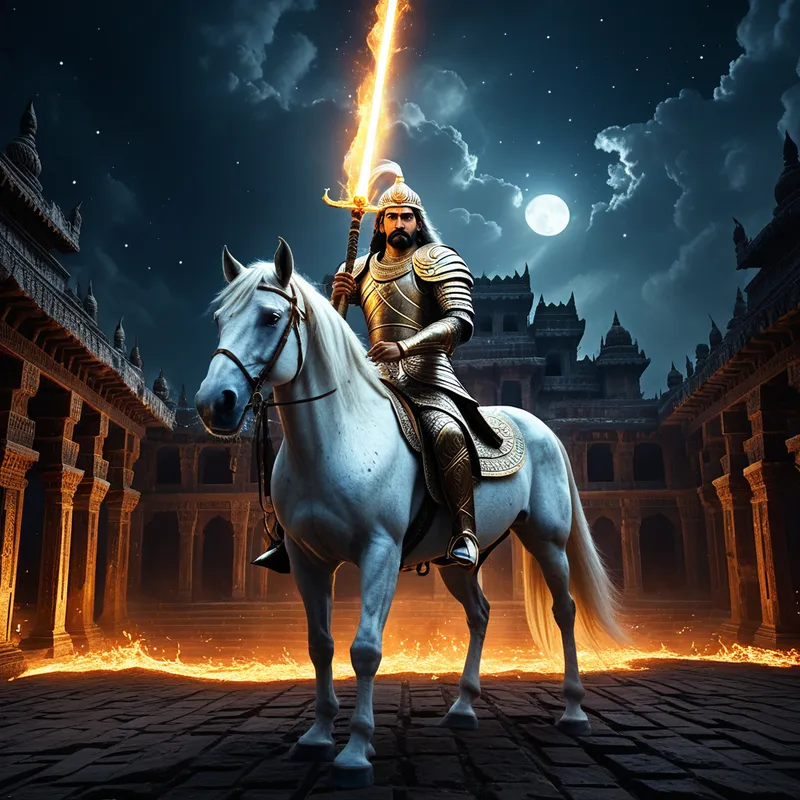
Then, a sound. Not a roar, but a clear, piercing note that cuts through the sludge of ages. It is the sound of a hoofbeat on the fabric of reality. From the pure lands of Vishnu, a final promise descends. He comes not as the cosmic dreamer or the universal sustainer, but as the terminator, the perfect end. He is Kalki.
He rides a horse as white as a newborn star, named Devadatta, “God-given.” In his hand is a sword that is not metal, but solidified wisdom, blazing with the light of a thousand suns. His countenance is terrible in its purity, for he has come not to punish, but to prune; not to destroy, but to make way.
The battle is not of armies clashing. It is a sweeping, surgical dissolution. Where Kalki rides, the forms of the corrupt age simply… unravel. Palaces of deceit crumble to sand. Fortunes built on lies evaporate like mist. The shadow-Kali, with all his clever arguments and legalistic corruptions, finds nothing to grasp, no purchase in this consuming light. The sword of discernment severs not heads, but the very roots of illusion. The world, thick with the disease of Adharma, is burned clean.
And in that utter, silent aftermath of cosmic fire, a strange peace descends. The ashes are rich and dark. From the void, a single, deep exhalation is heard—the sigh of Brahma awakening. A drop of celestial water falls. Then another. The rains come, gentle and purifying, soaking the fertile ash. And from that soaked ground, a green shoot, tender and impossibly bright, pushes toward a sky now clear and deep as a sapphire. The Satya Yuga dawns once more. The cycle turns. The story begins again.
Cultural Origins & Context
The myth of the Kali Yuga and the advent of Kalki is woven into the vast tapestry of Itihasa and Puranic literature. Its most detailed prophecies are found in texts like the Vishnu Purana, the Bhagavata Purana, and the Harivamsa. This was not a story told to frighten, but to contextualize. For ancient seers (Rishis), time (Yugas) was cyclical, not linear. Decline was as natural and inevitable as night following day.
The myth functioned as a sophisticated societal and psychological model. It explained the perceived moral and material decay of any given era, not as a unique catastrophe, but as a phase in a grand, predictable rhythm. It offered a theodicy—a reason for the presence of suffering and injustice. Most importantly, it provided an ultimate hope: no darkness is permanent. The story was passed down by storytellers (Sutas) and priests, serving as a mirror to society, a call to personal righteousness (sva-dharma) amidst collective failure, and a profound reminder of the transitory nature of all worldly conditions.
Symbolic Architecture
The Kali Yuga is not merely a prediction but a profound diagnosis of the human condition at its most alienated. It symbolizes the state where the ego, having severed its connection to the Self (the inner Atman), rules absolutely. Society’s decay is a macrocosm of the individual’s inner civil war.
Kali, the demon of discord, is the archetypal Shadow in its collective form—the embodiment of all the selfishness, deceit, and spiritual sloth we enact and witness, made systemic.
The white horse, Devadatta, represents the transcendent, unstained spirit that can traverse the mire of decay. Kalki’s sword is the sword of discrimination (Viveka), the fierce clarity that must precede any true renewal. He is not a savior who does the work for us, but the personification of the transformative principle itself. His arrival signifies the moment the psyche can no longer tolerate its own fragmentation and initiates a radical, purgative process.
The dissolution is not annihilation, but the alchemical solve—the breaking down of outworn, corrupt structures, both internal (beliefs, identities) and external. The subsequent rains and the sprouting of new life represent the coagula—the reconstitution of the personality on a foundation that has been scoured clean by truth.
The Dreamer’s Resonance
When this myth stirs in the modern unconscious, it rarely appears as literal religious imagery. Instead, it manifests as dreams of profound decay and latent renewal. You may dream of wandering through a familiar city now abandoned and crumbling, where technology fails and institutions are hollow shells. You may encounter faceless authorities, engage in transactions that feel deeply fraudulent, or feel a pervasive sense of being lost in a moral fog.
Somatically, this can accompany periods of deep existential fatigue, cynicism, or a feeling that one’s life is built on false premises. It is the psyche’s signal that a dominant, life-negating complex—a personal “Kali Yuga”—has reached its peak. The emotional tone is one of thick despair, but often with a strange, quiet core, as if waiting for a soundless hoofbeat. This is the dreamer at the nadir of the cycle, experiencing the necessary darkness before the dawn of a new psychic order.

Alchemical Translation
For the individual, the Kali Yuga end times myth maps the brutal, glorious path of individuation. It is the process of “hitting bottom” spiritually and psychologically.
The first step is the courageous, often painful, acknowledgment of one’s personal Kali Yuga—the ways in which one has lived in self-deception, neglected inner truth, and allowed the soul to be commodified.
This is the “Kalki” function of consciousness awakening. The white horse is the call from the Self, an intuition of a higher order. The sword is the application of ruthless self-honesty, cutting away the attachments, compromises, and false personas that have constituted the ego’s corrupt kingdom. This is a kind of psychic surgery, a nigredo that feels like annihilation.
The dissolution that follows is the dark night of the soul, where all former certainties and identities are burned away. It is a state of liminal emptiness. Yet, this void is fertile. The subsequent “rains” are the slow return of meaning, now authentic and self-generated. The green shoot is the birth of a new attitude, a personality centered not on the ego’s demands but on alignment with the deeper Self. One does not escape the cycle; one learns its rhythm, understanding that every ending within—every death of an outworn way of being—is the prerequisite for a more integrated beginning. The myth teaches that to be whole, one must first consent to the end of what is false.
Associated Symbols
Explore related symbols from the CaleaDream lexicon: