Kali Myth Meaning & Symbolism
The story of the goddess Kali, who emerges from fury to annihilate a demon, embodying the terrifying, transformative power of raw, unbound feminine energy.
The Tale of Kali
Listen, and let the veil between worlds grow thin. The cosmos itself was in agony. From a drop of blood spilled by the Asura king, a demon was born—Raktabija. His boon was a curse upon creation: for every drop of his blood that touched the earth, a thousand clones of himself would rise, fully formed and ravenous. The armies of the Devas were shattered. For every wound they inflicted, their enemy multiplied. The air grew thick with the iron scent of blood and the mocking laughter of an endless horde. Despair, cold and heavy, settled on the shoulders of the gods.
In their celestial court, trembling, they turned to the great goddess, Durga. She sat upon her lion, her ten arms holding the weapons of all the gods, her face a mask of divine fury. Hearing their pleas, a terrible smile touched her lips. From the center of her own brow, from the seat of transcendent wrath, a new form coalesced. It was not a birth but an emanation—a pure, unadulterated expression of the fury needed to preserve cosmic order.
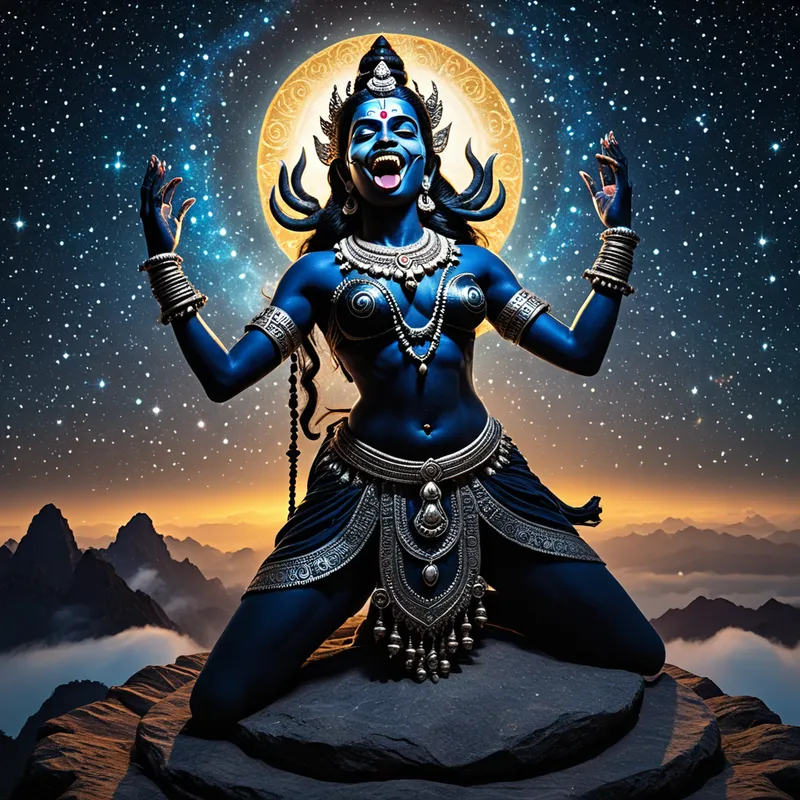
She emerged as Kali. Her skin was the blue-black of a midnight sky, the void before stars. Her eyes blazed with a red fire that saw only the task. Her hair, wild and untamed, flowed like a river of darkness. She was naked but for a girdle of severed arms and a garland of fifty-one human skulls—the letters of the Sanskrit alphabet, the building blocks of illusion. In her four hands, she held a sword, a noose, a severed head, and a skull-cup. With a roar that silenced the battlefield, she descended.
What followed was not a battle but a harvest. Kali did not fight Raktabija; she consumed the very condition of the battle itself. She swept across the plain, her sword a blur of silver. With each demon she beheaded, she did not let a single drop of blood fall to the fertile earth. Instead, with a terrifying grace, she caught each drop in her skull-cup or licked it from her blade with her long, protruding tongue. She drank the sea of clones. The demon army, the infinite recursion of Raktabija’s power, was being erased not by force, but by a total, annihilating absorption.
Finally, only the original Raktabija remained. In his terror, he tried to flee, but Kali’s noose found him. She pinned him down, drank his blood before it could touch the ground, and severed his head with a final, definitive stroke. The silence that followed was absolute. But the goddess, drunk on the fury of destruction, could not stop. The dance of annihilation had its own momentum. Her rage, now without an object, turned upon the world itself. She began to stomp the earth in a wild, ecstatic dance, threatening to shake the pillars of creation apart. The gods, saved from one doom, now cowered before another.
They turned to her consort, Shiva. Knowing force was useless, he lay down in her path. As Kali danced, lost in her frenzy, her foot came to rest upon the still, peaceful chest of Shiva. The moment her skin touched his, she stopped. She looked down. She saw the one she had come from, the silent ground of all being, lying beneath her. A shock of recognition. In that instant, the fury dissolved. Her tongue protruded further, not in a roar, but in a gesture of stunned shame and realization. The dance of destruction was complete. The world, purified by terror, could breathe again.
Cultural Origins & Context
The figure of Kali emerges from the deep, ancient strata of Shakta tradition, which venerates the Shakti, or divine feminine energy, as the supreme reality. Her earliest mentions appear in texts like the Devi Mahatmya (circa 5th-6th century CE), part of the Markandeya Purana. Here, she is not a standalone goddess but an aspect—the most terrifying and necessary aspect—of the great Goddess (Devi) herself.
Her stories were passed down not in sterile temples of philosophy alone, but in the fireside recitations of village storytellers and the ecstatic songs of tantric practitioners. She was, and is, a goddess of the margins. She is worshipped in cremation grounds, places of final transformation, symbolizing her domain over the ultimate limit of time and form. Her myth served a crucial societal function: it provided a sacred container for the aspects of reality that polite society and even conventional religion often shun—death, violence, rage, and the raw, untamed power of nature and the feminine. She was the acknowledgment that creation is inseparable from destruction, that life feeds on death, and that order sometimes requires a terrifying force to shatter stagnation.
Symbolic Architecture
Kali is the archetype of the necessary destroyer. She represents the aspect of the psyche—and the cosmos—that must tear down to make space for the new. Her black skin is not evil, but the color of pure potential, the fertile void from which all light emerges. The garland of skulls symbolizes the conquest of the ego (the individual "head") and the letters of illusion (Maya), showing she has consumed all limited identities.
Kali does not destroy out of malice, but out of a fierce, uncompromising love for truth. She is the surgeon’s scalpel that cuts away the cancerous growth to save the organism.
Her lolling tongue captures the blood—the vital, life-giving, but here corrupting, energy of Raktabija. It symbolizes the complete assimilation of shadow material. She does not project her fury outward indefinitely; she takes it back in, metabolizing the very source of the problem. Her standing on Shiva is the central, profound symbol. Shiva is pure, formless consciousness (Sat-Chit-Ananda), the static ground. Kali is dynamic, creative-destructive energy (Shakti). The image teaches that raw power, unchecked by conscious awareness, becomes chaotic and self-destructive. Conversely, consciousness without the energy to act is inert. Their union is the balance required for world maintenance and psychic wholeness.
The Dreamer's Resonance
When Kali storms into modern dreams, she rarely appears in her full, iconic form. Instead, one may dream of being chased by an unstoppable, dark force; of a beloved home being demolished by a wild storm; of a terrifying, all-consuming black wave; or of the self engaging in shocking, violent acts of tearing apart familiar structures. The somatic experience is often one of profound terror, a racing heart, and a feeling of utter helplessness.
Psychologically, this is the psyche’s signal that a process of radical deconstruction is underway. The dreamer is likely facing a situation where an old adaptation—a relationship pattern, a career identity, a deeply held belief—has become like Raktabija. Every attempt to "fix" it (cut it) only causes it to multiply and strengthen. The Kali energy emerges in the unconscious as the only force capable of stopping the recursive loop. The dream terror is the ego’s resistance to its own necessary dissolution. The process is one of confronting the personal and collective shadow—the repressed rage, grief, or wildness—and being asked not to fight it, but to develop the capacity to "drink it," to fully acknowledge and integrate it without letting it spill out and create more chaos.

Alchemical Translation
The myth of Kali is a precise map for the alchemical stage of Nigredo—the descent into the black, chaotic prima materia of the soul. The modern individual’s journey of individuation often requires a "Kali moment." This is when polite self-improvement fails, when therapy feels like slicing at a clone army of symptoms. The demon Raktabija is any complex, any addictive pattern, any core wound that regenerates from every well-intentioned attack.
The triumph is not in slaying the demon from a safe distance, but in developing the capacity to stand in the gore of one’s own shadow and consume its power, transforming poison into fuel.
The devotee’s task is to invoke Kali consciously. This means having the courage to let the old self die—to allow the fury at one’s own limitations to surface, to stomp upon the comfortable illusions (the prostrate Shiva of a stagnant consciousness). It is a terrifying, ego-shattering dance. But the goal is to reach that moment of shocking stillness, where the destructive fury, having done its work, looks upon the silent, witnessing consciousness within (Shiva) and stops. The tongue of shame becomes the symbol of realization: "I am not this fury; I am that upon which this fury plays out." From this union, a new consciousness is born—one that has faced the void and incorporated its power. The garland of skulls becomes not a trophy of conquest, but a necklace of liberated selves, each old identity honored and transcended. The individual is no longer afraid of their own darkness, for they have met the goddess who reigns there, and found her to be the ultimate, if terrifying, agent of their liberation.
Associated Symbols
Explore related symbols from the CaleaDream lexicon: