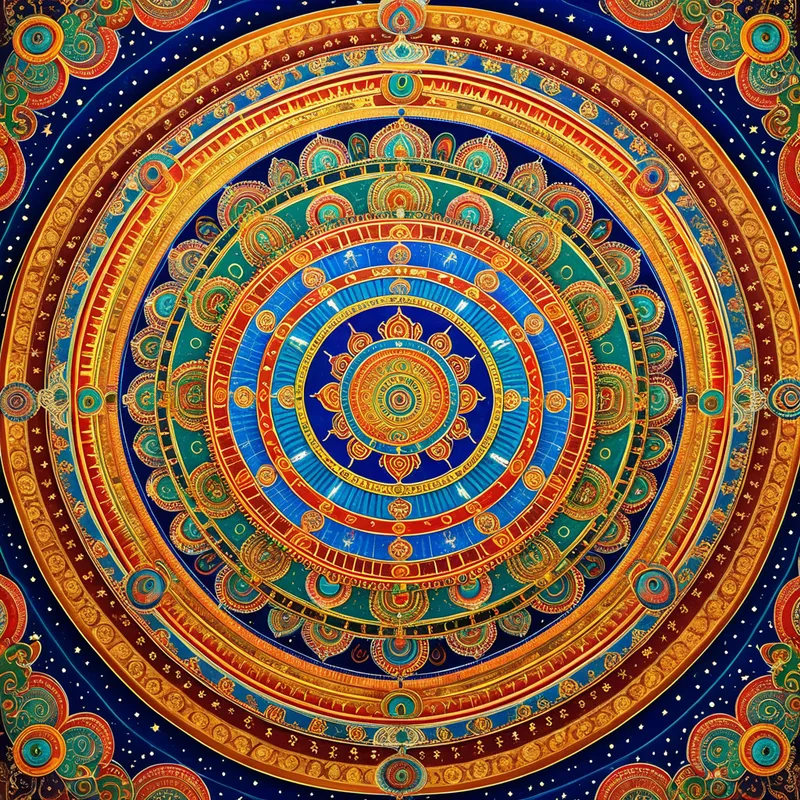
Kalachakra Mandala Myth Meaning & Symbolism
A sacred map of the cosmos and consciousness, where the wheel of time turns within the heart, guiding the soul from ignorance to luminous awakening.
The Tale of the Kalachakra Mandala
Listen, then, to the tale of the Turning of the Wheel of Time.
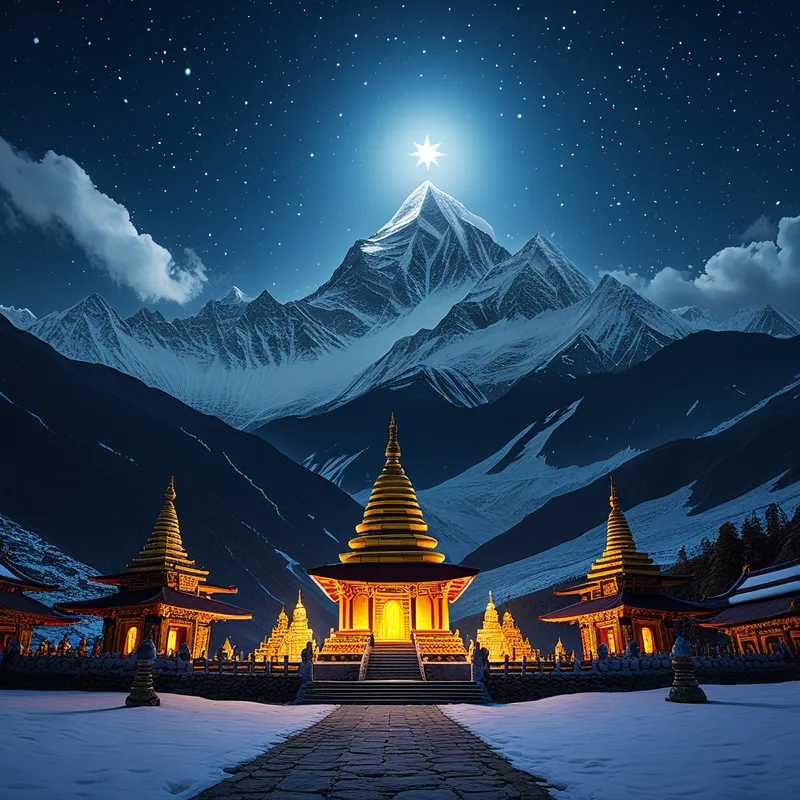
It did not begin in our world of dust and sorrow, but in a realm of perfected wisdom, a place beyond the maps of men. In the resplendent, hidden kingdom of Shambhala, where the mountains touch the sky and the rivers run with the nectar of understanding, a profound silence was broken. The air, thick with the scent of sandalwood and the promise of revelation, grew still. The king of that land, the noble Suchandra, felt a tremor in the fabric of reality—not of fear, but of an imminent, unimaginable dawn.
He journeyed, with his court of sages, to the Dhanyakataka stupa. There, beneath a sky that was neither day nor night, the very atmosphere crystallized into potential. And He appeared. Not as the historical Buddha of our age, but as Sakyamuni Buddha in his supreme, cosmic form—the Kalachakra, the Lord of Time Himself. His body was dark blue, the color of infinite space at midnight. In his countless arms, he held the tools of the cosmos: the curved knife to cut ignorance, the lotus of purity, the vajra of indestructible reality. Entwined with him in sacred union was his consort, Vishvamata, the radiant source of all phenomena.
For the king and his retinue, the world dissolved. The Buddha did not merely speak; he manifested. From his being erupted a celestial palace of breathtaking complexity—the Kalachakra Mandala. Its walls were made of rainbow light, its gates guarded by wrathful and serene deities. At its heart, in the palace of bliss, sat the divine couple, surrounded by 722 emanated deities, a complete parliament of cosmic forces. The Buddha’s teaching was the Mandala itself. He revealed the outer wheel—the movements of planets, stars, and ages. He revealed the inner wheel—the subtle winds, channels, and drops within the human body. And he revealed the alternative wheel—the path to liberation that runs through both.
He spoke of cycles, vast and terrifyingly beautiful: the external cycles of years and epochs, the internal cycles of breath and thought, and the secret cycle whereby one could step off the turning wheel entirely. He gave King Suchandra the key to stop time—not to freeze it, but to see through its illusion, to find the still point at the center of the spin. The king received this ocean of wisdom, this map of all existence, and carried it back to Shambhala, where it became the spiritual heart of a civilization, a treasure to be guarded until a future age when the world would need it most. The wheel was set in motion, and the map was drawn, not on parchment, but on the soul of reality.
Cultural Origins & Context
The myth of the Kalachakra is a unique and profound stream within the Vajrayana Buddhist tradition, with deep roots in the religious syncretism of North India. Historically, the Kalachakra Tantra is believed to have entered the human realm around the 10th century CE, though its mythic origins are placed in the timeless, mystical Shambhala. It represents a grand synthesis, weaving together Buddhist philosophy with sophisticated elements of Hindu cosmology, astronomy, astrology, and even Islamic calendrical science from the cultural exchanges along the Silk Road.
Its primary societal function was twofold. For the initiated, it was a supremely advanced mandala for tantric practice, a detailed psycho-cosmological map for achieving Buddhahood in a single lifetime. For the broader culture, particularly in Tibet, it served as a powerful eschatological and political narrative. The myth prophesies a future war between the forces of Shambhala and the forces of materialism and degeneration, culminating in a golden age. This narrative has provided a framework for understanding historical conflict, social decay, and the hope for a enlightened ruler who would restore cosmic and moral order. It was passed down through tightly held oral lineages and elaborate, secret initiation ceremonies, ensuring its potency and purity as a living transmission of transformative power.
Symbolic Architecture
At its core, the Kalachakra Mandala is not a picture of a place, but a dynamic model of a process—the process of consciousness itself. It is the ultimate symbolic architecture for the interdependence of all things.
The macrocosm of the turning galaxies and the microcosm of the beating heart are not two, but one reality viewed through different lenses of time.
The outer Kalachakra—the cosmos—symbolizes the objective world of phenomena, governed by predictable yet relentless cycles. The inner Kalachakra—the human body—symbolizes the subjective world of experience, with its passions, energies, and cognitive structures. The deity Kalachakra in union with Vishvamata represents the non-dual integration of method (compassion, skillful action) and wisdom (the direct insight into emptiness). The 722 deities are not external gods but the complete spectrum of our own psychic energies, from the most aggressive to the most peaceful, all invited to take their rightful place in the ordered palace of an enlightened mind.
The wheel, or chakra, is the central symbol. It is the wheel of time that grinds beings through suffering in samsara, but it is also the wheel of the Dharma that offers a path out. The Mandala teaches that to understand time—to see its empty, constructed nature—is to be freed from its tyranny. The entire system is a profound psychological truth: our perception of a solid, linear world "out there" is a construction of the winds and channels "in here." By mastering the inner through meditation, one gains mastery over the outer, realizing they were never separate.
The Dreamer's Resonance
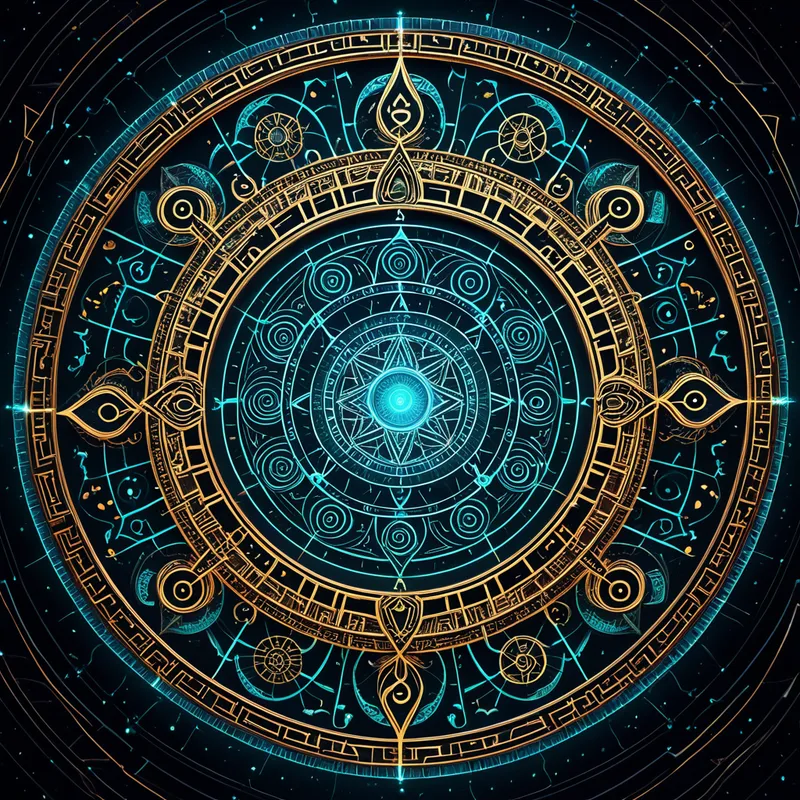
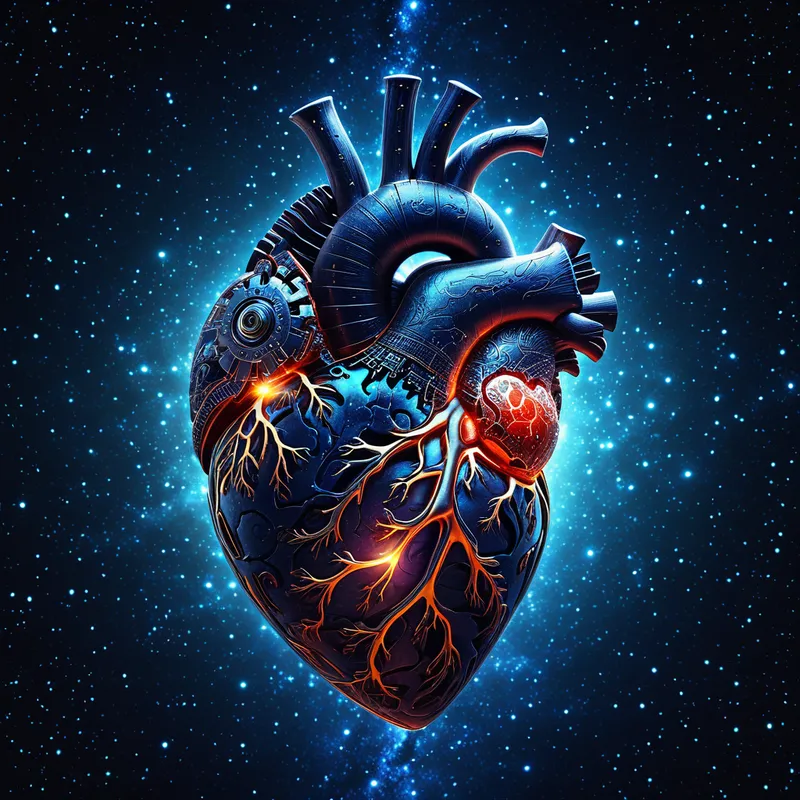
When the pattern of the Kalachakra stirs in the modern dreamer’s psyche, it often signals a profound confrontation with the nature of personal and existential time. One may dream of intricate, overwhelming clockwork mechanisms inside one’s own chest, or of a vast, silent wheel turning in a starry void. There may be a sense of being late for a cosmic appointment, or conversely, of stepping into a realm where time has stopped.
Somatically, this can correlate with a feeling of the heart chakra activating or constricting—a palpable pressure or expansion in the chest. Psychologically, this dream motif emerges when the individual is undergoing a deep process of re-synchronization. The ego’s frantic, linear timeline (career milestones, biological clocks, societal expectations) is being challenged by the soul’s cyclical, symbolic time. The dream is an expression of the psyche attempting to re-order itself, to align the personal biography with a more archetypal, meaningful rhythm. It is the unconscious presenting a map to navigate a life transition so fundamental it feels like a change in one’s very cosmic season. The dreamer is not just aging; they are moving from one kalpa (aeon) of their life to another, and the psyche is building the mandala-palace necessary to house the new consciousness.
Alchemical Translation
The myth of the Kalachakra provides a supreme model for the alchemical process of individuation—the forging of a coherent, timeless Self from the fragmented, time-bound ego. The initiate’s journey into the Mandala is the blueprint for this psychic transmutation.
First, one must receive the "transmission"—the call from one’s inner Shambhala, the intuitive knowing that a deeper order exists beneath the chaos of daily life. Then begins the laborious, precise work of construction: identifying and inviting each disparate aspect of the psyche (the 722 "deities" of our complexes, talents, and shadows) into a conscious, structured relationship. The wrathful deities must be acknowledged, not suppressed; the peaceful ones, cultivated. This is the integration of shadow and anima/animus.
The ultimate alchemy is the realization that the crucible is the cosmos, and the gold is the awareness that watches the fire.
The core struggle is against Mara, the lord of illusion, who here takes the form of literalistic, linear time and solid, separate identity. The triumph is not in destroying time, but in achieving the "alternative" Kalachakra: the ability to dwell in the world of cause and effect while abiding in the wisdom of its empty, dream-like nature. For the modern individual, this translates to living with purpose and compassion within history, while simultaneously having an anchor in the timeless present—the still, luminous palace at the center of the turning wheel. One becomes, like the mythic kings of Shambhala, a ruler of one’s own inner kingdom, a steward of time who is no longer its servant, embodying the sage who has seen the pattern within the chaos and has become one with the pattern itself.
Associated Symbols
Explore related symbols from the CaleaDream lexicon: