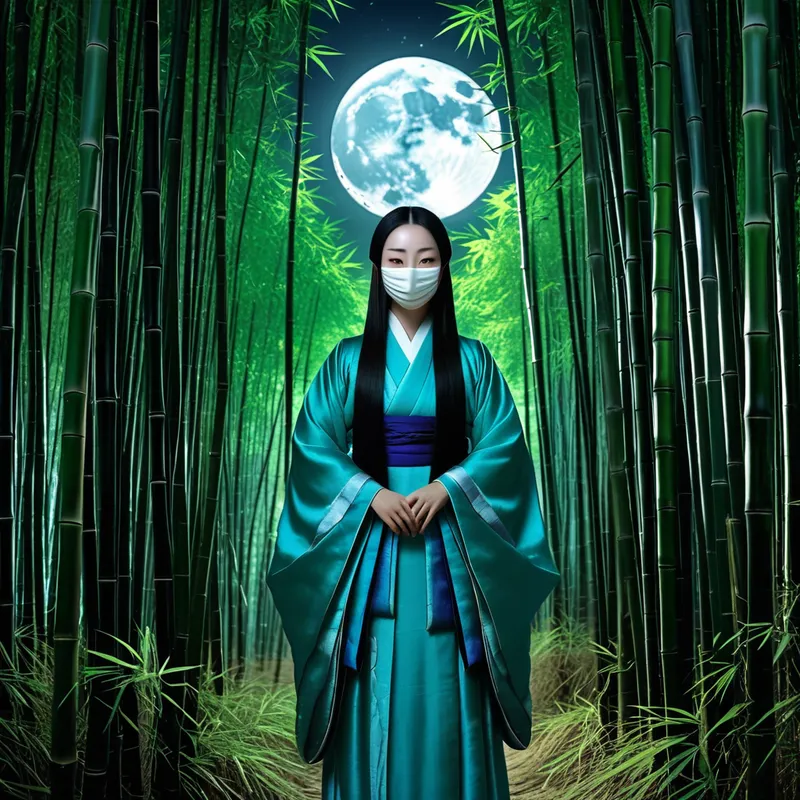
Kaguya-hime Myth Meaning & Symbolism
A celestial being found in a bamboo stalk grows up on Earth, only to be reclaimed by her true home on the moon, leaving a legacy of impossible love.
The Tale of Kaguya-hime
Listen, and hear a tale of a light that came to Earth, and the shadow of longing it left behind.
In a time when the world was closer to the gods, there lived an old bamboo cutter, a humble man named Taketori no Okina. His life was simple, his back bent from years of labor. One day, while working in a grove that shimmered with morning dew, he saw a stalk of bamboo glowing with an inner light. Cutting it open, he found within a tiny, perfect girl, no larger than his thumb, radiant as a pearl. He took her home to his wife, and they wept with joy, for they were childless. They named her Kaguya-hime, the Shining Princess.
From that day, whenever the old man cut bamboo, he found stalks filled with gold. His fortune grew, but it was the girl who was the true treasure. She did not grow as mortal children do. In mere months, she blossomed into a woman of such breathtaking beauty that her light seemed to fill their small house. News of her spread like wildfire across the land, carried on the breath of awe-struck travelers. Soon, the most powerful men in Yamato came calling—five princes and nobles, each determined to win her hand.
But Kaguya-hime was not of this earth. Her heart was a locked casket. To dissuade them, she set impossible tasks: bring me the stone bowl of the Buddha from India, fetch a jeweled branch from the mythical island of Hōrai, procure the legendary fire-rat's pelt, secure a colored jewel from a dragon's neck, find the easy-delivery charm from a swallow's nest. These were not mere whims; they were tests of a reality she knew they could not touch. The suitors failed, some through deceit, others through ruin, their earthly power crumbling before her celestial demands.
Even the Emperor himself, the Tennō, came, captivated by her otherworldly grace. He offered her all the glory of the mortal realm. She refused him, too, though with a kindness that pierced his soul. For in her presence, he felt not the thrill of conquest, but the quiet ache of gazing at the moon—beautiful, close, yet forever out of reach.
Then, on nights of the full moon, Kaguya-hime would sit by her window and weep. A sorrow deeper than any mortal grief would overcome her, her tears like liquid silver. Her foster parents begged her to tell them the cause. Finally, as the summer moon waxed full, she confessed the unbearable truth: she was not of this world. She was a being from the Capital of the Moon, sent to this world as a temporary refuge. Now, her people were coming to take her home. On the next full moon, they would descend.
The Emperor sent a guard of a thousand warriors to surround the humble cottage, to hold back the tide of heaven. But when the moon rose, round and blindingly bright, a host of celestial beings descended on a bridge of light. The soldiers were paralyzed, their weapons useless. A magnificent palanquin descended. The Lord of the Moon offered a robe of hagoromo and a cup of the Elixir of Life. To put it on was to forget all earthly attachment, all sorrow, all love.
Kaguya-hime, her heart torn, wrote two final letters. One, of profound gratitude and love, she gave to her broken foster parents. The other, with a vial of the Elixir and a fragment of her robe, she sent to the Emperor. Then, she donned the feather mantle. The sorrow left her eyes, replaced by a serene, distant light. She stepped into the palanquin, and the host ascended, fading into the moon's brilliant disc, leaving behind a world forever dimmed.
The Emperor, in his grief, ordered the Elixir and her letter burned on the highest mountain in Yamato, so that the smoke might reach her. They say the fire never went out, and that mountain is called Fuji, the mountain of the immortal ones. But the immortality was one of ash and memory, not of life.
Cultural Origins & Context
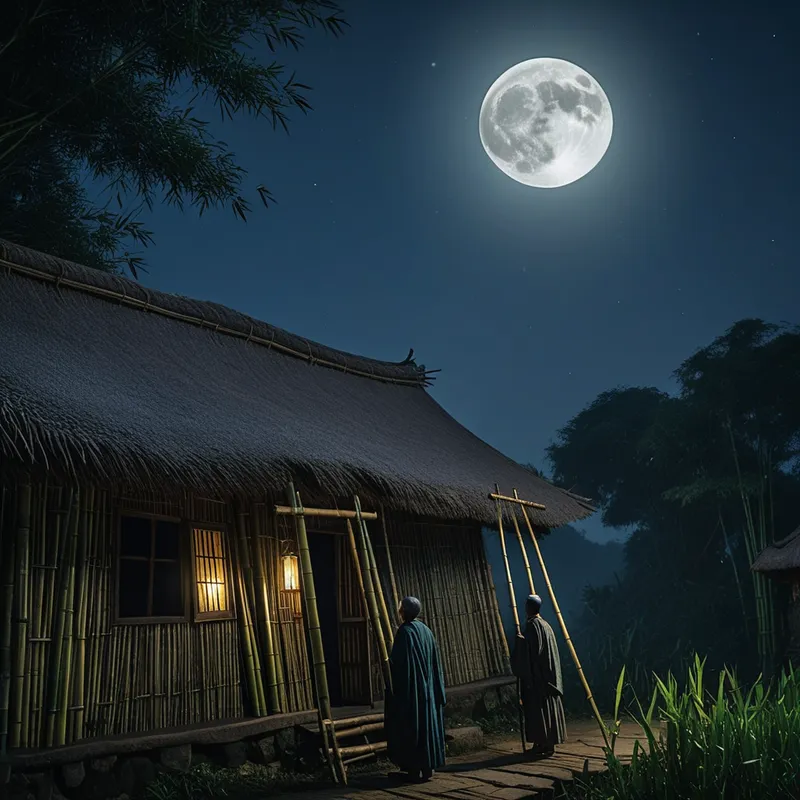
The tale of Taketori Monogatari, dating from the late 9th or early 10th century, is a foundational stone in Japanese literature. It emerges from the Heian period, a time of refined aesthetics, poetic sensibility, and a complex spiritual landscape where native Shintō beliefs mingled with imported Buddhist and Taoist thought.
It was not a folk tale told around a fire, but a written narrative, likely composed by a court aristocrat. Its function was multifaceted. On one level, it is a profound mono no aware—a sensitivity to the poignant beauty of impermanence. It explores the tension between the radiant, idealized beauty of the courtly aesthetic and the painful reality of separation, loss, and unattainable desire. The impossible tasks given to the suitors satirize the extravagant and often hollow pursuits of the aristocracy, while Kaguya-hime herself represents the ultimate, unpossessable ideal.
The myth also serves as an etiological tale, providing a sublime, poetic origin for Mount Fuji's name and its association with the eternal. By embedding the story in the "real" geography of Japan and connecting it to the Emperor, it bridges the celestial and the terrestrial, a core preoccupation of Shintō where the divine (kami) imbues the natural world.
Symbolic Architecture
Kaguya-hime is not a heroine on a quest; she is the object of the quest, a symbol of the soul's origin and destination. She represents the Self in its pure, pre-incarnate form—a spark of divine consciousness that descends into the material world (the bamboo stalk/Earth), is nurtured by earthly life (the foster parents), but can never be fully contained by it.
The bamboo stalk is the womb of the world, a vertical conduit between heaven and earth. To find divinity, one must cut into the ordinary, the repetitive, the mundane.
Her beauty is not merely physical; it is the blinding radiance of a consciousness that knows its true home. The suitors and the Emperor represent the ego's attempts to possess, categorize, and claim the Self through power, wealth, or romance—all of which fail. The impossible tasks are the soul's demands for authenticity; they cannot be met by the persona's toolkit.
The hagoromo, the feather robe, is the ultimate symbol of transcendence and amnesia. To remember one's celestial origin is to be crippled by earthly sorrow; to don the robe is to forget the earthly attachment, but also the earthly love. It is the bittersweet price of returning to wholeness, a severing required for completion.
The Dreamer's Resonance
When this myth stirs in the modern unconscious, it often manifests as dreams of profound, inexplicable homesickness—a longing for a place one has never known. One may dream of finding a secret, glowing object in a mundane setting (a closet, a desk drawer), of being pursued by faceless authorities for a truth one carries, or of watching a loved one ascend in a beam of light, feeling a grief that is both personal and cosmic.
Somatically, this can feel like a tightness in the chest, an ache of "divine displacement." Psychologically, it signals a process of differentiation. The dreamer is confronting the part of their psyche that feels alien, too bright, too sensitive, or too "other" to belong to their ordinary life—their inner Kaguya-hime. The conflict is between the ego's desire to keep this brilliant, mysterious element grounded (in a job, a relationship, an identity) and the Self's insistent pull toward its own unique destiny, which feels like a departure from everything familiar.

Alchemical Translation
The individuation process modeled here is not one of heroic conquest, but of conscious surrender and sacred grief. The "bamboo cutter" phase is the initial awakening—a moment of grace where one discovers a luminous potential within the ordinary grind of life. Nurturing it brings both inner wealth (the gold) and painful growth, as one outgrows old containers.
The "suitors" are the myriad false selves and societal expectations that try to claim this nascent Self. The alchemical work is to set the impossible tasks—to demand that life prove its worth to your soul, not the other way around. This involves refusing promotions that misalign, ending relationships that ask you to dim your light, and rejecting answers that do not resonate with your deepest truth.
The final alchemy is the brewing of the Elixir of Life from the tears of earthly attachment. It is not the avoidance of grief, but its full distillation into a potion of release.
The climax is the full moon realization: you cannot stay. This is the painful acknowledgment that to become who you are meant to be, you must "leave" the old identity, the familiar family system, or the comfortable worldview. Donning the hagoromo is the act of releasing identification with your personal history and wounds—not to deny them, but to see them from the vantage point of the eternal Self. You send letters of gratitude to what nurtured you (the foster parents) and offer your distilled wisdom (the Elixir) back to the world, as Kaguya-hime did to the Emperor. What remains is not a cold void, but the eternal mountain—the enduring, silent witness of your transformation, where the fire of longing has become the foundation of your being.
Associated Symbols
Explore related symbols from the CaleaDream lexicon: