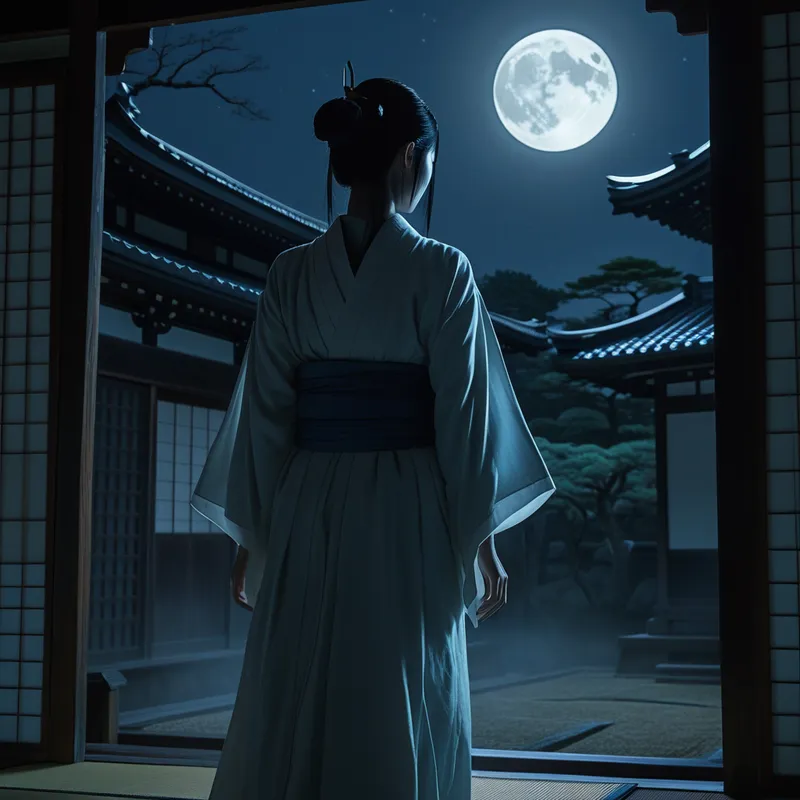
Kage-onna Myth Meaning & Symbolism
A spectral woman of shadow, Kage-onna is a Japanese yōkai who reveals the terrifying, inseparable nature of our own projected selves.
The Tale of Kage-onna
Listen, and let the night draw close. This is not a tale of distant mountains or ancient gods, but of the quiet house next door, of the space between the lamplight and the wall.
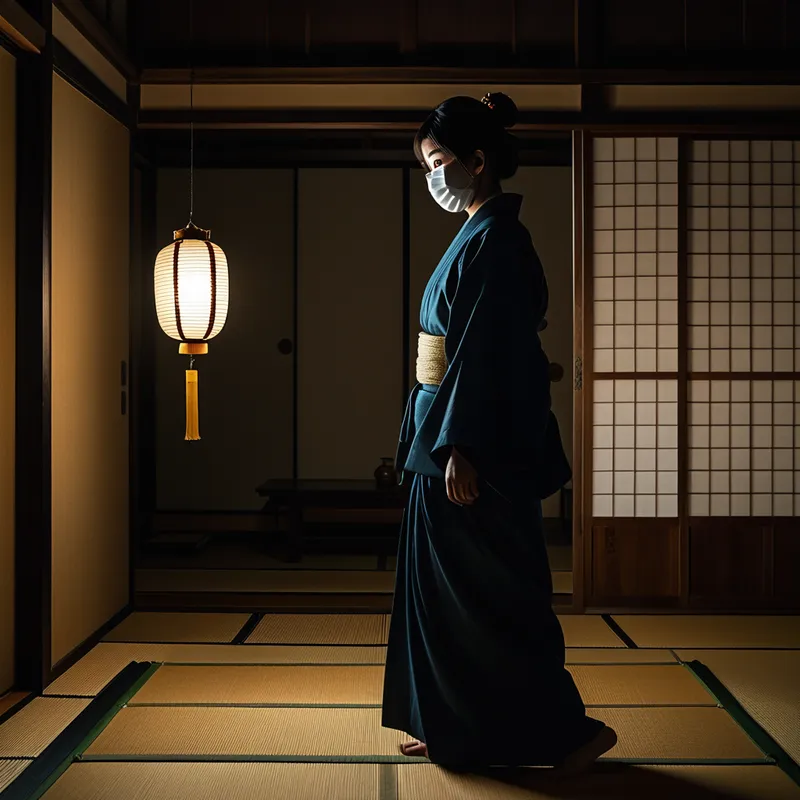
In the deep of an Edo-period night, when the world was held in the palm of silence, a woman would find herself alone. Perhaps she was tending a sick child, or waiting for a husband who tarried too long at the sake house. The only company was the andon lantern, its frail flame painting the room in pools of gold and caverns of black.
It began with a chill—a subtle siphon of warmth from the air, as if winter had found a crack in the shoji. Then, a presence. Not a sound, but a fullness in the emptiness. She would turn, and there, cast upon the shoji screen or the tatami mat, was a shadow. It was the shadow of a woman, elegant and distinct, but it was not her shadow. It stood at a wrong angle, moved with a separate intent. This was Yōkai made of absence: the Kage-onna, the Shadow Woman.
She had no face, no features, only the perfect, hollow silhouette of a female form. She did not speak; she echoed. If the living woman raised a hand, the shadow might raise its own a moment later, or not at all. If the woman fled to another room, the shadow was already there, waiting on a different wall, a silent, persistent companion. Panic was a seed that grew into a choking vine. The woman would scream for help, but to any who came running, they saw only a terrified woman and her ordinary, flickering shadow. The Kage-onna showed herself only to her chosen one.
There was no battle, no grand exorcism. The terror was in the inescapable proof. The shadow was a part of the scene, as fundamental as the air. The woman could not destroy it, for to attack the shadow was to attack the wall, the light, the very architecture of her world. Some tales say the haunted one simply wasted away, consumed by a fear no one else could see. Others whisper a more subtle end: a slow, dreadful merging. The woman’s own vitality would seep away, and the shadow, fed on this stolen essence, would become more substantial, until it was unclear who was the caster and who was the cast.
Cultural Origins & Context
The myth of the Kage-onna springs from the rich soil of Japanese kaidan and Hyakki Yagyō lore. Unlike region-specific mountain demons or river spirits, her domain is profoundly domestic. She belongs to the oku, the inner, private spaces of the home, traditionally the woman’s sphere. This was a world of long, solitary hours, of dim lighting, and of social expectations that could feel as confining as the walls themselves.
Passed down as a kōshaku or recorded in Edo-period anthologies, the Kage-onna served a dual function. On one level, she was a classic chilling tale for a dark night, a masterclass in atmospheric horror that transformed the familiar home into a theater of the uncanny. On a deeper, societal level, she gave form to the unspoken anxieties of isolation and invisible identity. In a culture with strict social roles, the “shadow” could represent all that a person was forced to suppress or could not express—a silent, ever-present double growing in the private corners of the self.
Symbolic Architecture
The Kage-onna is not an external monster, but an embodied paradox. She is the shadow made literal, but with a terrifying twist: she has gained autonomy. She represents the part of the self that has been so thoroughly disowned, so completely projected, that it appears to have a life of its own.
The most terrifying ghost is not the one that haunts your house, but the one that proves it has always lived in your skin.
Her symbolism is multifaceted. She is the repressed self, particularly facets deemed unacceptable by the collective or the ego: anger, ambition, wildness, or profound sorrow. She is the silenced voice, the identity shaped by expectation that now follows its creator with mute accusation. Crucially, she is a projection. The horror for the haunted woman is the dawning realization that this external, threatening “other” is, in fact, a piece of her own interior reality made visible. The Kage-onna makes the psychological process of projection—blaming an external object for what we refuse to see in ourselves—a tangible, inescapable fact.
The Dreamer’s Resonance
When the pattern of the Kage-onna stirs in the modern dreamscape, it signals a critical moment in individuation. To dream of a detached, following, or threatening shadow-figure—especially one with a gendered or personal form—is to dream of a denied aspect of the self knocking loudly at the door of consciousness.
The somatic experience is often one of paralysis, dread, and futile hiding. The dreamer runs, but the shadow is always there, because it is of them. This is the psyche’s dramatization of a psychological impasse: the ego is being confronted with content it has tried to exile. The shadow-figure is not yet integrated; it is perceived as a persecutor. The dream is an invitation, however frightening, to stop running and to turn around. The process underway is the initial, painful recognition that the “monster” is not an alien, but an orphaned part of one’s own soul, demanding acknowledgment.
Alchemical Translation
The myth of the Kage-onna models the first, brutal stage of psychic alchemy: the nigredo, the blackening. This is the confrontation with the shadow, the necessary decay of the ego’s illusion of completeness and purity. There is no triumph in the traditional sense; the “hero” of this myth often perishes. But for the modern individual, the myth provides the map of the failure, so we may choose a different path.
The alchemical work begins when we mimic the haunted woman’s final, awful realization—but instead of dissolving in terror, we solidify in curiosity. The instruction is to stop trying to destroy or flee the shadow. The task is to turn, face it, and in a act of immense courage, ask, “What are you?” This is the start of translation. The autonomous, terrifying onryō-like shadow must be invited back into dialogue.
Integration does not mean becoming your shadow; it means recognizing it as a former tenant of your own inner house, and negotiating a new, conscious relationship.
This process transmutes raw, projected fear into self-knowledge. The silent, stalking Kage-onna, when faced, may reveal herself as buried grief, unexpressed creativity, or a strength mistaken for a weakness. She ceases to be a persecuting ghost and becomes a lost guide. Her reintegration doesn’t make her disappear; it allows her essence to enrich the whole personality. The light and the shadow are seen as inseparable collaborators in casting the complete form of the self. The myth, in its haunting silence, ultimately asks: Will you be consumed by what you refuse to see, or will you gather all your fragments, even the darkest, and become whole?
Associated Symbols
Explore related symbols from the CaleaDream lexicon: