Kage-e Myth Meaning & Symbolism
A myth where a divine artisan weaves the world from shadow and light, revealing the sacred tension between form and formlessness, the seen and the unseen.
The Tale of Kage-e
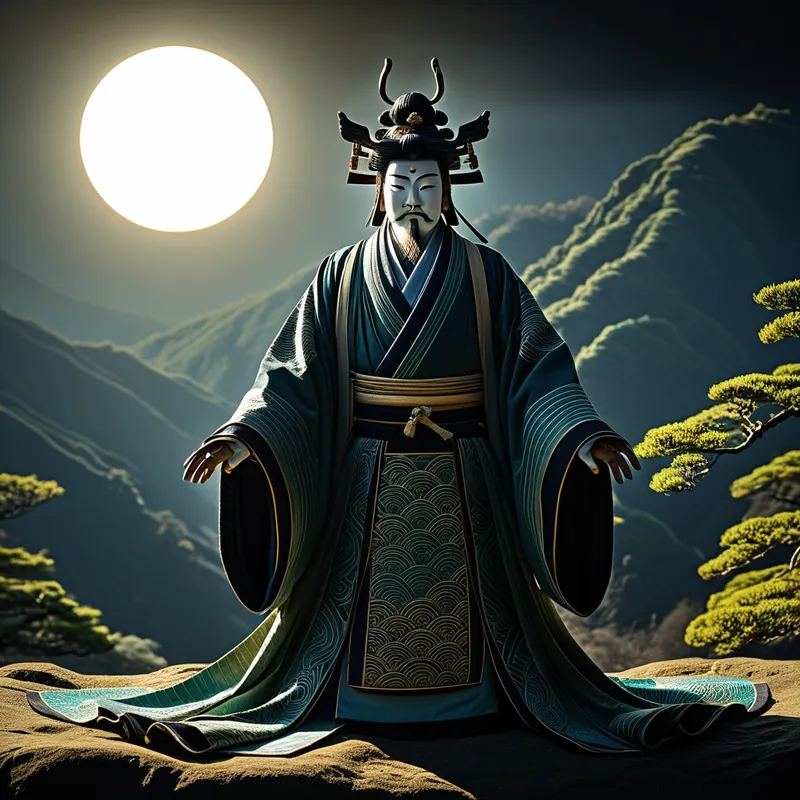
Listen, and let the world soften at its edges. In the time before time was measured, when the Kami still breathed the same air as the mist, there existed an artisan of such profound subtlety that their name was never spoken aloud. They were known only as the Weaver of Appearances.
This kami did not sculpt from clay nor paint on silk. Their medium was the space between the light and the stone, the fleeting moment when the sun slants through the cryptomeria trees. Their studio was the world itself, and their tools were nothing but intention and the angle of perception. They worked in a silent grove where a single, perfect source of light—neither sun nor moon, but a primordial glow—fell upon a vast, blank screen of polished jet.
The Weaver would stand before the void-screen and lift their hands. But they did not make shapes with their hands. Instead, they carefully positioned their spirit so that the light cast the shadow of their hands upon the dark surface. And from this simple, dark silhouette, a miracle unfolded. The shadow-fingers would lengthen, branch, and blossom. The silhouette of a clenched fist became the craggy peak of Fuji-san. The curve of a wrist-shadow flowed into the silver ribbon of the Kiso River. With the slightest tremor of intent, the shadow of a single finger-tip would burst into a flock of cranes, their dark wings beating against the jet background before dissolving back into formlessness.
For eons, the Weaver was content. They populated the screen with shadow-pines and shadow-bamboo, shadow-foxes and shadow-waves. This art was called Kage-e, and it was the first draft of the world. But a longing grew in the Weaver’s heart—a desire not just to cast the shadow, but to touch the world the shadow implied. They wished to feel the coolness of the mountain rock, the wetness of the river spray.
And so, the Weaver committed the ultimate act of artistic passion. They turned away from the light source and reached into the screen, into the world of pure shadow they had crafted. The moment their fingers touched the jet surface, a great rupture occurred. The perfect, two-dimensional Kage-e shattered into a billion fragments of darkness and potential. But from that rupture, something new was born. The shadows gained depth. The flat picture of a pine tree now had rough bark one could feel, scent one could smell. The world became solid, textured, real.
Yet, the cost was eternal. The Weaver became trapped within the very reality they had solidified. They could no longer stand outside as the artist; they were now a thread in the tapestry, subject to its storms and seasons. The perfect, controlled Kage-e was lost forever, replaced by a messy, beautiful, three-dimensional world where every object still casts a reminder of its shadowy origin. The light and the source remained, but now separate, watching the play of form and shade from a distance, a silent testament to the first creation.

Cultural Origins & Context
The concept of Kage-e as a foundational myth is not a single, codified story from a text like the Kojiki. Instead, it is a philosophical and aesthetic deep current, synthesized from multiple strands of Japanese thought. It finds its roots in the profound appreciation for shadow and subtlety in traditional aesthetics, best articulated by the author Jun'ichirō Tanizaki in his essay "In Praise of Shadows." Here, darkness is not absence, but a generative space, a "mother of beauty."
This mythic sensibility is echoed in the ancient Shinto understanding of Kami, who are not distant, perfect beings but often immanent in natural phenomena, residing in the grove, the rock, the waterfall—the very world the Weaver entered. The art of kage-e, or shadow puppetry, and the related kamishibai (paper theater) were folk traditions where simple cut-outs cast complex stories onto screens, a direct, tangible metaphor for creation from illusion. The myth, therefore, was passed down not as a canonical tale, but as an implicit understanding carried in the brushstroke of sumi-e ink painting (where the empty space is vital), in the design of a karesansui (rock garden), and in the theatrical conventions of Noh, where a mask and a gesture imply a universe of emotion. Its societal function was to instill a perceptual framework: the world is an interplay of the seen (omote) and the unseen (ura), and truth often resides in the delicate balance between them.
Symbolic Architecture
At its core, the myth of Kage-e is a profound allegory for the act of consciousness itself. The primordial light represents undifferentiated awareness, the unified field of being. The blank jet screen is the potential of the unconscious, the void pregnant with all forms. The Weaver is the emergent ego, the first point of self-awareness that stands between the two.
The artist does not create the world from nothing, but from the interplay between the light of consciousness and the dark potential of the unformed self.
The Kage-e is the world of psychic reality—the images, dreams, and ideas that feel real within the mind but lack physical substance. It is the perfect, controlled inner narrative. The Weaver’s fateful turn and reach symbolize the projection of this inner reality into the outer world, the moment psyche becomes matter, idea becomes action. This is the necessary fall into incarnation, into life with all its tangibility, suffering, and beauty. The trapped Weaver represents the human condition: we are both the creators of our perceived reality and prisoners within its constraints, forever sensing the "light source" of a deeper unity we can no longer directly access, seeing only its shadows cast as the solid world around us.
The Dreamer's Resonance
When this myth stirs in the modern unconscious, it often manifests in dreams of profound duality and artistic frustration or triumph. One might dream of trying to paint with darkness, or of one’s shadow moving independently, crafting beautiful, complex shapes. Another may dream of a perfectly detailed model world they have built, only to feel an irresistible urge to smash it to enter it, feeling both terror and exhilaration at the destruction.
Somatically, this can feel like a tension between contraction and expansion—a desire to remain safe in the two-dimensional plan (the known identity, the controlled life) and a deep, bodily pull to "touch the shadow," to make the dream real, regardless of cost. Psychologically, this is the process of confronting the Shadow not as a monster, but as the raw, creative material of the self. The dream is the psyche’s Kage-e screen, and the figures that appear on it are the silhouettes of unlived life, asking not just to be seen, but to be made substantial.
Alchemical Translation
The individuation journey modeled here is not one of slaying dragons, but of shifting perspective. The initial stage is the opus of the Kage-e: carefully observing the shapes cast by our inner light upon our inner darkness. This is self-reflection, therapy, dream analysis—mapping the silhouette of our complexes without yet acting them out.
The critical alchemical turn is the Weaver’s choice. This is the mortificatio or nigredo, the darkening. It is the voluntary dissolution of the perfect, controlled self-image (the beautiful shadow-picture) to engage with the messy, three-dimensional reality of the world and the full self. It is quitting the safe job to pursue art, ending the hollow relationship to face loneliness, speaking the painful truth instead of maintaining a pleasant facade.
Transmutation occurs not when we perfect the illusion, but when we sacrifice the safety of the illusion to embrace the flawed, tangible reality it implies.
The final stage is living as the trapped Weaver: no longer the isolated artist-god, but a participant. Here, the goal is to remember the light source while fully immersed in the shadow-play. This is the integrated life, where one creates (projects) consciously, knowing the world is both solid and a projection, both real and a kind of divine Kage-e. The suffering of being "trapped" is alleviated by the awe of being embedded in a creation that is forever unfolding from that sacred, silent interplay between the luminous source and the receptive dark. We become, at last, both the artwork and the artist, living in the breathtaking tension between the silhouette and the substance.
Associated Symbols
Explore related symbols from the CaleaDream lexicon: