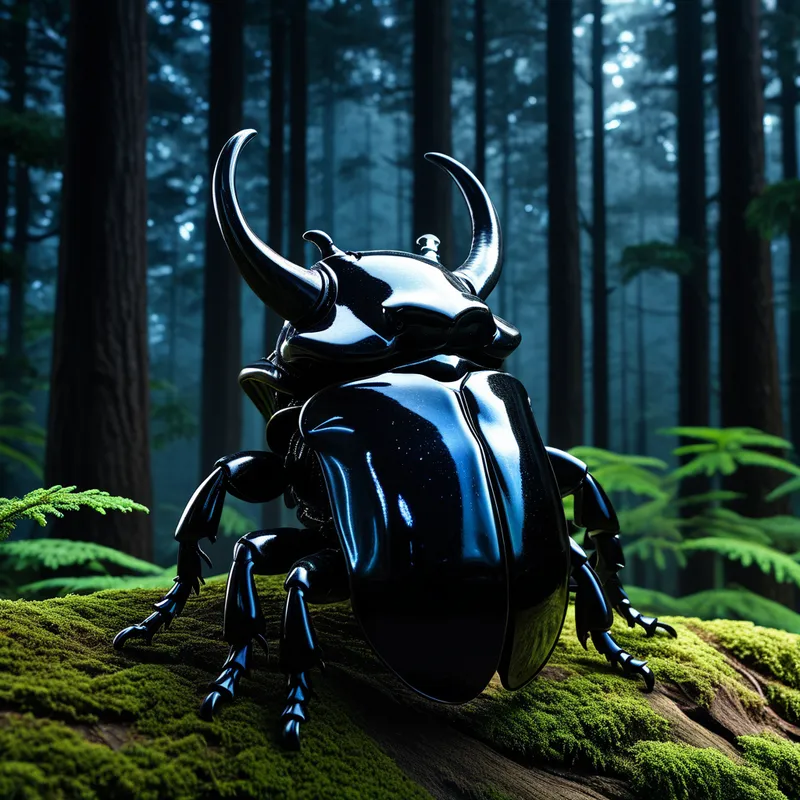
Kabutomushi Myth Meaning & Symbolism
A myth of a humble insect granted celestial armor, embodying the soul's journey from vulnerability to unyielding, honorable strength.
The Tale of Kabutomushi
Listen, and hear the tale whispered by the wind through the bamboo groves, a story not of gods on high, but of a creature of the humus and the loam. In the age when the world was still soft and names were being given, there lived a small, soft-bodied grub. It dwelled in the deep, dark earth beneath the roots of the great Kodama trees, a creature of pure potential, yet utterly vulnerable. It knew only the press of the soil, the taste of decay, and the silent, patient work of becoming.
Above, the world was a theater of tooth and claw. The stag beetle, with its mighty mandibles, ruled the rotten logs. The dragonfly, a jeweled dart, claimed the air. But the grub had no weapons, no shell, no swiftness. It could only wait and digest the darkness. It was said that Amaterasu herself, looking upon the struggles of the earthly realm, felt a pang of compassion for this most defenseless of her children. Yet, the way of the world was the way of strength; to simply grant protection would be to upset the balance.
The grub, in its silent chamber, did not pray for mercy. Instead, it dreamed. It dreamed not of flight, but of standing its ground. Not of piercing, but of enduring. Its longing was not for aggression, but for an unassailable dignity. This silent, steadfast yearning rose like vapor from the damp earth, a prayer without sound, and it reached the celestial forge of Kagutsuchi.
Touched by the purity of this desire—a wish not to dominate, but to simply be without fear—Kagutsuchi took action. But a kami’s gift is never a simple handout; it is a challenge, an alchemical recipe. One night, as the grub entered the final sleep of its larval life, a celestial fire descended, not to burn, but to bake. Starlight and the spirit of the mountain’s hardest stone were woven into the very substance of its being. The process was not gentle; it was a compression, a forging in the womb of the earth itself.
When the grub stirred, it did not recognize its own form. It was encased in a shell of incredible density, a living armor lacquered in deepest umber and chestnut, harder than ironwood. From its head grew a single, formidable horn, not for goring, but for lifting, for prying open the world. It had become Kabutomushi, the “helmet beetle.” It emerged from the soil not as a conqueror, but as a knight. It did not seek out the stag beetle for battle, but when challenged, it stood firm, its armor turning aside blows, its horn a lever of immovable resolve. It carried its fortress on its back, a walking testament that true strength is born from acknowledged vulnerability, tempered in the hidden fires of patience, and worn not for attack, but for honorable endurance.
Cultural Origins & Context
The myth of Kabutomushi is not enshrined in canonical texts like the Kojiki or Nihon Shoki. Its origins are folkloric, emerging from the intimate, daily observations of farmers, children, and woodsmen in rural Japan. This is a mukashibanashi (old tale) passed down through oral tradition, often told during the humid summer evenings when these magnificent beetles are most active, captured by children and admired for their placid strength.
Its societal function was multifaceted. For children, it was a natural wonder tale, explaining the beetle’s dramatic metamorphosis from a humble, ugly grub into a majestic, armored adult—a perfect metaphor for growth and unexpected potential. For adults, particularly those engaged in the hard, patient work of farming, the beetle embodied a deeply respected virtue: gaman (perseverance, endurance). The beetle’s life cycle—long periods of hidden development followed by a brief, glorious adulthood—mirrored the agricultural cycles and the quiet resilience required to survive hardship. It modeled a form of strength that was defensive, dignified, and deeply connected to the earth, contrasting with more aggressive symbols like the samurai’s sword.
Symbolic Architecture
At its core, the myth of Kabutomushi is a profound allegory for the development of psychological structure. The soft, vulnerable grub represents the nascent ego, the self before it has developed boundaries, defenses, or a solid identity. It is pure potential swimming in the nutritious yet chaotic darkness of the unconscious.
The armor is not a prison, but a psyche-skin. It is the necessary boundary that allows the "I" to exist in a world of otherness without dissolving.
The celestial forging by Kagutsuchi symbolizes the inevitable and often painful process of encountering the world. Hardship, conflict, and pressure are the fires that forge our character, our resilience, and our personal boundaries. The resulting “armor”—the beetle’s magnificent elytra and horn—is not merely physical protection. It represents the development of a coherent personality, principles, emotional resilience, and the ability to say “no.” It is the structure that allows one to engage with life from a place of integrity, not fragility.
The horn is particularly significant. It is not a sword for piercing, but a tool for leveraging, for prying open obstacles, for lifting burdens. It symbolizes applied strength directed outward in a constructive, rather than destructive, manner. The beetle’s overall demeanor—strong yet rarely the instigator of violence—embodies the ideal of bu no kokoro, the “heart of the warrior” that values protection and steadfastness over aggression.
The Dreamer's Resonance
When the pattern of the Kabutomushi myth arises in modern dreams, it often signals a critical phase of psychological metamorphosis. Dreaming of the soft, earth-bound grub may point to feelings of vulnerability, of being in a formative but fragile state, perhaps during a life transition, a new venture, or a period of healing where old defenses have been shed.
Dreaming of the forging process—of being compressed, heated, or reshaped—can mirror the somatic experience of intense stress or a “trial by fire” that feels like it is fundamentally changing the dreamer’s structure. This is not necessarily negative; it is the psyche’s depiction of boundary-formation.
To dream of wearing or becoming the armored beetle itself suggests the consolidation of this new strength. The dreamer may be integrating a newfound resilience, setting firm boundaries, or discovering an inner fortitude they didn’t know they possessed. The feeling in such a dream is often one of grounded power, quiet confidence, and a sense of being self-contained and capable of weathering challenges.

Alchemical Translation
The myth provides a flawless map for the alchemical process of individuation. The initial state (nigredo) is the grub in the black earth: a state of unconsciousness, potential, and often, a felt sense of worthlessness or formlessness.
The celestial forging is the albedo and citrinitas—the whitening and yellowing. It is the confrontation with the opposites (vulnerability vs. the need for strength) and the application of the transformative fire of conscious experience—suffering, challenge, and effort. This is the stage of “working on oneself,” where through discipline, therapy, or life trials, one begins to consciously shape their character.
Individuation is not about becoming invulnerable, but about becoming responsibly fortified. The goal is not a walled castle, but a flexible, articulate suit of armor that allows for both movement and protection.
The emergence of Kabutomushi is the rubedo, the reddening, the culmination. It represents the birth of the true, individuated self—not a self that has eliminated vulnerability (the soft body is still inside), but one that has constructed a functional, honorable, and resilient structure around it. The beetle does not fly away from the earth; it walks upon it, forever connected to its origins. So too, the individuated person does not transcend their humanity or their past wounds. Instead, they learn to carry them with strength and dignity, transforming raw vulnerability into a poised and grounded presence in the world. The Kabutomushi does not conquer; it endures, and in that steadfast endurance, it finds its supreme and humble victory.
Associated Symbols
Explore related symbols from the CaleaDream lexicon: