Ka-moho-ali'i Myth Meaning & Symbolism
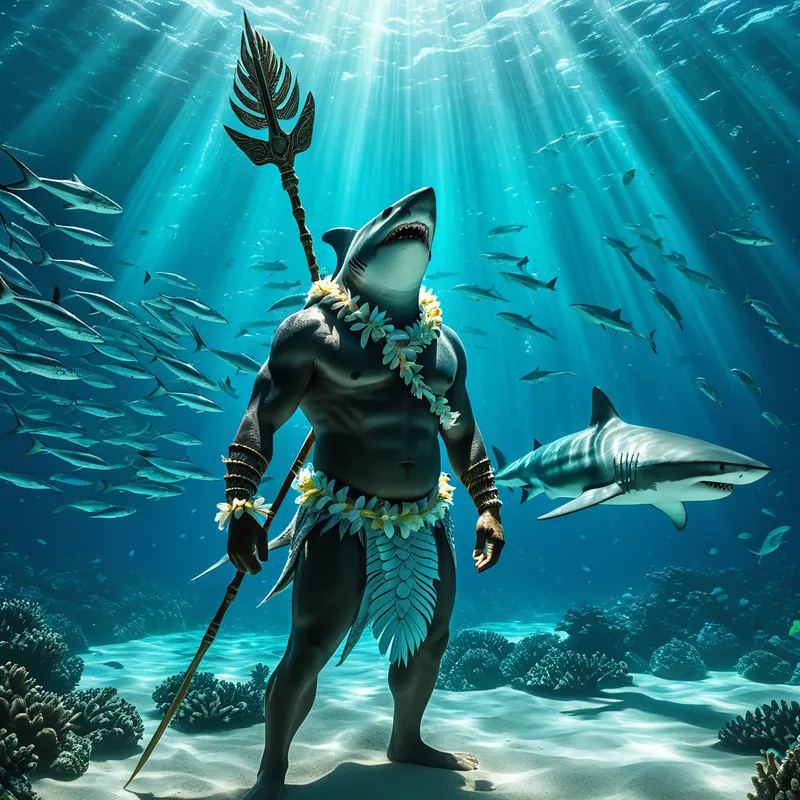
The myth of the shark god Ka-moho-ali'i, a sovereign deity of the deep who guards the life-giving waters and the ancestral soul of the people.
The Tale of Ka-moho-ali'i
Listen, and let the salt air fill your lungs. Let the rhythm of the great ocean, Moana-nui-a-Kiwa, become the drumbeat of this tale. In the time when gods walked just beneath the surface of things, when the boundary between land and sea was a permeable membrane, there ruled a king not of sun-baked earth, but of the eternal blue.
His name was Ka-moho-ali'i. He was the shark who walked as a man, the man who swam as a shark. Brother to the fiery goddess Pele, his domain was the opposite of hers. Where she commanded the eruptive, creative-destructive heart of the islands, he commanded the surrounding, sustaining, and profound depths. He was the guardian of the mana of the sea.
The story is told on the wind-whipped cliffs of Molokaʻi. A great famine had gripped the land. The taro withered, the fishing nets came up empty, and the people’s songs had turned to whispers of despair. Their kahuna had prayed, had offered, but the heavens were silent. The connection was severed; the people were adrift, orphaned from the source of life.
In their desperation, they turned to the last, most profound covenant. A chosen one, a sacred child of chiefly line, was prepared not for life, but for a journey. Adorned with the feather lei of royalty and anointed with seawater, they were taken to the pali that plunged into the abyss. The chants rose, not of mourning, but of invocation—a call into the deep blue unknown.
The child entered the water. The surface closed, and a terrible silence followed. The watchers on the cliff saw only the endless, hungry sea. Then, a disturbance. Not a struggle, but a transformation. The waters parted, and the great form of Ka-moho-ali'i revealed himself. In his presence was a terrifying grace. He did not devour; he received. He accepted the ultimate offering, the most precious tapu—a human life.
But this was no end. It was a transaction at the very root of existence. The next dawn, the fishermen pushed out their canoes with heavy hearts. They cast their nets with little hope. And the nets grew heavy, not with one fish, but with a multitude—silver, flashing, abundant. The ocean had given back. The famine broke. The child was gone from the village, but the people lived. They understood then, in their bones, that the child lived too—not in the village, but in the presence of the god. They had fed the guardian, and the guardian, in his sovereign law, sustained the whole.

Cultural Origins & Context
This myth springs from the heart of the Polynesian</abynesian world, a universe conceived not as a separation of elements, but as a vast, familial genealogy. The Kumulipo creation chant details how the cosmos unfolded from a deep, generative night, linking gods, humans, animals, and plants in one ohana (family). In this worldview, Ka-moho-ali'i is not a monstrous "other," but an aumakua—a deified ancestral spirit, often manifesting as an animal.
The myth was not mere entertainment; it was a foundational narrative of ecology and ethics, passed down by kāhuna and storytellers. It encoded the sacred laws of reciprocity. The ocean was not a resource to be exploited, but a relative to be respected, a kingdom with its own sovereign. The story explained the necessity of sacrifice—not of wanton destruction, but of conscious, ritualized giving to maintain the balance of mana. It taught that survival demanded a relationship with the terrifying, awe-inspiring powers that sustain life, a relationship built on profound respect and the hardest of offerings.
Symbolic Architecture
Psychologically, Ka-moho-ali'i is the archetypal Sovereign of the Deep Unconscious. He represents the autonomous, ancient law of the psyche that exists beneath the "land" of our conscious ego and identity.
The guardian of the depths does not operate on the currency of compassion, but on the law of reciprocal exchange. To receive its sustenance, one must offer something of equal value from the realm of the conscious self.
The shark form symbolizes the ruthless efficiency of the unconscious processes—instinctual, ancient, and perfectly adapted to its environment. It is not evil, but it is impersonal and potent. The acceptance of the sacred child represents the ego's most prized possession—its innocence, its potential, its very sense of a separate, protected self—being surrendered to a greater, transpersonal power. The famine on land symbolizes a psychic state of aridity, where the ego's resources are depleted, and connection to the vital, instinctual, and creative waters of the unconscious has been lost. The return of the fish signifies the enlivening energy, inspiration, and vitality that floods the conscious mind once this sacred pact with the deep self is honored.
The Dreamer's Resonance
When this myth stirs in the modern dreamer, it often manifests as dreams of being in deep, dark water, observing a shark that is neither attacking nor ignoring you, but assessing you. There is a palpable somatic tension—a chill, a stillness, a focused dread. This is the psyche signaling a critical encounter with the Self (in the Jungian sense), the central, organizing principle deeper than the ego.
The dreamer may be at a life impasse—a creative famine, an emotional drought. The shark’s presence indicates that the deep psyche is active and demanding attention. The psychological process is one of confrontation with the transpersonal. The ego is being asked: What cherished identity, what long-held innocence, what "sacred child" within you, must be given over to a larger, more ruthless, and ultimately more sustaining truth? The fear is not of annihilation, but of fundamental transformation. The dream is an invitation to approach the cliff edge of the known self and prepare an offering.

Alchemical Translation
The alchemical process mirrored here is the nigredo—the blackening, the dissolution of the old, naive conscious attitude (the famine) in the aqua permanens, the permanent water of the unconscious. Ka-moho-ali'i is the spirit that presides over this dissolution.
Individuation is not self-improvement; it is a sacred covenant where the ego surrenders its small kingdom to gain citizenship in a vast and ancient one.
The "sacred child" offered is the prima materia, the unrefined, precious core of the personality that must be "devoured" by the unconscious processes to be transformed. The modern individual engages in this alchemy not through literal sacrifice, but through the courageous act of shadow work, of confronting what they have cast into their own personal sea. It is the sacrifice of the ego's absolute authority. We offer our rigid self-image, our victim narratives, or our idealized innocence to the shark-god of our own deepest truth.
The resulting "abundance of fish" is the albedo—the whitening, the illumination. It is the flow of authentic insight, renewed creativity, and genuine power that comes from being realigned with the sovereign law of one's own being. One no longer lives just from the dry land of persona, but has a conscious, respectful, and sustaining relationship with the terrifying and fertile depths within. One becomes, in part, a steward of that inner ocean, having met its king and understood the price, and the gift, of its grace.
Associated Symbols
Explore related symbols from the CaleaDream lexicon: