Jurema the Sacred Tree Myth Meaning & Symbolism
A myth of a beautiful woman who, through profound sacrifice, becomes the sacred Jurema tree, offering healing, visions, and a bridge between worlds.
The Tale of Jurema the Sacred Tree
In the time before time, when the world was still soft and the songs of the first people echoed in the green cathedral of the forest, there lived a woman of such beauty and kindness that the very air seemed to soften around her. Her name was Jurema. She was not a goddess, but a child of the people, her laughter like the trickle of a clear stream, her touch as gentle as a butterfly’s wing. She walked the forest paths knowing the true name of every leaf and the secret language of every creature.
But a great shadow fell upon the people. A sickness, silent and creeping, slithered from the damp shadows of the undergrowth. It was a wasting illness that stole the light from the eyes and the warmth from the limbs. The shamans chanted until their voices were hoarse, the healers applied every poultice known, but the sickness only grew, a cold vine tightening around the heart of the village. Despair, a bitter fruit, began to ripen.
Jurema walked among the sick, her heart a heavy stone in her chest. She wiped fevered brows and held trembling hands, feeling the life ebb from her people like water into sand. One night, under a moon veiled in sorrowful mist, she went deep into the forest, to the oldest, most silent place where the roots of the great trees drank from the dark water of the world. She fell to her knees on the moss, and her tears, hot and salt, fell upon the earth.
“Great Spirit of the Forest,” she whispered, her voice cracking the stillness. “I offer my song for their breath. I offer my dance for their strength. Take from me what you will, but let them live.”
The forest held its breath. Then, a voice, not a sound but a vibration in the soil, in the air, in her very bones, answered. “Your offer is heard, daughter of compassion. But the price is not your song or your dance. It is your form. To give them life, you must become life itself. You must become the bridge between the world of flesh and the world of spirit.”
Without hesitation, Jurema bowed her head. “Let it be so.”
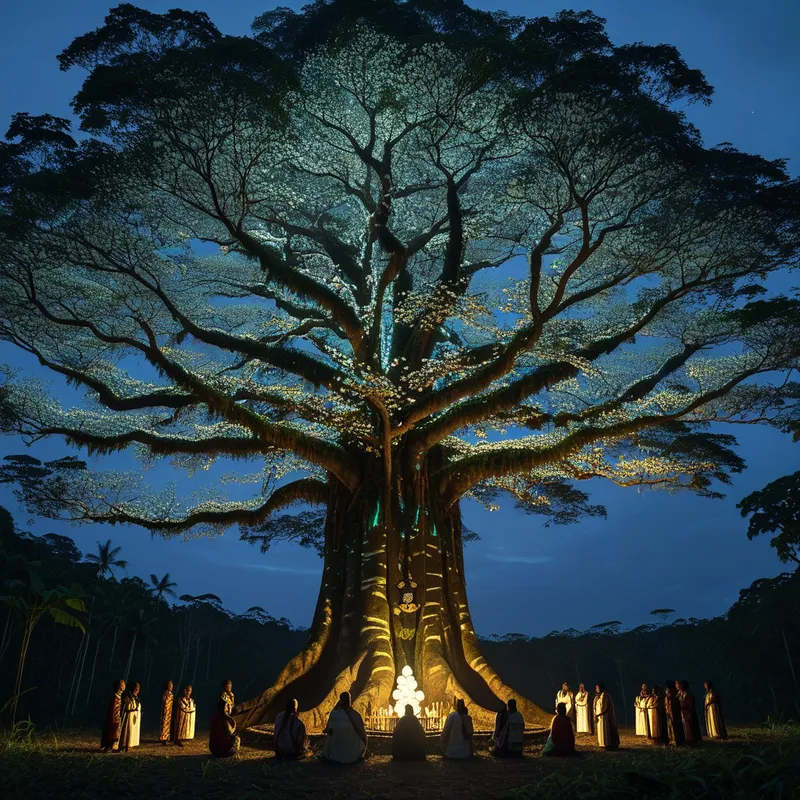
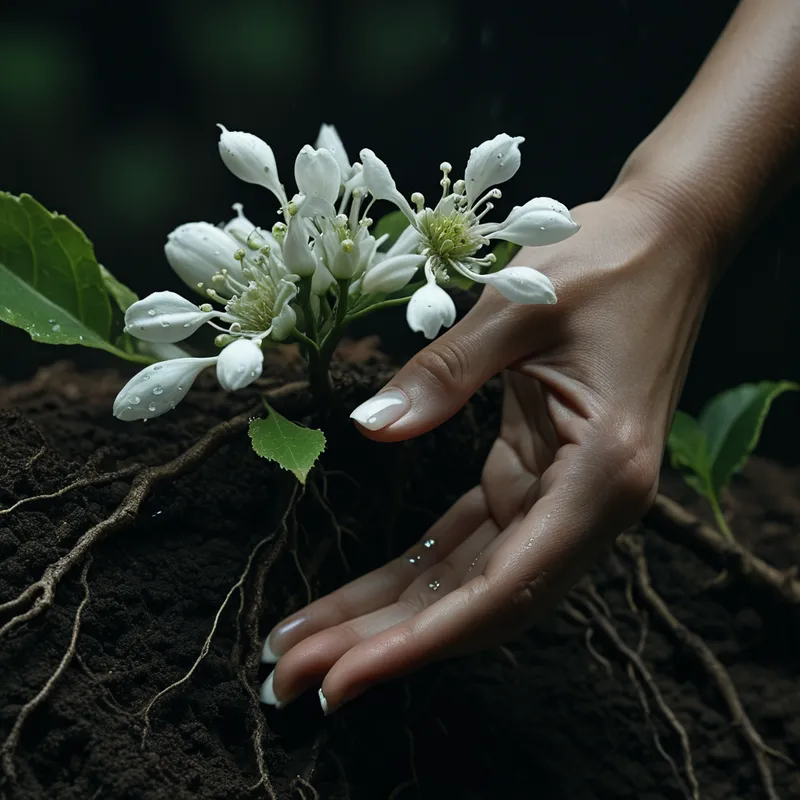
A profound warmth spread from the earth into her feet. It was not painful, but immense, a slow, inevitable tide. She felt her toes lengthen, digging deep into the soil, seeking the hidden waters. Her legs fused and strengthened, becoming a mighty trunk, her skin transforming into bark, patterned with the stories of her people. Her arms stretched toward the sky, branching out, her fingers becoming twigs that trembled in the night air. As the transformation reached her heart, a final, radiant pulse of love burst forth from her chest. From that sacred center, a thousand delicate, fragrant white blossoms erupted, glowing with a soft, inner moonlight. Where her tears had fallen, new, tender shoots of Jurema broke through the earth.
With the dawn, the people, weak and confused, felt a new scent on the wind—sweet, clean, and piercingly hopeful. They followed it to the forest clearing and found, where their beloved Jurema had last been seen, a magnificent, radiant tree they had never seen before. Understanding dawned, a bittersweet awe. The shamans, with trembling hands, harvested the bark and the roots. They prepared the sacred drink. And as the first sip touched the lips of the sick, the cold vine of illness shriveled. Visions of the spirit world opened to them, guided by Jurema’s enduring presence. She had not left them. She had become the cure, the vision, the bridge. She had become the Sacred Tree.
Cultural Origins & Context
The myth of Jurema is rooted in the spiritual traditions of numerous Indigenous peoples of northeastern Brazil, most notably among the Tupi-Guarani and other groups. It is far more than a story; it is the living narrative companion to the actual, physical Jurema tree (Mimosa hostilis) and the psychoactive sacrament, Vinho da Jurema, brewed from its roots and bark. The myth was and is transmitted orally by shamans (Pajés) and elders, often during the rituals themselves, weaving the participants directly into the story's fabric.
Its societal function is multifaceted. Primarily, it serves as an etiological myth, explaining the divine origin of the central sacrament that facilitates healing, divination, and communication with the spirit world. It establishes a sacred covenant: the tree is not merely a plant, but a conscious, sacrificed ancestor. This frames all interaction with it—from harvesting to consumption—as an act of profound reciprocity and respect, preventing exploitation and embedding ecological ethics deep within the culture’s spiritual core. The myth sanctions the ritual, and the ritual re-animates the myth, in a continuous cycle of remembrance.
Symbolic Architecture
At its heart, the myth of Jurema is a profound map of a specific kind of transformation: one driven not by a quest for power, but by radical, self-obliterating compassion. Jurema represents the ultimate archetype of the life-giving principle that surrenders its individual identity to become a systemic source of nourishment and connection.
The most profound healing often requires a dissolution of the healer. The cure is not applied from the outside; it is grown from a seed of sacrifice planted within the collective wound.
The Sickness symbolizes a state of spiritual and communal disconnection, a paralysis of life force. Jurema’s Sacrifice is not a tragic end, but an alchemical act. Her human body, a singular form, is deconstructed and recomposed into the arboreal body—a networked, rooted, flowering form that serves the entire community. The Vinho da Jurema becomes the distilled essence of this transformation, a liquid medium carrying her consciousness—the bridge—into those who partake. She becomes an axis mundi, linking the earthly realm of suffering (the village) with the subterranean realm of origins and the celestial realm of spirit (through her blossoms).
The Dreamer's Resonance
When this mythic pattern stirs in the modern dreamer, it often signals a profound somatic and psychological process: the call to become a vessel for something greater than the individual self. Dreams featuring themes of merging with nature, particularly turning into a tree, or finding healing in a forest, may echo Jurema’s journey.
Somatically, this can manifest as a felt sense of "rooting" or "grounding"—a deep need for stability and connection to one’s origins or the physical body, often after a period of illness, burnout, or existential floating. Psychologically, it speaks to the process of "creative illness," where a personal crisis demands not just a return to a previous state of health, but a fundamental metamorphosis of identity. The dreamer may feel they are being asked to give up a cherished form of themselves—a role, an ambition, a self-image—to serve a deeper, often collective, need for healing, whether in their family, community, or their own fragmented psyche. The dream is an invitation to consider what must be sacrificed, not out of martyrdom, but out of love, to become a source of genuine nourishment.
Alchemical Translation
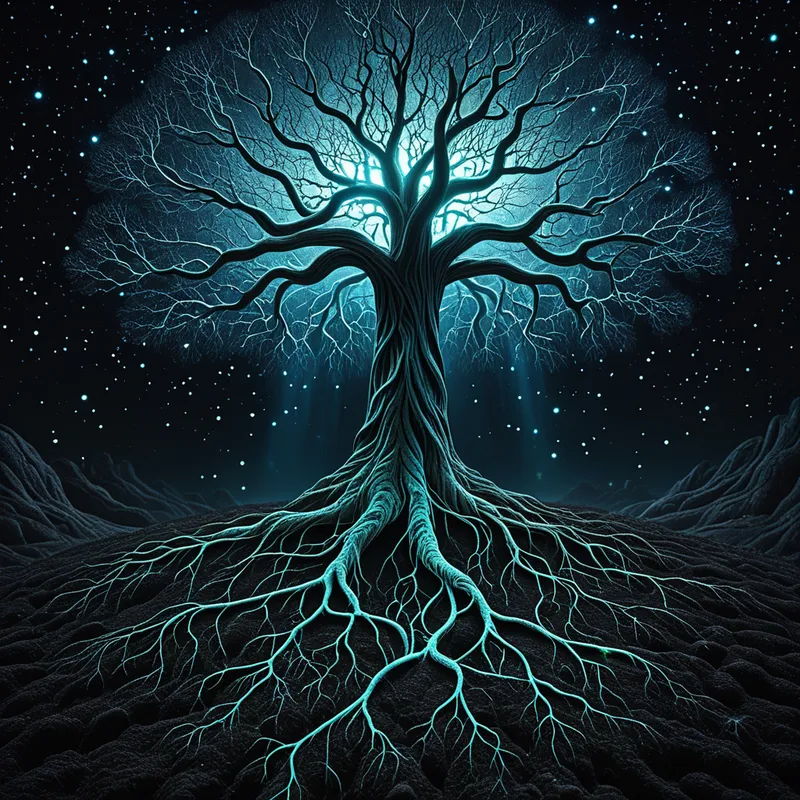
In the alchemical vessel of the soul, the myth of Jurema models the stage of putrefactio and alimentatio. The individual ego (the beautiful, singular Jurema) must willingly submit to dissolution in the waters of the unconscious (the fertile, dark earth) to be reconstituted into a form that feeds the whole psychic system.
Individuation is not about becoming a perfectly bounded self, but about becoming a rightly related self—a node in a living network, a tree in a forest.
The modern individual engaged in this work is called to identify what "sickness" in their life or environment feels unbearable. The transformation begins not with an attempt to fix it from a position of separateness, but with a descent into it, a kneeling upon that ground. The sacrifice demanded is the rigid, self-protective identity. The act of "becoming the tree" is the act of building a psychic structure that is both deeply rooted in one’s own truth (instincts, body, heritage) and expansively branching into connection, creativity, and spirit. The "visions" granted by the sacred drink translate as the expanded, non-ordinary states of consciousness—achieved through deep meditation, active imagination, or artistic creation—that become possible when one stops being a consumer of life and starts being a conduit for it. The ultimate goal is not to be admired as a solitary hero, but to be, quietly and steadfastly, a source of healing shade and sustaining fruit for the world one is rooted in.
Associated Symbols
Explore related symbols from the CaleaDream lexicon:
- Tree — The central symbol of transformation and sacrifice, representing the stable, life-giving form that emerges from the dissolution of the individual self to serve the whole.
- Roots of a Sacred Tree — Symbolize the deep, often hidden connection to ancestral wisdom, the unconscious, and the nourishing darkness from which healing and vision ultimately spring.
- Healing — The core purpose and outcome of Jurema's sacrifice, representing not just the curing of illness but the restoration of spiritual and communal wholeness.
- Sacrifice — The voluntary surrender of a prized individual form for a greater, systemic good, which is the catalytic engine of the entire myth.
- Bridge — Represents Jurema's primary function after her transformation: serving as a living conduit between the human world, the spirit world, and the earthly realm.
- Vision — The gift granted by the Jurema tree, symbolizing expanded consciousness, access to hidden truths, and the spiritual sight that emerges from sacrificial love.
- Spirit — The realm Jurema connects to, representing the invisible forces, ancestors, and consciousness that animate the material world.
- Earth — The receptive, fertile ground that accepts Jurema's sacrifice and from which new life and the tree itself emerges, symbolizing the physical and instinctual foundation of existence.
- Cup — A vessel for the sacred Vinho da Jurema, representing the container (the ritual, the individual psyche) that must be prepared to receive the transformative essence of the sacrifice.
- Mother — Embodies the nurturing, life-giving, and self-sacrificing aspect of the archetype that Jurema fully incarnates through her transformation.
- Flower — The beautiful, fragrant blossoms of the Jurema tree, symbolizing the visible, gracious, and inspiring manifestation of inner sacrifice and the flowering of spirit.
- Ritual — The structured, respectful practice of engaging with the sacred tree and its sacrament, which keeps the covenant of the myth alive and operational in the community.