Judas Iscariot Myth Meaning & Symbolism
The story of the disciple whose betrayal, for thirty pieces of silver, catalyzed the crucifixion and resurrection, embodying the paradox of necessary shadow.
The Tale of Judas Iscariot
Listen. There is a story woven into the very fabric of the West, a thread of deepest black in a tapestry of gold. It begins not with a king, but with a keeper of the purse.
He was called Judas Iscariot. Among the twelve who walked the dust-choked roads of Galilee with the Rabbi Yeshua, he was the pragmatic one. While others dreamed of kingdoms, Judas counted coins. He smelled the scent of crushed olives, heard the murmur of desperate crowds, felt the weight of the common purse at his belt—a weight that seemed to grow lighter as the teacher spoke more of a kingdom not of this world.
The tension was a taste of metal on the tongue. The authorities, the Sanhedrin, watched with cold eyes from the marble porticoes of Jerusalem. The Rabbi’s words were a flame threatening to catch the dry tinder of Roman occupation. And Judas watched it all, his calculations turning in the silent vault of his mind.
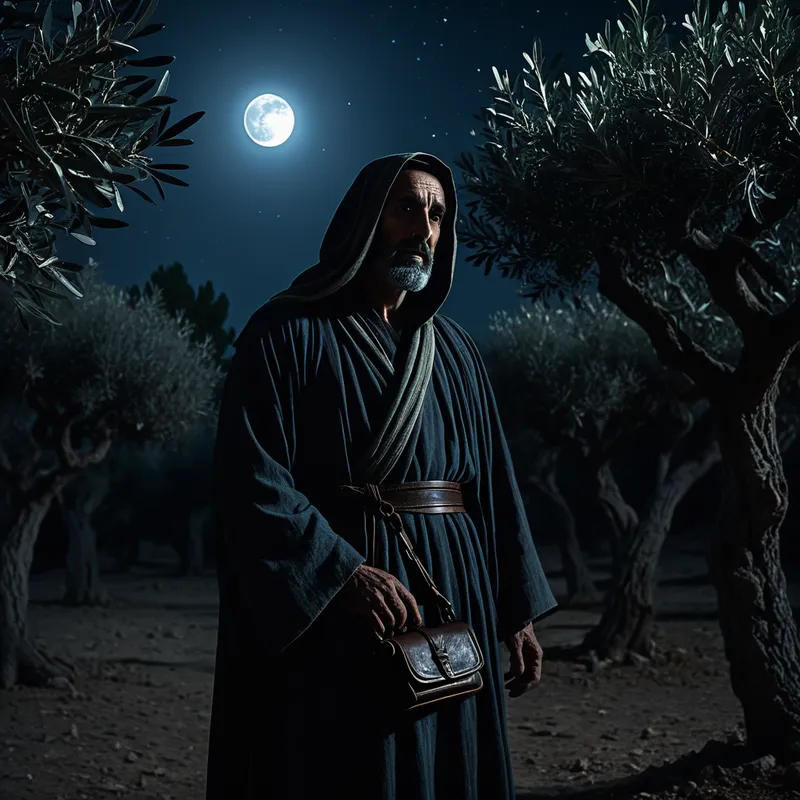
Then came the night in Gethsemane. The air was thick with the scent of cypress and impending rain. The other disciples, heavy with wine and sorrow, slept among the gnarled roots. Judas moved through the shadows, not as a thief, but as a man walking a path he alone could see. The kiss was not an act of passion, but a signal—a terrible, intimate punctuation in the dark. The touch of his lips to the teacher’s cheek was cold, a seal. Torchlight erupted from the trees, glinting on armor and the hard faces of temple guards. In that chaotic moment, their eyes met—the betrayed and the betrayer. It was not hatred in the Rabbi’s gaze, but a sorrow so vast it seemed to contain the very night.
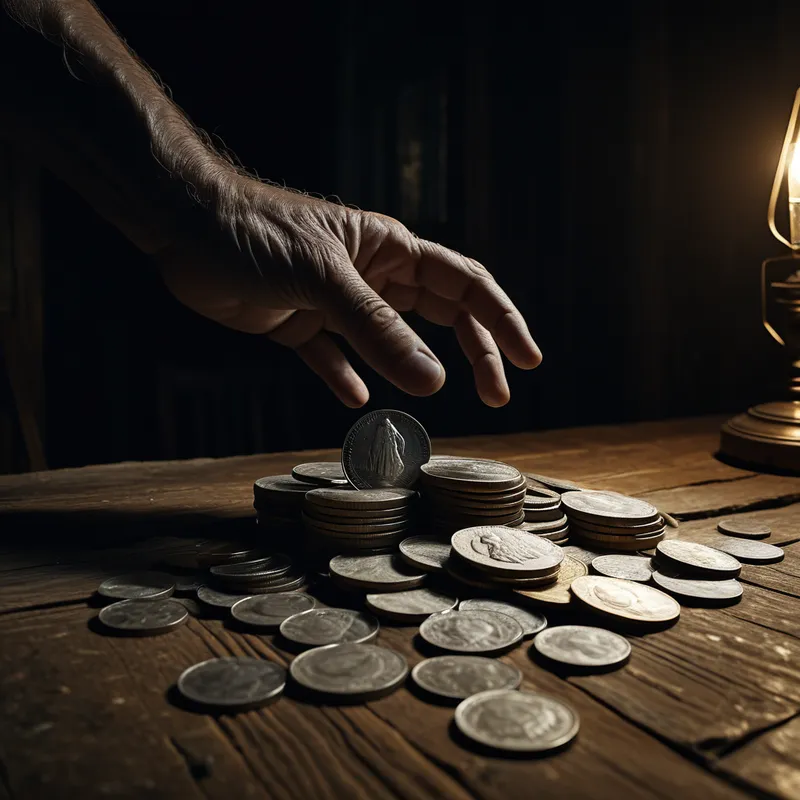
The silver, thirty pieces, clinked in the purse, a hollow music. When the deed was done, and the teacher was bound, the weight of the coins transformed. They were no longer currency, but condensed guilt, burning like coals in his hand. He flung them into the Temple sanctuary, where they rolled across the sacred floor, a profane offering. Then he went to a lonely place, a field of blood bought with that silver. There, beneath a sky indifferent to human anguish, the keeper of the purse met his end, and the story says he went “to his own place.” The silver was gathered, used to buy a potter’s field—a burial place for strangers. The betrayer was gone, but his shadow stretched long across all that was to come.
Cultural Origins & Context
This tale emerges from the crucible of first-century Judea, a society straining under Roman rule and fractured by internal religious fervor. The story of Judas is not a standalone myth but a critical, painful nerve within the foundational narrative of the Passion. It was passed down orally among early Christian communities, eventually crystallized in the four canonical Gospels. Each telling—Matthew, Mark, Luke, John—adds its own nuance, from the specifics of the betrayal price to the nature of Judas’s end, reflecting the evolving theological and communal struggles of the early church.
Societally, the figure of Judas served a profound and difficult function. He became the ultimate scapegoat, the narrative vessel into which the community could pour the unbearable contradiction of the Messiah’s death at the hands of his own people. He externalized the betrayal that, psychologically, every follower might fear within themselves. By naming Judas, the story could maintain the purity of the disciples and the tragic inevitability of the divine plan, while also offering a terrifying warning about the consequences of faith corrupted by worldly calculation.
Symbolic Architecture
Judas Iscariot is the embodied shadow of the Christian mythos. He is not mere evil, but the necessary counterpoint, the agent of the darkest transaction without which the central drama of death and resurrection cannot unfold.
He is the human hand that turns the key in the lock of destiny, the part of the psyche that must enact the terrible deed so that transformation can be born.
The thirty pieces of silver symbolize the reduction of the sacred to a transactional value—the soul’s betrayal for a material guarantee. The kiss is the ultimate symbol of intimacy weaponized, love perverted into its opposite, revealing that the deepest wounds are always delivered by those closest to us. His suicide is not just an end, but the shadow’s own self-annihilation upon realizing the full consequence of its separation from the whole. Judas represents the archetypal rebel whose rebellion becomes a trap, the pragmatic intellect severed from the heart, destined to serve a purpose grander and more terrible than it can comprehend.
The Dreamer's Resonance
When the pattern of Judas manifests in modern dreams, it signals a profound confrontation with the personal shadow. The dreamer may not see a biblical figure, but will feel the essence: the dream of handing over something precious (a secret, a relationship, one’s integrity) for a hollow reward—promotion, security, approval. They may dream of a betraying kiss, or of coins that feel cold and dead in the hand.
Somatically, this process often feels like a tightening in the chest, a visceral clenching of guilt or shame that has no clear, conscious source. Psychologically, it is the recognition of one’s own capacity for betrayal—of others, of one’s own values, of the Self. The dream is not a condemnation, but an unveiling. It asks the dreamer: Where in your life have you sold a piece of your soul? What sacred trust have you, consciously or unconsciously, broken for the silver of convenience, fear, or resentment? The agony of Judas in the dream is the psyche’s agony at its own fragmentation.
Alchemical Translation
The alchemy of the Judas myth is the most bitter and necessary of transmutations. It models the stage in individuation where one must consciously acknowledge and integrate the betrayer within.
The psychic gold of wholeness cannot be forged without the leaden weight of the shadow’s treason. The crucifixion of the ego’s ideal self requires a Judas.
For the modern individual, this means courageously facing the parts of oneself that have “sold out”—the ambitions that compromised relationships, the fears that silenced truth, the envy that poisoned admiration. The thirty pieces must be counted and owned. This is not about self-flagellation, but about reclaiming that disowned energy. The field of blood (Akeldama) becomes, alchemically, the fertile ground where the rejected parts of the self are buried so that something new can grow—a compassion born of having known one’s own darkness.
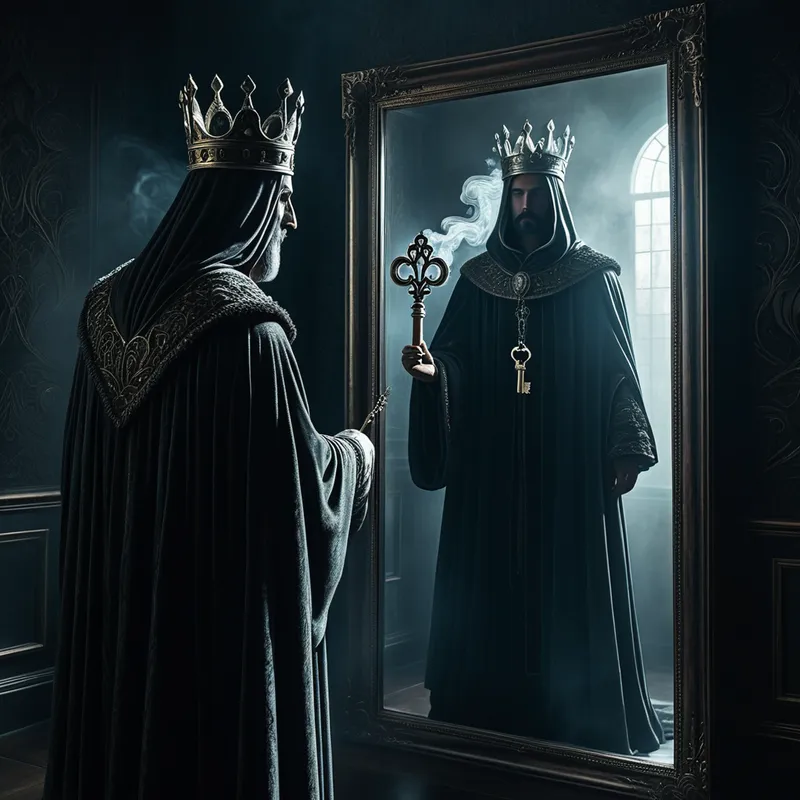
The ultimate translation is the realization that the betrayer and the betrayed are aspects of the same psyche. To integrate Judas is to understand that the hand that holds the silver and the cheek that receives the kiss belong to the same being. In this reconciliation, the archetypal rebel’s energy is redeemed. It no longer acts out in secret treachery but can now consciously challenge inner tyrannies and false loyalties. One becomes, paradoxically, both steward of the sacred and acknowledger of the shadow, holding the purse and the kiss in a terrible, redeemed unity. The myth thus completes its arc: from betrayal as catastrophe to betrayal as the dark, unwilling midwife of the soul’s most crucial birth.
Associated Symbols
Explore related symbols from the CaleaDream lexicon: