
Judar and His Brothers Myth Meaning & Symbolism
A fisherman's son, blessed by a mystic, is repeatedly betrayed by his envious brothers, yet his integrity and magical destiny lead to a final, transformative justice.
The Tale of Judar and His Brothers
In the ancient port of Fez, where the scent of salt and spices hangs heavy in the air, lived a fisherman and his three sons. The father died, leaving behind a legacy of poverty and a simple fishing net. The two elder brothers, Salim and Selim, were idle and greedy of heart, their eyes forever calculating what they had not earned. The youngest, Judar, was of a different spirit—patient, dutiful, and bearing a quiet strength that comes from honest labor.
One day, after his brothers had squandered their shared inheritance, Judar took the net, the last relic of their father, and cast it into the sea. He toiled from dawn till dusk, his hands growing raw, his back aching, catching only enough to feed his mother. His brothers ate of his labor but offered only scorn in return. Yet Judar persevered, his soul as steady as the tide.
His fate changed when he gave his meager catch to a weary stranger—a Moor from the distant lands of the Maghrib. This was no ordinary traveler, but Abd al-Samad, a master of hidden arts. In gratitude, and seeing the pure metal of Judar’s character, the Moor took him as a partner on a perilous quest. They journeyed far from Fez, across burning deserts and into the shadow of a mountain that touched the belly of the sky.
Their goal was a treasure guarded by dread jinn in a cavern at the bottom of a remote river. The Moor performed intricate rituals, drawing circles of protection and chanting names of power. He gave Judar a magical horse of wood and leather, a charm against drowning, and a knife. “Cast the net,” he instructed, “and bring me what you find, but speak not a word, lest we be undone.”
Judar, his heart a drum of fear, did as commanded. He dove into the chilling water, fought the swirling currents, and in the abyss, faced the guardians: two monstrous figures with eyes like coals and hands like pincers. With the knife and the charm, he prevailed. He filled the net with treasures of gold and jewels beyond imagining and the ultimate prize: two enchanted boxes and a magical ring.
The Moor, true to his word, gave Judar the mule-loads of treasure and the two lesser boxes, keeping only the ring for himself—a ring that could summon a jinni to fulfill any desire. Judar returned to Fez a prince among men. He built a palace, cared for his mother, and even welcomed his scheming brothers, showering them with wealth. But their hearts, poisoned by envy, could not bear his goodness. Twice they betrayed him, stealing his wealth and casting him into poverty. Twice, through fate and the kindness of those he had helped, Judar rose again, his spirit unbroken.
In their final and most vile act, the brothers learned of the magical ring. With false tears and hollow words, they lured Judar to a feast. There, they slipped a powder of forgetfulness into his food. As he fell into a deep slumber, they stole the ring from his finger. The elder brother, Salim, rubbed it. The mighty jinni appeared. “Command, and I obey,” it boomed.
“Take my brother Judar,” Salim cried, his voice trembling with malice, “and cast him into the farthest, most desolate desert to die.”
And so it was done. Judar awoke under a pitiless sun, alone in a sea of sand, stripped of everything but his life. Yet the brothers’ triumph was brief. Their greed turned them against each other. In a squabble over the ring, Selim slew Salim, only to be betrayed in turn by the jinni itself, who understood the corruption of the new master. The jinni then returned to Judar in the desert, restored the ring, and carried him home on a cloud of destiny.
Judar returned to Fez. He found his mother grieving, his palace defiled by his brothers’ brief, cruel reign. With a heavy heart but a hand steady with justice, he summoned the jinni one last time. “Take my brothers,” he said, “and imprison them.” The earth opened, and they were taken down, not to death, but to a timeless confinement—a living tomb for their envious souls. Judar ruled thereafter in wisdom and peace, a king whose throne was founded not on magic, but on the integrity that had called the magic forth.
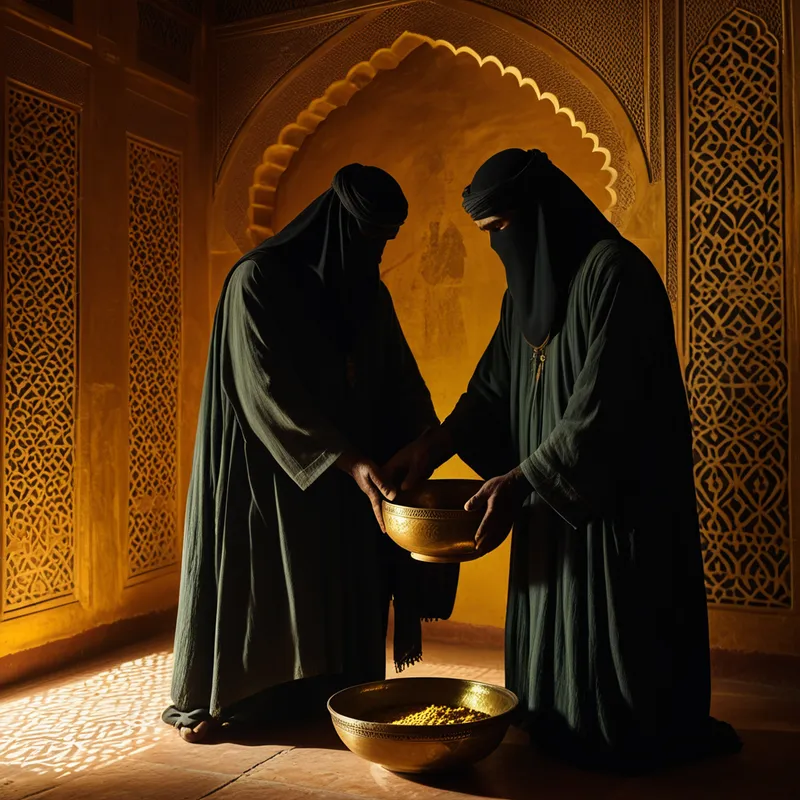
Cultural Origins & Context
This intricate tale is woven from the rich narrative fabric of the One Thousand and One Nights. While the frame story is Persian in origin, the tales themselves are a mosaic of Indian, Persian, Mesopotamian, and Arabic folklore, compiled and Arabized over centuries. "Judar and His Brothers" is distinctly North African in its setting—Fez, the Maghrib, the Moorish sorcerer—placing it within the Islamic cultural sphere of the medieval period.
Told in coffeehouses, royal courts, and family quarters, these stories served as entertainment, moral instruction, and a repository of cultural wisdom. The storyteller, or hakawati, would have animated the tale, emphasizing the dramatic tension between familial duty and betrayal, and the ultimate triumph of qadar and adl. The myth functioned as a societal mirror, warning against the corrosive power of envy (hasad) within the family unit, while championing the virtues of patience (sabr), trust in God (tawakkul), and righteous action. It reassured listeners that the universe, though filled with hidden forces (jinn), is ultimately structured by a moral order where integrity is the true key to power.
Symbolic Architecture
At its core, this is a myth of the Orphan archetype. Judar is orphaned not only by his father’s death but, more profoundly, by the betrayal of his familial bonds. His brothers represent the shadow of the family—the part of our psychic inheritance that seeks to consume our vitality and sabotage our destiny.
The treasure is not the gold, but the integrated Self. The journey to retrieve it requires diving into the unconscious (the river), facing the shadowy guardians of our deepest fears, and returning with the prize intact.
The magical ring symbolizes a connection to a transpersonal power, the jinni being the potent, amoral force of the unconscious itself. It is neutral; it serves whoever holds it, reflecting the wielder’s character. In the hands of the integrated Judar, it is an instrument of providence. In the hands of the fragmented brothers, it becomes an engine of self-destruction. The repeated betrayals and resurrections map the painful, iterative process of confronting betrayal not as a one-time event, but as a recurring pattern that must be fully endured and understood before it can be finally resolved.

The Dreamer's Resonance
When this myth stirs in the modern psyche, it often manifests in dreams of profound betrayal by those closest—family, partners, or trusted friends. The dreamer may find themselves in a vast, empty landscape (the desert), feeling abandoned with all support systems vanished. Alternatively, they may dream of discovering a powerful tool or secret (the ring), only to have it stolen by a familiar face.
Somatically, this can feel like a hollowing out in the gut, a literal feeling of being poisoned or made to forget one’s own power (the drugged food). The psychological process is one of confronting the "brother shadow"—the part of oneself or one's history that feels entitled to one’s energy, that envies one’s growth, and that must be consciously separated from and contained. The dream is not merely replaying a wound; it is initiating the dreamer into the Judar process: the slow, painful cultivation of self-reliance and the eventual reclaiming of one’s innate authority from the internal saboteurs.

Alchemical Translation
The alchemical journey in this myth is one of separatio and solutio—separation and dissolution. The initial state is a massa confusa: the undifferentiated family unit where the pure element (Judar) is mixed with the corrupt (his brothers). The death of the father is the first separation, forcing the process.
Judar’s trials are the alchemical washing and purifying. The sea and the river are the solutio, the dissolving waters that wash away the mundane. His descent into the treasure cave is the nigredo, the dark night of the soul where he faces the shadowy guardians (his own fears and the projected malice of others). Returning with the treasure is the illumination of albedo, but it is incomplete. The brothers’ betrayals represent recurring impurities; the gold is not yet fixed.
The final, willing descent into the desert—the ultimate ordeal of abandonment—is the crucial mortificatio. It is the death of all external attachment, the reduction to the essential, barren self. Only from this absolute zero can the true philosopher’s stone be born.
The reclaiming of the ring from this state is not a reversal, but a transcendence. It is the rubedo, the reddening, where the fully integrated Self, tempered by suffering and stripped of illusion, assumes its rightful sovereignty. The imprisonment of the brothers is not vengeance, but the final separatio—the conscious, permanent containment of the destructive complexes within the psyche’s dungeon, allowing the ruled and unified Self (Judar as king) to govern a peaceful, prosperous inner kingdom.
Associated Symbols
Explore related symbols from the CaleaDream lexicon:
- Brother — The shadow sibling, representing envy, betrayal, and the part of the psyche or personal history that seeks to sabotage one's growth and steal one's power.
- Water — The realm of the unconscious, emotion, and the unknown; Judar must dive into the river to claim his destiny, symbolizing a necessary descent into the depths of the psyche.
- Ring — A symbol of wholeness, sovereignty, and a connection to immense, amoral power; it serves its wielder's character, reflecting either integration or corruption.
- Desert — The place of absolute isolation, ordeal, and mortificatio; it is where all external support is stripped away, forcing a confrontation with the bare essence of the self.
- Treasure — The latent potential of the integrated Self, the hidden wholeness that must be retrieved from the guarded depths of the unconscious through courage and ordeal.
- Net — The tool of one's humble inheritance and honest labor; it is both the means of survival and the instrument used to haul the treasures of the deep into consciousness.
- Key — The virtue of integrity and patience, which unlocks the aid of the Moorish guide and, ultimately, the magical destiny; it is not a physical object but a quality of character.
- Poison — The corrupting influence of envy and betrayal, which seeks to induce forgetfulness of one's own power and purpose, delivered by those who should offer sustenance.
- Journey — The essential, perilous quest away from the familiar (Fez) into the unknown (the Maghrib mountains), which is necessary for transformation and cannot be avoided.
- Shadow — The monstrous guardians in the cave and the treacherous brothers both represent aspects of the personal and collective shadow that must be faced and overcome.
- Mountain — The distant, daunting goal or spiritual summit where the great ordeal and revelation take place, representing a monumental challenge to the seeker.
- Cave — The inner sanctum of the unconscious, the womb of the earth where the treasure/self is guarded by primal fears and complexes.