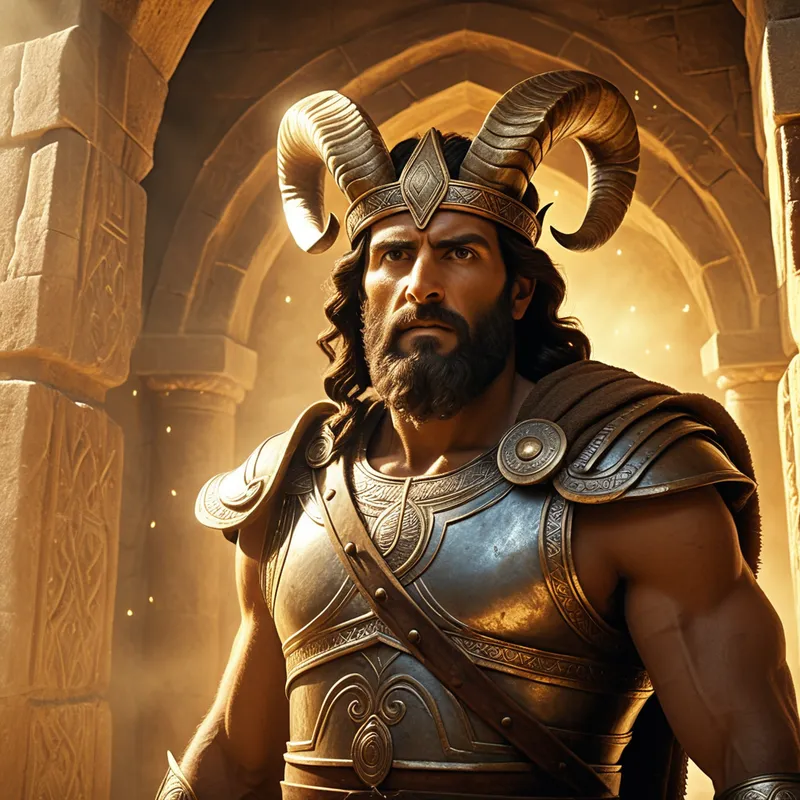
Joshua's Horns Myth Meaning & Symbolism
A story of a mistranslated divine command that transformed a warrior's face, revealing the shadow power and terrifying grace of sacred violence.
The Tale of Joshua's Horns
Hear now a tale not of peace, but of power. Not of a still, small voice, but of a sound that shatters walls and a sight that chills the blood.
The sun was a bronze disc over the plains of Jericho, beating down on a city shut tight as a fist. Before its immense, mocking walls stood a man, Joshua, son of Nun. The weight of a promise and the ghosts of a generation lost in the wilderness rested on his shoulders. He was alone, a solitary figure tracing the perimeter of stone that barred his people from their destiny. Was it prayer or strategy that moved his feet? In that liminal space between the camp and the citadel, between human effort and divine will, a presence descended.
It was not the pillar of cloud or fire his teacher Moses knew. This was a manifestation of raw, commanding authority. A figure stood before him, a sword drawn in its hand, not sheathed. Joshua’s challenge—"Are you for us, or for our adversaries?"—was met with a silence more profound than any answer. The voice that finally spoke was not of this earth. "No. I am the commander of the army of YHWH. I have now come."
Joshua fell on his face. The command that followed was not a battle plan, but a sacred injunction of terrifying simplicity. "Remove your sandals from your feet, for the place on which you stand is holy." The holiness was not in the dust of the plain, but in the commission itself. The divine will was about to be enacted, and Joshua was to be its instrument. The communication was pure, a transmission of intent from the celestial to the mortal.
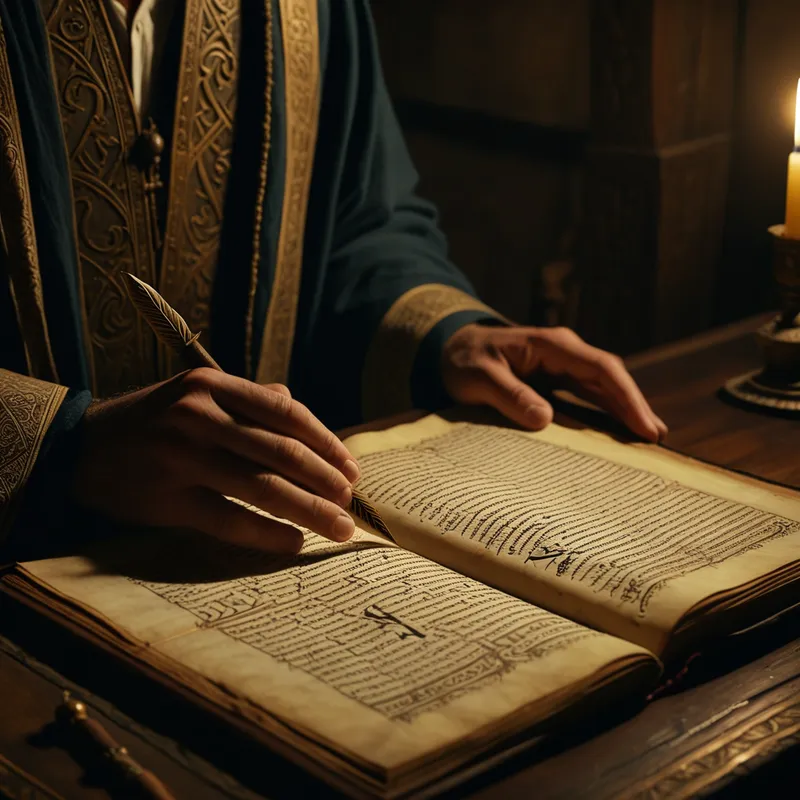
But here, in the telling, the story passes through a veil. Centuries later, in a cold scriptorium far from the desert sun, a scholar-saint named Jerome bent over the sacred Hebrew texts. His task: to render the word of God into the tongue of Rome. He came to the book of Joshua, to this very encounter. The Hebrew text described the divine figure. The word was qeren. A word meaning "radiance," "a shining beam of light," a halo of glorious power. Jerome’s eye saw the word, but his linguistic mind, shaped by a culture of empire and symbol, made a choice. Qeren could also mean "horn." And in his Latin Vulgate, the verse was born: Et ecce vir stans contra eum, et in manu eius framea evaginate. And behold, a man stood against him, with a drawn sword in his hand.
The radiant being, the qeren of divine authority, was translated. Joshua did not see a being of light. He saw a being with horns.
And so the myth was seeded. The image passed into the bloodstream of Western art and imagination: Joshua, the holy warrior, confronted not by an angel of radiance, but by a horned commander of the heavenly host. The horns were not demonic, but majestic; not of a beast, but of a ram, the symbol of primal strength and sacrificial kingship. They crowned the divine messenger, and by the strange alchemy of this "error," they cast their shadow upon Joshua himself. In the minds of those who heard the Latin tale, the horns became a part of the encounter’s essence—a mark of the terrifying, untamed power of the God who commands walls to fall. The hero was forever linked to the symbol of the horned one, a bearer of a fearsome, ambiguous grace.
Cultural Origins & Context
This myth is unique; it is born not at the campfire of oral tradition, but in the silent, lamplit cell of textual transmission. Its origin is the Pentateuch and the book of Joshua, texts central to the Judaic identity, chronicling the conquest and covenant of the promised land. The original Hebrew narrative is starkly theophanic—it concerns the appearance and command of God. Joshua is the model of the obedient leader, succeeding where others doubted.
The myth of the horns, however, is a distinctly Western Christian artifact, forged in the 4th century CE by Jerome’s Vulgate. This translation became the definitive Bible of Western Christendom for over a millennium. The myth was propagated not by bards, but by priests, monks, and artists. It functioned in the medieval mind as a potent visual and conceptual symbol. In a culture deeply allegorical, the "horn" was a rich symbol: of power (as in the "horn of salvation"), of strength (like a ram or bull), and of ancient, perhaps pre-Christian, divine figures.
The societal function was multifaceted. For the common believer, it reinforced the awe-ful, sometimes fearsome nature of the Biblical God and His commands—holiness that could manifest in forms outside comfortable human imagery. For scholars and artists, it provided a compelling visual paradox to explore: divine power expressed through a symbol that walked the line between the majestic and the bestial. It served as a permanent reminder of the gap between the original divine encounter and the human attempt to capture it in language, a gap where mystery and interpretation flourish.
Symbolic Architecture
At its core, the myth is a profound exploration of misinterpretation as revelation. The "error" of translation unveils a deeper truth about the nature of sacred power and the psyche of the one who wields it.
The Shofar is the key. The horn is not merely an animal weapon; it is an instrument of spiritual acoustics. Its blast announces kingship, shatters complacency, and calls the community to attention and awe. The horned divine commander, therefore, symbolizes the terrifying, resonant voice of destiny itself—a call to action that is unavoidable and world-shattering.
The horn is the shape of a shout made permanent, the visible form of a command that breaks walls and identities.
Joshua’s association with these horns (through the translated narrative) signifies the introjection of this awesome power. He must internalize the commander’s authority. The horns represent the "shadow" of the hero archetype: the raw, undifferentiated, potentially destructive force required to fulfill a divine mandate. This is not the clean, bright heroism of fairy tales, but the stained, conflicted heroism of history—the leader who must become an instrument of conquest and necessary violence to establish a new order. The horns are his burden of command, the terrifying grace he must bear.

The Dreamer's Resonance
When this myth stirs in the modern unconscious, it rarely appears as a Biblical scene. Instead, it manifests as a dream of ambiguous empowerment. The dreamer may find themselves in a moment of critical decision or confrontation—facing a literal barrier (a locked door, a high wall) or a metaphorical one (an oppressive boss, a personal limitation).
The somatic experience is often one of surging, almost overwhelming energy in the head and temples, a pressure seeking release. Psychologically, this is the ego confronting a command from the deeper Self—the internal "commander of the host." The resolution comes in a shocking self-image: the dreamer sees their reflection, and horns have sprouted from their brow. The emotion is not pride, but a profound ambivalence—awe mixed with terror. "Is this my power, or am I becoming a monster?"
This dream signals a process of owning one’s latent, perhaps repressed, authority and strength. The horns symbolize a power that feels alien, archaic, and dangerous to the conscious personality. The dreamwork involves reconciling with this "horned" aspect of the self—not to act out brute force, but to integrate its resonant, boundary-shattering potential. It is the psyche’s way of announcing: "You are being called to a task that requires a strength you did not know you possessed, and it will change how you see yourself forever."
Alchemical Translation
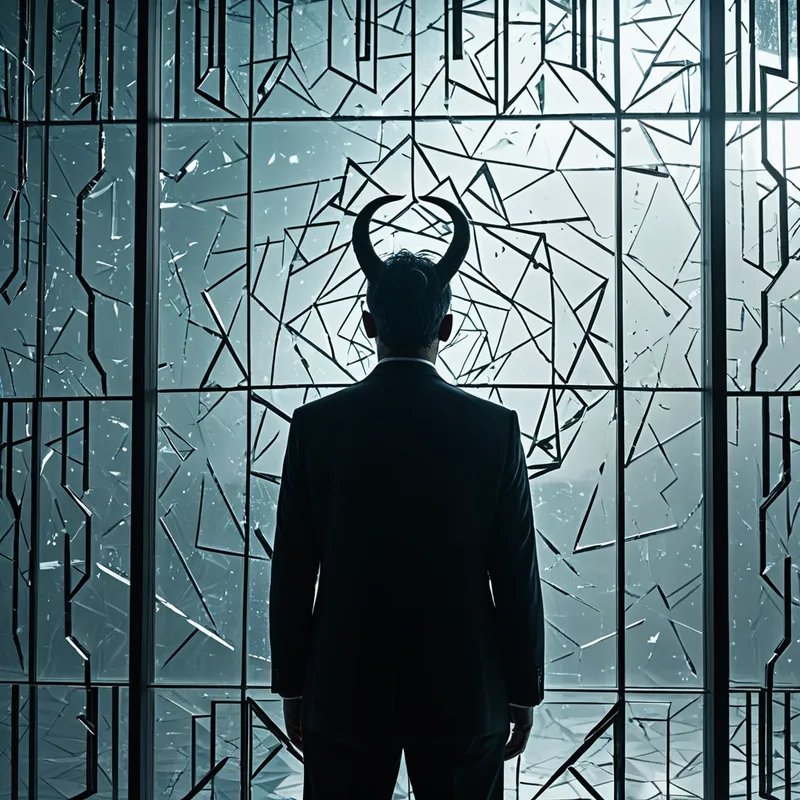
The alchemical process modeled here is the transmutation of the word. The base metal is the original, pure experience (qeren as radiance). The "error" of translation is the nigredo, the blackening, the confusing descent into the ambiguous and the shadowy (qeren as horn). This is not a mistake to be corrected, but a necessary mortification. The conscious ego (Joshua/the reader) must endure the dissolution of a pure, "radiant" understanding and sit with the darker, more complex symbol.
The horn, as a symbol, becomes the vessel for the albedo and rubedo—the whitening and reddening. The whitening is the refinement: recognizing the horn as the shofar, an instrument of sacred purpose. The reddening is the integration: Joshua must take this horned authority into himself to lead his people across the Jordan and bring down the walls of Jericho. The psychic walls that fall are those of a naive self-concept. The individual undergoing this process moves from being a follower of external commands to becoming a commander of their own internal host—integrating their will, their strength, and their capacity for necessary, focused action.
The ultimate revelation is that the power to shatter your Jericho was never outside you. It was a latent radiance within, which the soul, in its profound poetry, first perceived as a horn.
The myth teaches that our deepest calls to destiny may first appear in forms we misunderstand—as fearsome, archaic, or shadowy. The journey of individuation requires us to remove the sandals of our old identities on this holy, terrifying ground, and to bear the horns of our own authentic, commanding power, not as a curse, but as a covenant with the Self.
Associated Symbols
Explore related symbols from the CaleaDream lexicon: