Joseph's Granaries Myth Meaning & Symbolism
A Hebrew dreamer interprets divine warnings of famine, guiding a nation to build vast storehouses, transforming collective anxiety into salvation through foresight.
The Tale of Joseph's Granaries
Listen. In the land of the two rivers, where the sun baked the mud into brick and the great river was life itself, there lived a dreamer. He was a son of the wandering herdsmen, a youth with a coat of many colors and a soul that walked in the world of shadows and signs. His name was Joseph. Betrayed by the green fire of his brothers' envy, he was cast into a pit, then sold into chains, descending into the underworld of Egyptian slavery and prison. Yet, in the dark, his gift did not wither. It grew roots.
In the cell, he listened to the dreams of the royal butler and the baker—visions of vines and baskets, of birds pecking at bread. He spoke their meanings, and his words were true. But years are long in the dark.
Until the day the Pharaoh himself was troubled. The god of the Nile, Hapi, sent a vision that coiled in the royal bedchamber like a serpent of dread. Seven cows, fat and sleek as polished obsidian, rose from the reeds. And behind them, seven cows, gaunt and skeletal, their ribs like the bars of a cage, emerged and devoured the fat ones, yet remained thin as death. Again, in a second dream: seven ears of grain, full and golden on a single stalk. Then seven ears, shriveled and blasted by the east wind, swallowing the healthy ones.
The court was silent. The priests of Ra had no answer. The scent of fear, like dry papyrus burning, filled the halls. Then the butler remembered the man in the dungeon, the listener of night-whispers.
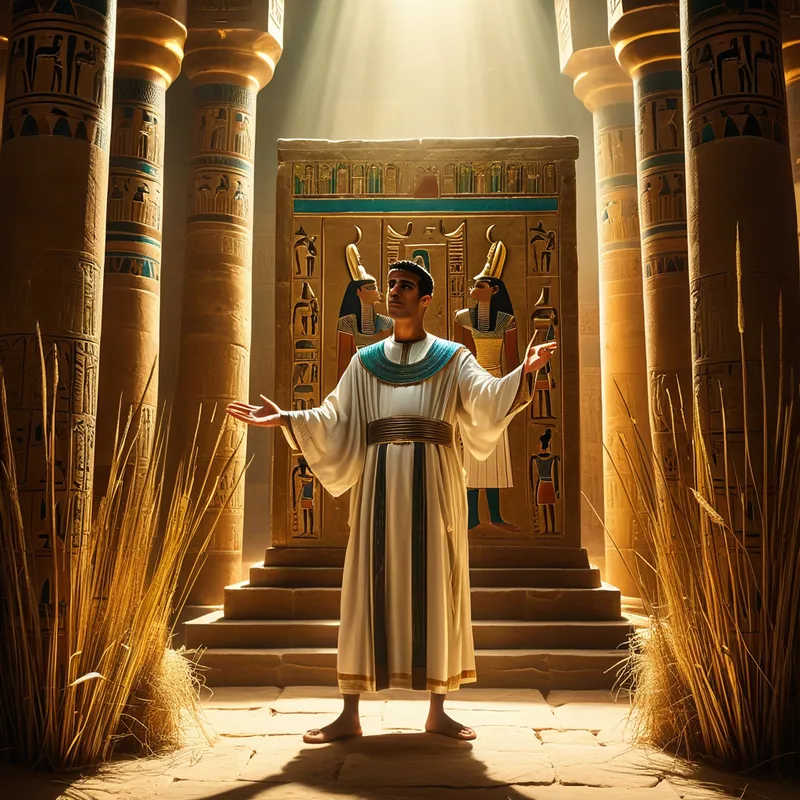
Brought from the pit to the palace, Joseph stood, not as a slave, but as a vessel. He did not claim the power as his own. "It is not in me," he said. "Elohim will give Pharaoh a reply of peace." And he spoke: The two dreams are one. Seven years of abundance, a flood of grain from the earth's womb, are coming. They will be followed by seven years of famine, a breath so hot it will scorch the memory of plenty from the land. The doubling of the dream means the matter is fixed by the divine, and it will come to pass swiftly.
But he did not stop at the warning. The dream contained its own cure. "Now let Pharaoh select a man discerning and wise," Joseph proclaimed. Let him appoint overseers. Take a fifth of the produce of the seven good years. Gather all the excess food. Store it in granaries under the authority of the city, a hoard against the coming emptiness.
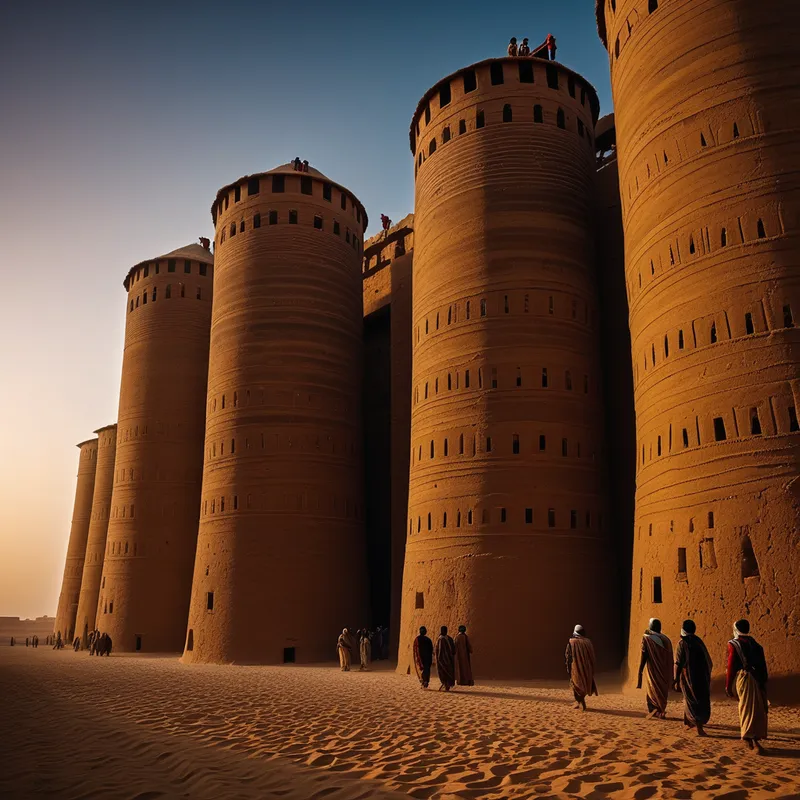
The word became law. Joseph, the dreamer, was robed in fine linen, a gold chain placed around his neck, and set over all the land of Egypt. He became the architect of salvation. For seven years, the earth groaned with bounty. Joseph traversed the cities, building storehouses—vast, silent temples of grain, mountains of sustenance sealed against time. Then the seven years of famine struck, as sure as the dream had foretold. The Nile shrank. The earth cracked its lips. Hunger walked the roads.
But Egypt held life within its man-made mountains. The granaries were opened. The people came, and they were fed. The famine gripped the whole world, but in Egypt, there was bread. The dreamer, once sold for pieces of silver, had become the savior of nations, the steward who turned prophetic dread into the solid, life-giving reality of the granary.
Cultural Origins & Context
This narrative is embedded in the Book of Genesis (Chapters 37, 39-41). It is a foundational story within the Hebrew tradition, part of the epic of the Patriarchs that explains how the Israelites came to dwell in Egypt, setting the stage for the later Exodus. It was an oral tradition long before it was codified in written scripture, told around fires and in tents, a story of how their ancestor's divine favor and wisdom positioned him at the right hand of the world's greatest power.
Societally, it functioned on multiple levels. For a people often on the margins of great empires, it was a story of vindication and elevation, proving that their god's wisdom surpassed that of Pharaoh's court. It also served as a profound theological statement: history is not chaotic; it is guided by a divine providence that communicates through chosen individuals. The myth reinforced values of prudent governance, foresight, and the moral responsibility of power—the ruler as a steward, not just an owner, of the people's survival. It transformed the experience of famine, a common and terrifying reality in the ancient Near East, from a blind force of nature into a challenge that could be met and mastered through wisdom and divinely-inspired preparation.
Symbolic Architecture
At its heart, this is a myth about the translation of the intangible into the tangible, of spirit into matter. Joseph is the archetypal psychopomp of collective crisis. His personal descent into the pit and the prison—the classic "night sea journey"—forges him into a vessel capable of containing and interpreting the terrifying symbols of the collective unconscious, represented by Pharaoh's dreams.
The granary is the solidified dream. It is the conscious structure built to contain the bounty of the fruitful unconscious and to shield against the famine of psychic depletion.
The seven fat and seven lean years symbolize the inevitable cycles of life, psyche, and culture: expansion and contraction, inflation and depression, creativity and sterility. The act of "devouring" in the dream is crucial; the barren does not simply follow the fruitful—it consumes it, suggesting that times of famine can utterly erase the memory and security of former abundance if no mediating consciousness intervenes.
Joseph’s role is that of the interpreting consciousness. He does not prevent the cycle; he prepares for it. He is the ego that heeds the warning from the deeper Self and institutes practical, life-preserving measures. The granaries themselves become a powerful symbol of cultural memory and psychological resilience—a stored reserve of nourishment (both physical and spiritual) that can be drawn upon when the external world, or the inner world, falls fallow.

The Dreamer's Resonance
When this myth stirs in the modern dreamer, it often signals a crucial phase of anticipatory integration. To dream of vast storehouses, of filling silos, or of preparing for a looming, undefined hardship is not necessarily literal. It points to a somatic and psychological process of gathering one's resources.
The psyche is sensing a coming "famine"—a period of emotional drought, creative exhaustion, financial strain, or relational hardship. The dream is the Pharaoh's nightmare, a somatic anxiety from the depths. The dreaming ego's task is to become Joseph: to recognize the pattern, to interpret the warning not as paralyzing dread, but as a call to action. This process might manifest as a sudden urge to save money, to consolidate learning, to strengthen social bonds, or to build healthier habits before a crisis hits. It is the psyche's innate wisdom attempting to initiate a program of resilience, urging the conscious self to build its inner granaries—stores of self-knowledge, coping skills, and supportive structures—against future seasons of scarcity.

Alchemical Translation
The alchemical journey of this myth is a masterclass in individuation. The prima materia is the raw, terrifying dream-image—the devouring cows, the blighted grain. This is the nigredo, the blackening, the initial state of chaotic, frightening potential. Joseph's interpretation is the albedo, the whitening, where meaning is extracted and clarity emerges from the murk.
The true alchemical gold is not the grain, but the foresight itself—the transformed consciousness that can hold the tension of opposites (plenty/famine) without being destroyed by it.
The building of the granaries represents the citrinitas, the yellowing, where insight is applied and given form. It is the embodiment of the transcendent function—the creation of a new, third position (the stored reserve) that was not present in the original dichotomy of fat versus lean. Finally, the distribution of the grain in famine is the rubedo, the reddening, the culmination where the inner work sustains the whole being (or the collective) through the trial.
For the modern individual, this models the process of psychic transmutation. We all receive "dreams"—intuitions, anxieties, premonitions of life's cycles. The immature ego ignores them or is paralyzed by fear. The individuating ego does the work of Joseph: it descends into the material (faces the anxiety), interprets it (seeks its meaning), and then builds the internal and external structures (habits, boundaries, skills, savings) that allow it to navigate the inevitable lean years not as a victim, but as a steward of its own destiny. We become, in our own small kingdoms, the discerning and wise ruler, transforming prophetic dread into enduring substance.
Associated Symbols
Explore related symbols from the CaleaDream lexicon: