
Joseph Myth Meaning & Symbolism
A favored son, betrayed and enslaved, rises through dream interpretation to become the savior of nations, embodying the alchemy of suffering into wisdom.
The Tale of Joseph
Listen, and hear the tale of the dreamer. In the land of Canaan, under a sky heavy with promise and jealousy, lived a father, Jacob, whose heart held a secret chamber for one son above his eleven others. This was Joseph, born of Rachel, the beloved. For him, Jacob wove a garment—a coat of many colors—a banner of favor that cast a long, divisive shadow over the dusty fields.
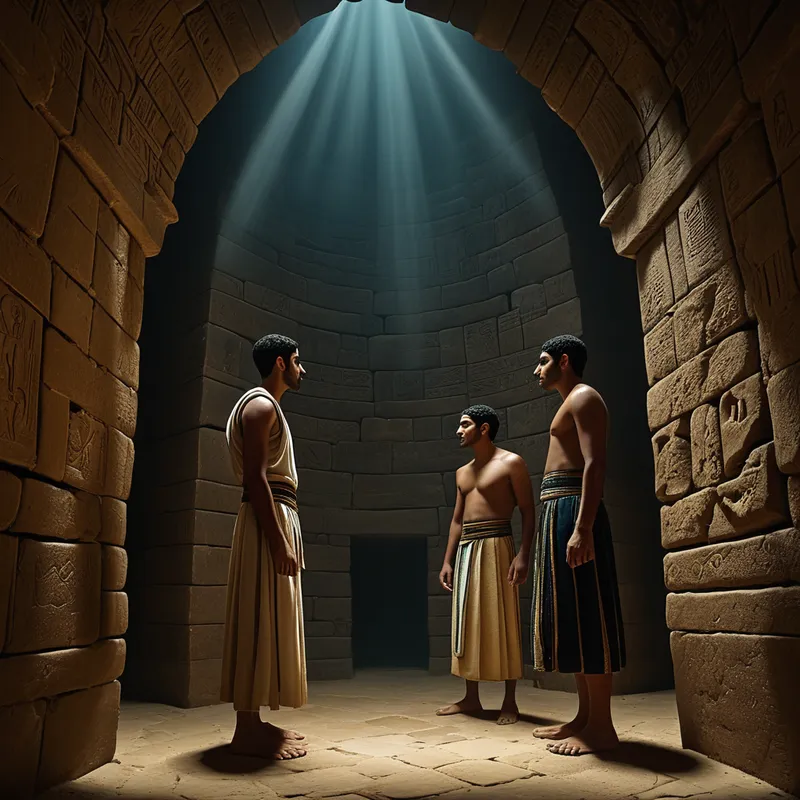
Joseph dreamed. In his sleep, he saw sheaves of grain in the field; his sheaf stood upright while his brothers’ sheaves circled and bowed. He saw the sun, the moon, and eleven stars bowing down to him. He spoke these visions aloud, and the words were like sparks on dry tinder. The jealousy of his brothers curdled into a murderous plot. “Here comes the dreamer!” they snarled, stripping him of the hated coat and casting him into a dark, empty cistern—a pit of echoing despair. The taste of dust and the cold of the stone were his only companions.
But commerce overrode murder. He was hauled up and sold to a caravan of Ishmaelites, his price twenty pieces of silver. The coat, dipped in goat’s blood, was delivered to his grieving father, a false shroud for a living son. Thus Joseph descended—from favored son to slave in the house of Potiphar in mighty Egypt. Yet even in bondage, the divine spark within him made him prosper. Until Potiphar’s wife, scorned in her advance, clutched his garment as evidence of a crime he did not commit. From the steward’s house to the king’s prison, Joseph descended further still, into the granite belly of the state.
In the dungeon, his gift persisted. He listened to the troubled dreams of Pharaoh’s imprisoned cupbearer and baker, interpreting symbols of vine and basket. “In three days,” he said, one would be restored, the other hanged. It came to pass, but the cupbearer forgot him. Two long years passed in the silence of oblivion.
Then, a rupture in the world. Pharaoh dreamed. Seven fat cows devoured by seven gaunt ones. Seven plump ears of grain consumed by seven thin, blighted ones. The court magicians were mute. Then, the cupbearer remembered the Hebrew in the dungeon. Summoned, shaved, and changed, Joseph stood before the golden throne. “It is not in me,” he said, “God will give Pharaoh a favorable answer.” The dreams were one: seven years of staggering abundance, followed by seven years of famine that would swallow the land whole. He offered more than interpretation; he offered a plan—a strategy of storage and stewardship.
Pharaoh saw the spirit of the gods within him. The slave, the prisoner, was elevated in an instant. The signet ring was placed on his finger, robes of fine linen on his shoulders, a gold chain around his neck. He was given the name Zaphenath-paneah and made vizier over all Egypt. He stored grain like a dragon hoarding gold, and when the famine gripped the world, the nations came to Egypt, to Joseph, to bow. Among them, unrecognized at first, came his ten brothers, desperate for food. The dreamer beheld the fulfillment of his youthful visions. After a masterful drama of testing and concealed identity, he revealed himself: “I am Joseph, your brother, whom you sold into Egypt. Do not be distressed… for God sent me before you to preserve life.” The family was reunited, the father brought down to Goshen, and a people were saved from extinction. The boy who dreamed of stars became the man who stewarded the fate of empires.
Cultural Origins & Context
The Joseph narrative forms a critical bridge in the Torah (Genesis 37–50), linking the patriarchal stories of Abraham, Isaac, and Jacob to the national epic of the Exodus. It is a literary masterpiece of the Biblical tradition, likely refined during the monarchic or exilic periods as a profound meditation on diaspora, providence, and identity. Unlike earlier patriarchal cycles, it is a sustained, novelistic tale, likely passed down and honed by storytellers and scribes to address a core question for a people often at the mercy of greater powers: How can we understand suffering and displacement not as meaningless chaos, but as part of a larger, inscrutable pattern?
Its societal function was multifaceted. For a nation in exile, it was a story of hope and high status in a foreign court. It provided an etiology for the Israelite presence in Egypt, setting the stage for the Exodus. Most importantly, it introduced the potent theological concept of divine providence working through human malice and fragile circumstance—a sophisticated move from a deity who intervenes directly to one who works in the shadows of history and the human heart.
Symbolic Architecture
At its core, Joseph’s myth is an archetypal map of the development of consciousness. The Coat of Many Colors represents the nascent, undifferentiated Self in its initial, privileged state. It is a gift, but one unearned and flaunted, provoking the “brotherhood” of the unconscious psyche—the shadow aspects—to revolt.
The pit and the prison are not interruptions of the path; they are the path. They are the alchemical vas where the raw ore of talent is separated from the dross of naive ego.
His two great trials—Potiphar’s wife and the forgotten promise of the cupbearer—are initiations into the mysteries of embodied instinct and the crushing reality of time. He learns to resist the seduction of a shortcut to power (through Potiphar’s wife) and to endure the agony of hope deferred. His gift, dream interpretation, symbolizes the ability to translate the symbolic language of the unconscious—the Self—into conscious, actionable insight. He does not just have dreams; he becomes a vessel for making meaning out of dreams, for others and for a nation.
His rise to power as Zaphenath-paneah signifies the ultimate integration. The dreamer is not consumed by his inner world but becomes its masterful administrator in the outer world. He builds granaries—structures of consciousness—to contain the abundance of the fruitful years (insight) to survive the famine of meaning (aridity, depression, crisis). When his brothers bow, it is not a victory of vengeance but of recognition: the once-rejected, special consciousness is now acknowledged as the necessary, saving center.

The Dreamer's Resonance
When this myth stirs in the modern psyche, it often manifests in dreams of dramatic reversal: dreams of being falsely accused, of falling from a height into a confined space (the pit), or of suddenly being elevated to a position of great responsibility for which one feels unprepared. One might dream of a cherished, colorful object being stolen or destroyed, or of interpreting a cryptic text or image for a powerful, anonymous authority.
Somatically, this can feel like a tightening in the gut—the visceral memory of betrayal—or a sudden, expansive lightness in the chest, the shock of unexpected vindication. Psychologically, the dreamer is navigating the painful but necessary death of a favored self-image. They are in the process of having their innate gifts—their “colorful coat”—stripped away by life’s circumstances, not to destroy the gift, but to force it to root itself in something deeper than parental favor or naive talent. It is the psyche’s initiation into resilience, where one’s core identity must be forged in the dungeon of hardship, not in the sunshine of easy approval.

Alchemical Translation
The Joseph story is a perfect allegory for the Jungian process of individuation—the psychic transmutation of the lead of suffering into the gold of wisdom and wholeness.
- Calcinatio (The Burning of the Old Self): The betrayal by his brothers and the loss of his coat is the burning away of his inherited, tribal identity. His value is no longer in being Jacob’s favorite, but in his own being.
- Solutio (Dissolution in the Waters of the Unconscious): His descent into Egypt, the land of the Nile, and into the prison, is a dissolution. He is stripped of status, family, and freedom, immersed in the chaotic, fertile waters of the unknown.
- Coagulatio (Formation of a New Substance): In the dungeon, he practices his art. He gives form (interpretation) to the formless (dreams). This is the slow, patient work of making meaning in the dark, forming a new, resilient ego-structure based on service and skill, not privilege.
- Sublimatio (Elevation and Spiritualization): His sudden elevation to vizier is the sublimation. The insight honed in the depths is now raised to the highest place of practical application. He becomes the conscious steward of the kingdom’s unconscious abundance (the grain).
- Coniunctio (The Sacred Reunion): The final, tearful reconciliation with his brothers is the coniunctio oppositorum—the union of opposites. The conscious ego (Joseph) embraces the shadow (the brothers). The once-rejected part of the self is integrated, not as a threat, but as a necessary component of the whole. The dreamer saves the dreamers who tried to kill him.
The ultimate alchemy is not Joseph ruling Egypt, but Joseph weeping on his brother Benjamin’s neck. The triumph of the psyche is not in transcending the family of origin, but in redeeming it, thus ending the cycle of envy and completing the great work.
For the modern individual, the myth instructs: your deepest wounds and betrayals are the very pits from which your unique destiny will be hauled. Do not abandon your dreams in the face of envy or prison walls. Learn their language. Your gift, however nascent and irritating to others, is needed not for your glory alone, but for the preservation of life in a world perpetually threatened by famine of spirit. You must be sold into Egypt to become its savior.
Associated Symbols
Explore related symbols from the CaleaDream lexicon: