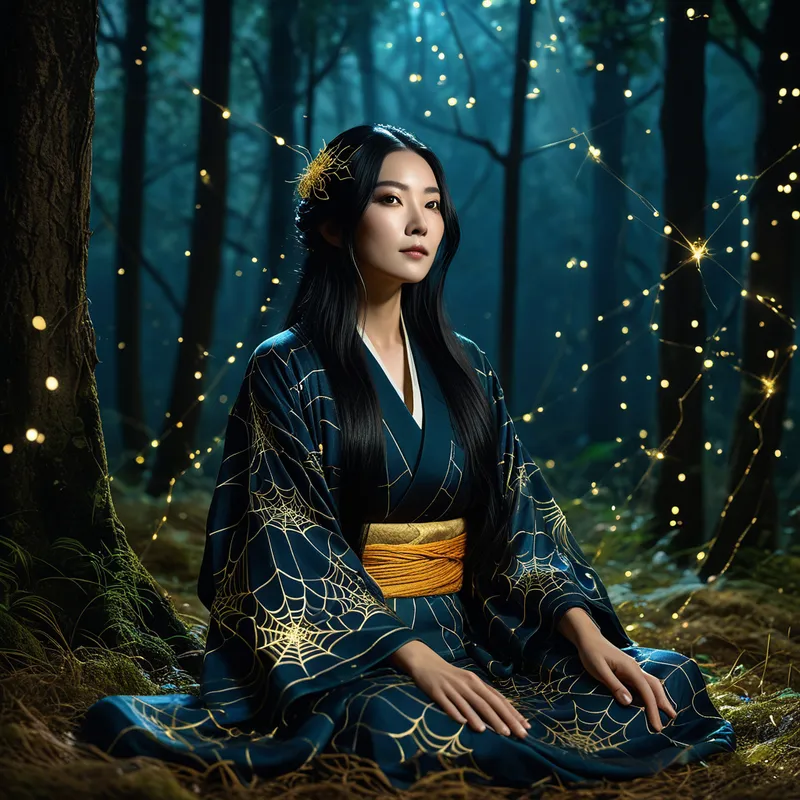
Jorōgumo Myth Meaning & Symbolism
A yōkai spider-woman who weaves illusions of love to ensnare travelers, revealing the perilous allure of the wild and the shadow of desire.
The Tale of Jorōgumo
Listen, and let the mountain mist carry you back. To a time when the old forests of Japan held their breath, where shadows pooled deep and the line between root and rock, woman and wild, was as thin as a single strand of silk.
A traveler walks the mountain pass as dusk bleeds into violet night. He is weary, a man of the world—a samurai perhaps, or a merchant—his mind on warm sake and a soft bed in the village below. A flicker of light catches his eye, a soft glow deep within the cedar grove. Curiosity, that old serpent, stirs. He follows, pushing aside damp ferns, until he finds a small, exquisite house he is certain was not there yesterday.
In the doorway stands a vision. A woman of impossible beauty, her skin pale as moonlight on river stones, her hair a cascade of night. She wears a kimono of such fine silk it seems woven from cloud and shadow, patterned with subtle, spiraling designs. Her eyes are deep pools of knowing. She is alone, she says, and the night is cold and dangerous. Would he honor her with his company? Just until dawn.
The fire in her hearth is warm. The tea she pours is fragrant, steaming. Her voice is a melody that soothes the ache from his bones. She speaks of poetry, of loneliness, of the long, silent years. He is enchanted, captivated. The world outside—the muddy road, his duties, his name—all dissolve like sugar in her tea. She leans closer. The scent of her is night-blooming flowers and ancient, damp earth. He feels a gentle touch on his wrist, like the brush of a moth's wing, but strangely sticky.
As the night deepens, a faint, rhythmic sound begins, a soft shhh-shhh-shhh from the shadows behind her screen. A loom, she smiles, her work is never done. He nods, his eyelids heavy. He tries to raise his cup but finds his arm slow to respond. A gossamer thread, nearly invisible, stretches from his sleeve to the tatami mat. He blinks, looks down. More threads, fine as a breath, bind his legs to the floor.
His gaze snaps to the woman. Her beautiful face is placid, but her eyes now reflect the firelight not with warmth, but with a cold, multifaceted gleam. The shhh-shhh-shhh grows louder, faster, not the sound of a loom, but of many legs skittering across wood. From the darkness behind her, long, jointed limbs of polished black chitin slowly unfold. The beautiful kimono falls away, not to skin, but to the swollen, patterned abdomen of a spider larger than a man. The yōkai reveals herself. She is Jorōgumo. And he is not a guest, but a fly, already caught in the web he was too blind to see.

Cultural Origins & Context
The myth of the Jorōgumo is a creature of the Edo period (1603-1868), born from the specific anxieties and storytelling traditions of that time. As travel became more common along the mountainous Gokaidō routes, so too did tales of the perils that awaited the lonely wayfarer. These stories were told in whispered warnings at roadside inns, enacted in kabuki plays, and immortalized in woodblock prints by artists like Utagawa Kuniyoshi.
The Jorōgumo is a classic hengeyōkai, but her origins are distinctly ecological. She is said to be a spider—often the large, striking jorō-gumo—that has lived for 400 years, accruing magical power and the wisdom to take a woman's form. This reflects a deep, animistic layer of Japanese spirituality, where any being, through age and presence, could accumulate a spirit (tama) and agency.
Societally, the myth functioned as a potent cautionary tale. It warned of the literal dangers of remote places, but also of more intimate perils: the seductive stranger, the too-convenient shelter, the allure that distracts from one's path. For a culture with strict social hierarchies and codes of conduct, the Jorōgumo represented the terrifying, attractive chaos that existed beyond the village borders and social contracts—the wild that could mimic civilization to consume it.
Symbolic Architecture
At its core, the Jorōgumo myth is an encounter with the Anima in its most devouring aspect. She is not the inspiring muse or the comforting soul-image, but the Anima as a fatal enchantress, the psychic force that can lure consciousness away from its purpose and into a state of passive, blissful oblivion.
The web is not spun in the dark forest, but in the twilight of the traveler's own awareness, woven from the threads of his unexamined longing.
Her dual nature—the breathtaking beauty and the monstrous predator—symbolizes the fundamental duality of nature itself: creative and destructive, nourishing and consuming, all within the same entity. The house that appears where none should be represents the illusion, the maya, that the unconscious can construct to suit our deepest, laziest desires. The sticky silk is the gradual, often imperceptible, binding power of a complex, an obsession, or a comforting delusion that first soothes, then paralyzes.
The spider, a universal symbol of fate-weaving and patient predation, deepens this. The Jorōgumo does not attack; she invites. The victim actively walks into the web, complicit in his own ensnarement through his desire for comfort, beauty, and respite from his journey.

The Dreamer's Resonance
When the pattern of the Jorōgumo stirs in modern dreams, it rarely appears as a literal spider-woman. Instead, the dreamer may find themselves in a beautifully appointed but subtly wrong room, feeling a growing, paralyzing comfort. They may dream of a captivating but elusive lover whose touch feels strangely cold or binding, or of being wrapped in luxurious fabrics that slowly tighten.
Somatically, this dream points to a process of enchantment and immobilization. The psyche is signaling that a part of the dreamer's life energy—their will, their direction, their vitality—is being seduced and bound by an alluring but ultimately devouring complex. This could be a relationship that consumes identity, a career path that offers prestige but drains the soul, or an addiction that promises solace but delivers stagnation. The feeling upon waking is often one of vague unease, a sense of being "stuck" or "trapped" in a situation that, on the surface, appears desirable.
The dream is a call to vigilance, to feel for the first, faint threads of adhesion. Where in your waking life are you ignoring the soft shhh-shhh-shhh of something spinning in the shadows of your choices?

Alchemical Translation
The alchemical journey modeled by the Jorōgumo myth is not one of slaying the monster, but of seeing the web. The triumph is in the moment of horrific recognition—when the traveler feels the first thread and looks into the beloved's eyes to see the alien gleam. This is the nigredo, the blackening, the crushing disillusionment that is the necessary beginning of all true transformation.
Individuation requires the courage to spit out the poisoned honey and see the mandibles in the smile.
The process involves withdrawing the projection of the soul-image from the external situation or person that has ensnared us. We must recognize that the captivating beauty and the terrifying predator are two aspects of the same inner reality—our own capacity for creating beautiful prisons out of our unmet needs and fears. The "samurai" must use his sword of discrimination not on the spider, but on the silken bonds themselves, cutting through the illusion of passive comfort.
The ultimate alchemical goal is not to destroy the spider, but to integrate its wisdom. The Jorōgumo is a master weaver, an agent of the deepest, most instinctual layers of the psyche. The integrated lesson is to learn to weave our own destiny with similar patience and artistry, but consciously—to build a home that is not a lure for others, but a true sanctuary for the self, and to walk the mountain path with an awareness that makes us immune to the false lights of our own unconscious traps. We must become weavers, not flies.
Associated Symbols
Explore related symbols from the CaleaDream lexicon: