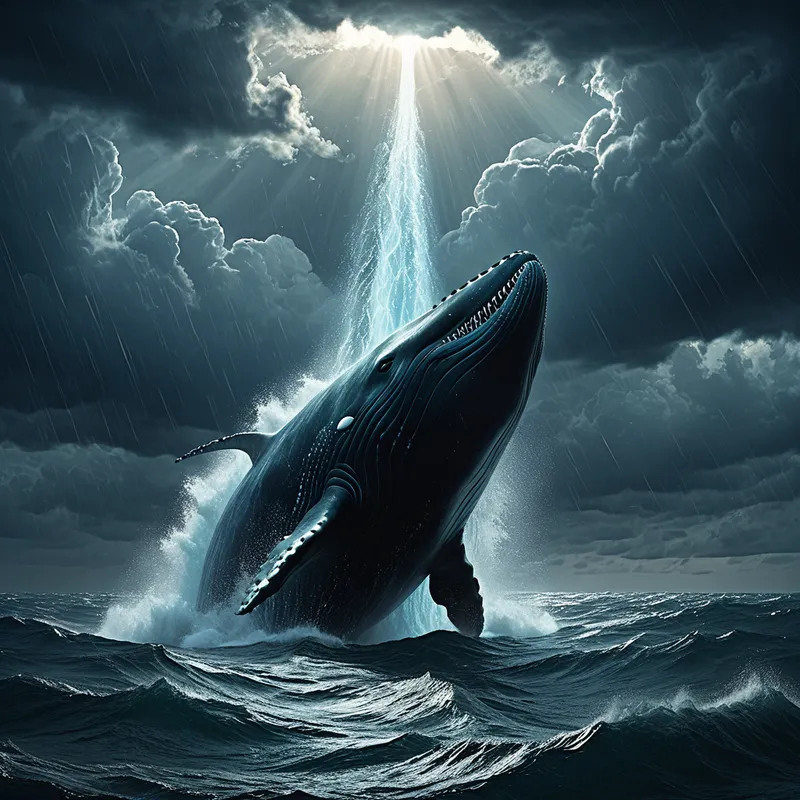
Jonah and the Whale Myth Meaning & Symbolism
A prophet flees his divine calling, is swallowed by a great fish, and emerges transformed, embodying the universal ordeal of descent and return.
The Tale of Jonah and the Whale
Hear now the tale of the one who ran from the voice of [the sky](/myths/the-sky “Myth from Persian culture.”/). In the days when kings held scepters and prophets held truth, there lived a man named [Jonah](/myths/jonah “Myth from Christian culture.”/), son of Amittai. [The word](/myths/the-word “Myth from Biblical culture.”/) of Yahweh came to him, a sound like thunder in the bones: “Arise, go to Nineveh, that great city, and cry out against it, for its evil has risen up before me.”
But Jonah’s heart turned to stone. Nineveh was the jewel of the enemy, a nest of cruelty. To warn them was to offer mercy, and Jonah desired [justice](/myths/justice “Myth from Tarot culture.”/), a cleansing fire. So he turned his face from the east and fled toward the west, to the very edge of the known world. He found a ship at Joppa bound for Tarshish, paying his fare to sail away from the presence of Yahweh.
Yet the One who spoke is the One who stirs [the sea](/myths/the-sea “Myth from Greek culture.”/). As the ship carved through the waves, Yahweh hurled a great wind upon the waters. A storm awoke, not of clouds and rain, but of primal chaos. The sea roared, the ship groaned, timbers screaming as it was tossed like a walnut shell. The seasoned sailors, faces pale with a terror deeper than any squall, cried each to his own god and cast the cargo into the raging deep to lighten the ship. And Jonah? He had gone down into the inner recesses of the ship, lay down, and fell into a deep, stubborn sleep.
The captain found him, shook him awake. “What do you mean, sleeper? Arise, call on your god!” The sailors cast lots to find on whose account this calamity had come, and the lot fell on Jonah. “Tell us,” they demanded, [the wind](/myths/the-wind “Myth from Various culture.”/) whipping their words. “What is your occupation? And where do you come from?”
“I am a Hebrew,” Jonah confessed, his voice barely audible over the gale. “And I fear Yahweh, the God of heaven, who made the sea and the dry land.” He told them he was fleeing. A greater terror seized the men. “What shall we do to you that the sea may quiet down for us?”
“Pick me up and hurl me into the sea,” Jonah said, the words heavy with a fate he now accepted. “Then the sea will become calm for you, for I know it is because of me that this great tempest has come upon you.”
The men rowed harder, straining to bring the ship to land, but the sea grew more violent. Seeing no escape, they cried out to Yahweh, “Please, do not let us perish on account of this man’s life!” Then they took Jonah and threw him into the heart of the storm.
The moment he hit the churning [water](/myths/water “Myth from Chinese culture.”/), the sea stilled. A great calm fell. And Yahweh appointed a great fish to swallow Jonah. Down, down he went, into the living darkness. Not into death, but into a stranger fate: the belly of the beast. For three days and three nights, Jonah was in the belly of the fish, in a tomb of salt and sinew.
And there, in that absolute interior, pressed on all sides by the rhythm of a heart not his own, Jonah prayed. From the belly of Sheol he cried out. He remembered Yahweh. His prayer rose like a bubble from the deep. And Yahweh spoke to the fish, and it vomited Jonah out upon the dry land.
The word of Yahweh came to Jonah a second time. “Arise, go to Nineveh.” And Jonah arose and went, a man remade in the dark. He entered the vast city, a day’s journey in, and cried out, “Yet forty days, and Nineveh shall be overthrown!” The people believed. From the greatest to the least, they put on sackcloth and fasted. The king rose from his throne, covered himself in sackcloth, and sat in ashes. A decree went out: let every man and beast turn from his evil way and from the violence in his hands.
God saw their works, that they turned from their evil way, and God relented of the disaster he had said he would bring upon them.
And Jonah? He was exceedingly displeased, and he was angry. He built a booth east of the city and sat under its shade, waiting to see what would become of the city. Yahweh caused a plant to grow up over him to shade his head, and Jonah was glad. But at dawn the next day, God appointed a worm that attacked the plant, so that it withered. When the sun rose, God appointed a scorching east wind, and the sun beat down on Jonah’s head until he grew faint and asked that he might die.
Yahweh said to him, “You pity the plant, for which you did not labor, nor did you make it grow. Should I not pity Nineveh, that great city, in which there are more than 120,000 persons who do not know their right hand from their left, and also much cattle?”
The story ends there, with the question hanging in the air, and Jonah silent in the heat.

Cultural Origins & Context
The Book of Jonah is a unique work within the Hebrew Bible. Unlike the historical chronicles of kings or the oracles of other prophets, it is a finely crafted narrative, a theological novella. Scholars place its final composition in the post-exilic period (5th-4th centuries BCE), a time when Jewish identity was being reforged after the trauma of the Babylonian exile. The story, however, likely draws on much older traditions and motifs.
Its societal function was profound and subversive. It was told not merely as history but as a prophetic parable. At its heart, it confronts the tension between particularism (God of Israel) and universalism (God of all creation). The audience, rebuilding a small, vulnerable community in Judah, would have instinctively identified with Jonah’s hatred for the brutal Assyrian empire of old. The story shocks them by having their God show compassion to the archetypal enemy. It critiques religious nationalism and narrow righteousness, expanding the concept of divine mercy beyond tribal boundaries. The prophet himself becomes an anti-hero, a vessel through which God’s true, unsettling character is revealed.
Symbolic Architecture
The myth is a masterwork of symbolic descent. Jonah is not just a man but the personification of the resistant ego, the part of us that knows its calling and flees from it. His [flight](/symbols/flight “Symbol: Flight symbolizes freedom, escape, and the pursuit of one’s aspirations, reflecting a desire to transcend limitations.”/) to Tarshish is a [movement](/symbols/movement “Symbol: Movement symbolizes change, progress, and the dynamics of personal growth, reflecting an individual’s desire or need to transform their circumstances.”/) toward the literal and psychological “west,” the place of [sunset](/symbols/sunset “Symbol: A sunset symbolizes the end of a cycle, transition, and often the beauty found in change and closure.”/), of unconsciousness, and of forgetting.
The storm is not punishment, but the psyche’s necessary chaos, summoned to halt a life lived in opposition to its own deepest truth.
The great fish is the central [mystery](/symbols/mystery “Symbol: An enigmatic, unresolved element that invites curiosity and exploration, often representing the unknown or hidden aspects of existence.”/). It is not a [monster](/symbols/monster “Symbol: Monsters in dreams often symbolize fears, anxieties, or challenges that feel overwhelming.”/) of [punishment](/symbols/punishment “Symbol: A dream symbol representing consequences for actions, often tied to guilt, societal rules, or internal moral conflicts.”/) but an agent of divine grace, a paradoxical [womb](/symbols/womb “Symbol: A symbol of origin, potential, and profound transformation, representing the beginning of life’s journey and the unconscious source of creation.”/)-tomb. It prevents physical [death](/symbols/death “Symbol: Symbolizes transformation, endings, and new beginnings; often associated with fear of the unknown.”/) by enacting a symbolic one. The three days in the belly mirror the [night](/symbols/night “Symbol: Night often symbolizes the unconscious, mystery, and the unknown, representing the realm of dreams and intuition.”/) sea [journey](/symbols/journey “Symbol: A journey in dreams typically signifies adventure, growth, or a significant life transition.”/), a universal [motif](/symbols/motif “Symbol: A recurring thematic element, pattern, or design in artistic or musical works, representing underlying ideas or emotional currents.”/) of [incubation](/symbols/incubation “Symbol: A period of internal development, rest, or hidden growth before emergence, often associated with healing, creativity, or transformation.”/) and [rebirth](/symbols/rebirth “Symbol: A profound transformation where old aspects of self or life die, making way for new beginnings, growth, and renewal.”/). This is not a digestive tract but a liminal [space](/symbols/space “Symbol: Dreaming of ‘Space’ often symbolizes the vastness of potential, personal freedom, or feelings of isolation and exploration in one’s life.”/), the Tehom (the Deep) made personal. Here, the defiant ego is dissolved, stripped of its grand projects of flight, forced into a state of utter dependency where the only [action](/symbols/action “Symbol: Action in dreams represents the drive for agency, motivation, and the ability to take control of situations in waking life.”/) possible is [prayer](/symbols/prayer “Symbol: Prayer represents communication with the divine or a higher power, often reflecting inner desires and spiritual needs.”/)—the re-establishment of the severed [connection](/symbols/connection “Symbol: Connection symbolizes relationships, communication, and bonds among individuals.”/).
Nineveh represents the [shadow](/symbols/shadow “Symbol: The ‘shadow’ embodies the unconscious, repressed aspects of the self and often represents fears or hidden emotions.”/), the rejected, “evil” part of [the world](/myths/the-world “Myth from Tarot culture.”/) (and of [the self](/myths/the-self “Myth from Jungian culture.”/)) that the conscious ego wishes to condemn and destroy. Jonah’s ultimate anger at God’s mercy reveals the [story](/symbols/story “Symbol: The symbol of ‘Story’ represents the narrative woven through our lives, embodying experiences, lessons, and emotions that shape our identities.”/)’s deepest cut: the struggle to accept that love and transformation are available even to what we most despise.

The Dreamer’s Resonance
When this myth appears in modern dreams, it signals a profound somatic and psychological process of containment and enforced introspection. To dream of being swallowed by a whale or a large creature is not necessarily a nightmare of predation. It often coincides with life periods where one feels consumed by a situation—a job, a relationship, a depression, an illness.
The dreamer is in the belly of the fish. Psychologically, this is a state where the usual avenues of escape and action (the ship to Tarshish) have been closed off. [The ego](/myths/the-ego “Myth from Jungian culture.”/) is submerged in the unconscious. The somatic feeling is one of pressure, constriction, and a strange, rhythmic safety—the heartbeat of a process larger than oneself. It is a dream of necessary incubation. The [psyche](/myths/psyche “Myth from Greek culture.”/) has orchestrated a crisis (the storm) to force a halt, and has provided a living container (the fish) to hold the dreamer while a vital, unwanted transformation occurs. The dream may feel claustrophobic, but its purpose is protective: to prevent a literal shipwreck of the personality by facilitating a symbolic death and rebirth.

Alchemical Translation
The alchemy of Jonah models the individuation process with stark clarity. The [Nigredo](/myths/nigredo “Myth from Alchemical culture.”/) is his flight and the storm—the conscious life falling into contradiction and chaos. The call to Nineveh is the call of the Self, the total, integrated psyche. The ego (Jonah) refuses, preferring its own limited sense of justice and identity.
The swallowing is the crucial [Putrefactio](/myths/putrefactio “Myth from Alchemical culture.”/). The ego is sealed in the [vas hermeticum](/myths/vas-hermeticum “Myth from Alchemical culture.”/) of the fish’s belly. Here, in the dark, all former certainties are dissolved. This is not a passive waiting but an active, if agonizing, fermentation. His prayer is the first stirring of the new connection, the anima media natura reaching toward the source.
The vomiting onto dry land is the Albedo—the dawn of a new consciousness. The ego re-emerges, but it is no longer the same. It has been humbled, stripped of its absolute authority, and made porous to a will greater than its own.
He now goes to Nineveh, but the final stage, the [Rubedo](/myths/rubedo “Myth from Alchemical culture.”/), is not his [triumph](/myths/triumph “Myth from Roman culture.”/) but his failure. His angry, petty reaction to the plant’s death reveals the last vestige of the old, self-centered ego. God’s final question is the alchemical gold: the realization that the process of transformation is never just for the individual. True individuation breaks the heart open to the suffering of the “other,” to the Nineveh within and without. The work is complete not when the prophet is successful, but when he is confronted with the boundless, inconvenient compassion of the Self, and must sit, silent, in its unbearable heat, beginning the work of integration anew.
Associated Symbols
Explore related symbols from the CaleaDream lexicon: