Job's Sores Myth Meaning & Symbolism
A righteous man is stripped of everything and afflicted with agonizing sores, becoming a living testament to the mystery of undeserved suffering.
The Tale of Job's Sores
Hear now a tale from the land of Uz, of a man whose name was a byword for integrity. Job. Blameless, upright, a man who turned from evil. His flocks darkened the hillsides; his children feasted in his halls. He was a pillar of the earth, and his piety was a sweet smoke upon the altar of heaven.
In the council of the sons of God, the YHWH pointed to his servant Job upon the earth. But another was there, the Ha-Satan, who walks to and fro upon it. "Does Job fear God for nothing?" the Accuser hissed. "You have built a hedge around him. But stretch out your hand, touch all that he has, and he will curse you to your face."
A divine wager was struck. "All that he has is in your power," said the Voice, "only do not lay a hand on his person."
Then the whirlwind of loss began. Raiders took his oxen and donkeys. Fire from heaven consumed his sheep. Chaldeans stole his camels. A great wind struck the house where his children feasted, and it fell. In a single day, the pillar was stripped bare. Job arose, tore his robe, shaved his head, and fell to the ground. "Naked I came from my mother's womb," he whispered into the dust, "and naked I shall return. YHWH gave, and YHWH has taken away; blessed be the name of YHWH."
Again in the council, the Accuser spoke. "Skin for skin! A man will give all he has for his life. But stretch out your hand now and touch his bone and his flesh, and he will curse you to your face."
"Behold, he is in your power," came the reply, "only spare his life."
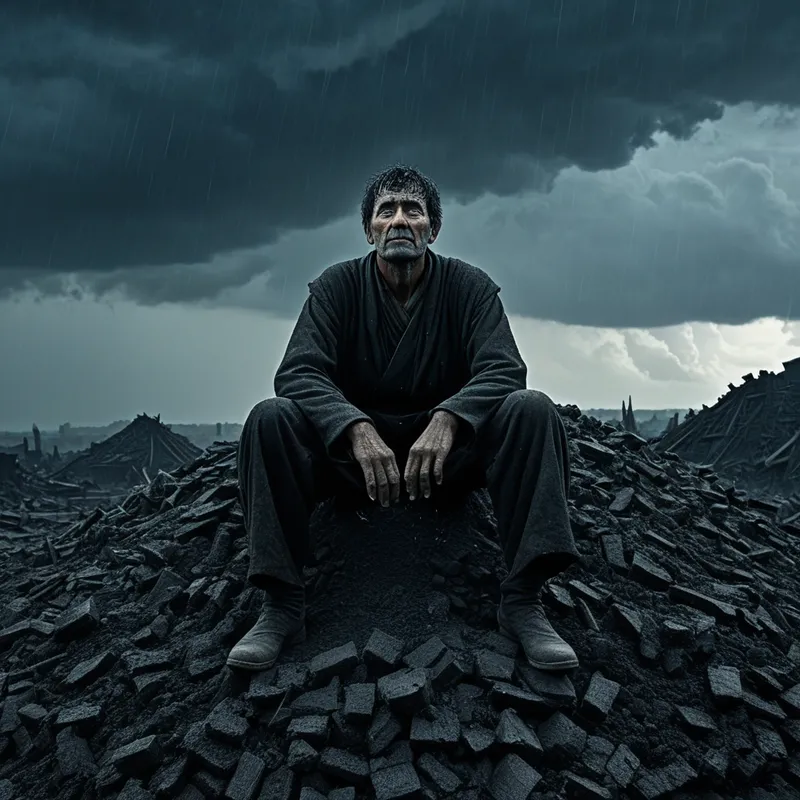
Then the Accuser went out and struck Job with loathsome sores from the sole of his foot to the crown of his head. Job took a potsherd to scrape himself as he sat among the ashes, the dust of his former life now his only throne. His wife, witnessing the ruin of flesh and fortune, could bear it no longer. "Do you still hold fast your integrity?" she cried. "Curse God and die!"
But Job looked at her from his throne of ashes, his body a map of agony. "You speak as one of the foolish women speaks," he said, his voice a dry wind. "Shall we receive good from God, and shall we not receive adversity?" In all this, Job did not sin with his lips.
His three friends came—Eliphaz, Bildad, and Zophar. They did not recognize the ruin before them. For seven days and seven nights, they sat with him in the dust, and no one spoke a word, for they saw that his suffering was very great. And the silence was the last mercy he would know from them.
Cultural Origins & Context
The Book of Job is a profound anomaly within the Torah and the wider wisdom literature of the ancient Near East. It is not a historical record but a sophisticated poetic and philosophical drama, likely composed during or after the Babylonian Exile (6th century BCE), a period of national trauma that forced a radical questioning of traditional covenant theology. If God rewards the righteous and punishes the wicked, why do the righteous suffer?
The tale of Job’s sores sits at the heart of this theological crucible. It was a story told not to explain suffering, but to dismantle easy explanations. It functioned as a cultural pressure valve, giving voice to the unspeakable experience of innocent agony. The friends represent the orthodox, retributive view of suffering—Job must have sinned. Job’s bodily affliction becomes the undeniable, visceral evidence that challenges this entire worldview. His sores are not a punishment; they are the central mystery.
Symbolic Architecture
Job’s sores are the ultimate symbol of undeserved affliction. They represent the collapse of the transactional worldview, where goodness is rewarded and evil punished. The body, in ancient thought, was the seat of identity and the boundary of the self. To have one’s boundary invaded by festering wounds is to have one’s very selfhood called into question.
The sore is where the soul leaks out, and the world leaks in. It is the puncture in the myth of a just universe.
The Ha-Satan is not a devil in the later Christian sense, but a necessary function of the divine court—the prosecutor, the questioner. He represents the principle of radical doubt, the part of the psyche (and perhaps the cosmos) that insists on testing integrity to its absolute limit, separating faith from mere reward-seeking. The ash heap is the liminal space—neither home nor tomb—where this alchemical testing occurs. The potsherd Job uses to scrape himself is a powerful symbol of using the broken pieces of one’s former life, one’s shattered certainties, to engage with the raw pain of the present.

The Dreamer's Resonance
When this pattern manifests in modern dreams, it rarely appears as literal Biblical sores. Instead, the dreamer may experience dreams of:
- Skin peeling, cracking, or revealing something alien beneath. This somatic signal often accompanies a psychological "shedding" where an old identity or defensive layer is being painfully stripped away, not by personal failure, but by life itself.
- Being publicly exposed while covered in a shameful mark or substance. This reflects the feeling of being unjustly scrutinized or judged (the three friends) for a suffering one did not cause.
- A vital possession (home, vehicle, talisman) crumbling to dust or ash. This is the dream equivalent of the whirlwind of loss, the deconstruction of one’s external supports and securities.
Such dreams indicate a profound process of depotentiation. The ego’s strategies, its carefully built identity as a "good" or "effective" person, are being rendered useless. The dreamer is in the ash heap, scraping at the raw nerve of an existential question: "Who am I when I am not what I have, what I do, or even what I appear to be?"

Alchemical Translation
The myth of Job’s sores models the nigredo of the soul—the blackening, the putrefaction, the darkest night of the psyche. It is the stage in individuation where all conscious attitudes fail. The "deal" we thought we had with life—that if we are good, diligent, or faithful, we will be spared—is revealed as a childish fantasy.
The alchemical fire is not one we choose; it is the fire of the Ha-Satan, the adversarial principle within reality itself that demands authenticity. The sores are the prima materia, the base, suffering matter from which a new consciousness must be born. The process is not about finding a reason for the suffering, but about enduring its mystery without resorting to falsehoods—either the falsehood of self-condemnation (the friends' path) or the falsehood of cursing life itself.
The triumph is not in healing, but in the quality of the cry. Job’s relentless, angry, faithful lament is the alchemical process. He refuses false comfort and holds his agony up to the void, demanding an answer.
The resolution comes not with the removal of the sores, but with a direct, overwhelming encounter with the Mysterium Tremendum itself—the Voice from the Whirlwind. This encounter does not explain the sores; it dwarfs them in a vision of cosmic wildness and creativity. The final healing and restoration are almost an afterthought. The true transmutation is the death of the ego that believed it could comprehend the divine, and the birth of a consciousness that can hold the terrible, beautiful, and ultimately unfathomable tension of existence. The gold produced is not a life free of sores, but a soul that has met its God in the ashes.
Associated Symbols
Explore related symbols from the CaleaDream lexicon: