
Job Myth Meaning & Symbolism
A righteous man is stripped of everything by a divine wager, enduring unimaginable loss to confront the terrifying, untamed face of God.
The Tale of Job
In the land of Uz, there lived a man named Job. He was blameless and upright, one who feared God and turned away from evil. His life was a testament to divine favor: seven sons and three daughters, flocks that numbered beyond counting, and servants as plentiful as the sands. He was the greatest of all the people of the east.
But in the courts of heaven, a conversation unfolded. The ha-satan came among the sons of God. The Lord said to the Accuser, “Have you considered my servant Job? There is none like him on the earth.”
The Accuser’s voice was a dry whisper of cynicism. “Does Job fear God for nothing? Have you not put a hedge around him and his house and all that he has? Stretch out your hand and touch all that he has, and he will curse you to your face.”
And the Lord said, “Behold, all that he has is in your power; only against his person do not stretch out your hand.”
The storm fell swiftly. A messenger, breathless and ash-covered, arrived as Job feasted with his children. “The Sabeans fell upon the oxen and donkeys, and took them away. They struck down the servants with the edge of the sword.” Before he could finish, another came. “Fire from God fell from heaven and burned up the sheep and the servants.” A third, trembling. “The Chaldeans raided the camels and took them.” Then a fourth, his face a mask of horror. “Your sons and daughters were eating and drinking in their eldest brother’s house, and behold, a great wind came across the wilderness and struck the four corners of the house. It fell upon the young people, and they are dead.”
Job arose, tore his robe, shaved his head, and fell to the ground. The dust of the earth filled his mouth. And he said, “Naked I came from my mother’s womb, and naked shall I return. The Lord gave, and the Lord has taken away; blessed be the name of the Lord.”
Again, the Accuser stood before the Lord. “Skin for skin! A man will give all he has for his life. But stretch out your hand and touch his bone and his flesh, and he will curse you to your face.”
“Behold, he is in your hand,” said the Lord, “only spare his life.”
So the Accuser struck Job with loathsome sores from the sole of his foot to the crown of his head. Job took a potsherd to scrape himself, and sat among the ashes.
His wife, her soul a bitter void, said to him, “Do you still hold fast your integrity? Curse God and die.”
But he said to her, “You speak as one of the foolish women speaks. Shall we receive good from God, and shall we not receive evil?”
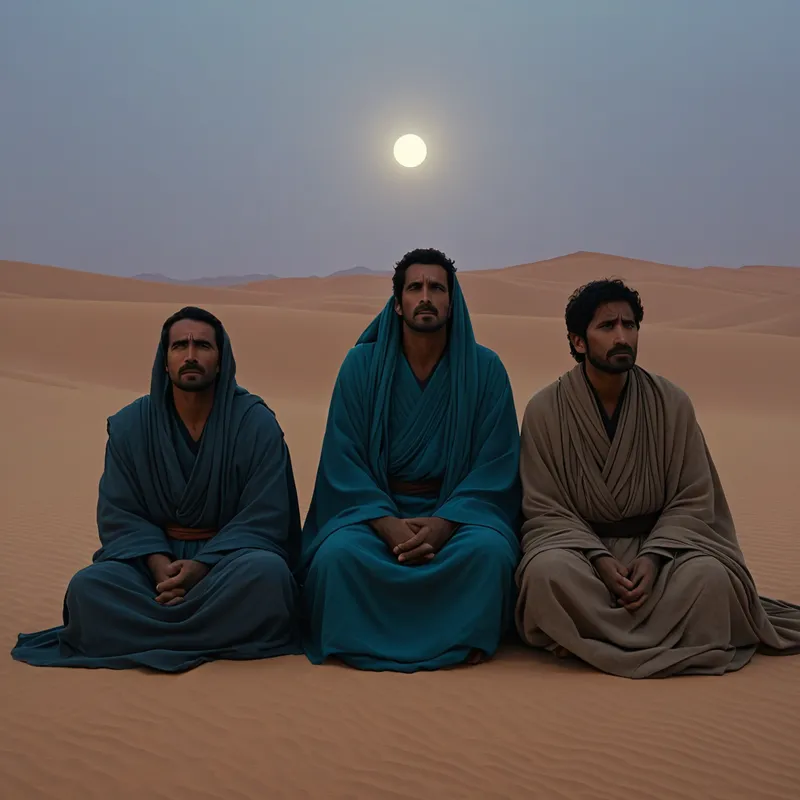
Then came his three friends—Eliphaz the Temanite, Bildad the Shuhite, and Zophar the Naamathite. They saw him from a distance and did not recognize him. They raised their voices and wept; they tore their robes and threw dust in the air. For seven days and seven nights, they sat with him on the ground, and no one spoke a word, for they saw that his suffering was very great.
Then Job opened his mouth and cursed the day of his birth. The great debate began—cycles of poetic anguish and theological certainty. Job cried out to the void, demanding an audience with God, protesting his innocence. His friends, anchored in a world of simple moral arithmetic, insisted he must have sinned, for God does not punish the innocent. The dialogue spiraled into despair.
Finally, from the heart of a whirlwind, a Voice answered. Not with explanations, but with questions that spanned the cosmos. “Where were you when I laid the foundation of the earth?… Can you bind the chains of the Pleiades, or loose the cords of Orion?… Does the hawk soar by your wisdom?”
Job, who had demanded a hearing, was rendered speechless before the terrifying, magnificent, and utterly untamed reality of the Divine. He put his hand over his mouth. “I had heard of you by the hearing of the ear, but now my eye sees you; therefore I despise myself, and repent in dust and ashes.”
And the Lord restored the fortunes of Job, giving him twice what he had before. His brothers and sisters came, and they comforted him. He had seven more sons and three daughters, and he lived to see his descendants to the fourth generation. Job died, an old man, and full of days.
Cultural Origins & Context
The Book of Job is a profound anomaly nestled within the Old Testament. Scholars place its composition between the 6th and 4th centuries BCE, a period of exile and deep theological crisis for Israel. It is not a historical account but a sophisticated wisdom text—a philosophical drama in poetic form. Its author is unknown, a sage who dared to question the dominant Deuteronomic theology of retributive justice.
It was passed down not as simple history, but as a sacred challenge. It functioned as a societal pressure valve, giving voice to the unbearable question that faith, in its darkest hours, must whisper: Why do the righteous suffer? It served to complicate a simplistic worldview, introducing the mystery of divine freedom and the limits of human understanding. It was a text for those whose experience of life no longer matched the tidy formulas of their tradition.
Symbolic Architecture
At its core, Job is not about a test of loyalty, but a demolition of a psychological idol. Job’s initial piety, while genuine, is built upon a transactional relationship with the divine—the hedge, the blessings, the moral contract. The Accuser represents the corrosive truth that such faith may be conditional, a shadow of self-interest.
The true adversary is not suffering, but the comforting, logical, and utterly false theology that seeks to explain it away.
Job’s friends symbolize the collective consciousness, the rigid, dogmatic ego that cannot tolerate ambiguity or mystery. Their “comfort” is a violence of certainty, an attempt to force reality back into a comprehensible box. Job’s physical afflictions represent the somatic reality of psychic rupture—when the foundational myths of the self are shattered, the body itself becomes a site of agony.
The whirlwind theophany is the eruption of the Self into the shattered realm of the ego. It does not answer Job’s “why.” Instead, it expands the “who.” The God who speaks from the storm is not the God of moral ledgers, but the God of Behemoth and Leviathan, of wild stars and untamed creation—a reality vastly more complex, terrifying, and real than the deity Job thought he served.

The Dreamer's Resonance
When this myth stirs in the modern dreamer, it signals a profound initiation into meaningless suffering. One may dream of losing a home that dissolves into sand, of cherished family members turning to silent statues, or of one’s own body breaking out in inexplicable, glowing marks.
The somatic process is one of de-structuring. The ego’s carefully constructed life—its identity as a successful professional, a good person, a capable parent—is being forcibly dismantled by forces that feel arbitrary and cruel. The psychological process is the agonizing death of a worldview. The dreamer is in the ash-heap phase, where the old consolations (represented by the dream figures of logical friends or helpful advisors) ring hollow and false. The dream ego, like Job, is left howling into the void, not for relief, but for a witness to the injustice. This is the psyche’s raw, pre-verbal protest, a necessary stage before any new consciousness can be born.

Alchemical Translation
The alchemy of Job is the transmutation of transactional faith into numinous encounter. The prima materia is the righteous, intact ego (Job’s initial state). The nigredo, the blackening, is the total loss—of possessions, family, health, and social standing. This is the dissolution of all that the ego believed was “me” and “mine.”
The long debate with the friends is the albedo, the whitening or purifying struggle, where the mind tries and fails to mentally solve the problem, burning away simplistic logic. The arrival of the whirlwind is the citrinitas, the yellowing or dawning of a new, terrifying light—not an intellectual answer, but an overwhelming experience of reality’s scale.
The final stage, the rubedo or reddening, is not the restoration of twice the livestock. It is the moment Job says, “Now my eye sees you.” The gold produced is not prosperity, but a transformed consciousness capable of holding the paradox of suffering and majesty, of personal agony and cosmic beauty, without collapsing into denial or despair.
For the modern individual, the myth maps the journey from being an Ego in a predictable universe to becoming a vessel for the Self. One is not healed by getting answers, but by being seen by, and in turn seeing, a reality so vast it shatters the old questions. The restored fortunes are not the goal, but an almost incidental footnote to the real treasure: a soul that has met the whirlwind and survived, no longer innocent, but infinitely more real.
Associated Symbols
Explore related symbols from the CaleaDream lexicon: