
Jingwei Myth Meaning & Symbolism
A daughter, drowned by the sea, is reborn as a bird who vows to fill the ocean with pebbles and twigs, an eternal act of defiant purpose.
The Tale of Jingwei
Listen, and hear a story written in the salt of tears and the rhythm of wings against an uncaring wind.
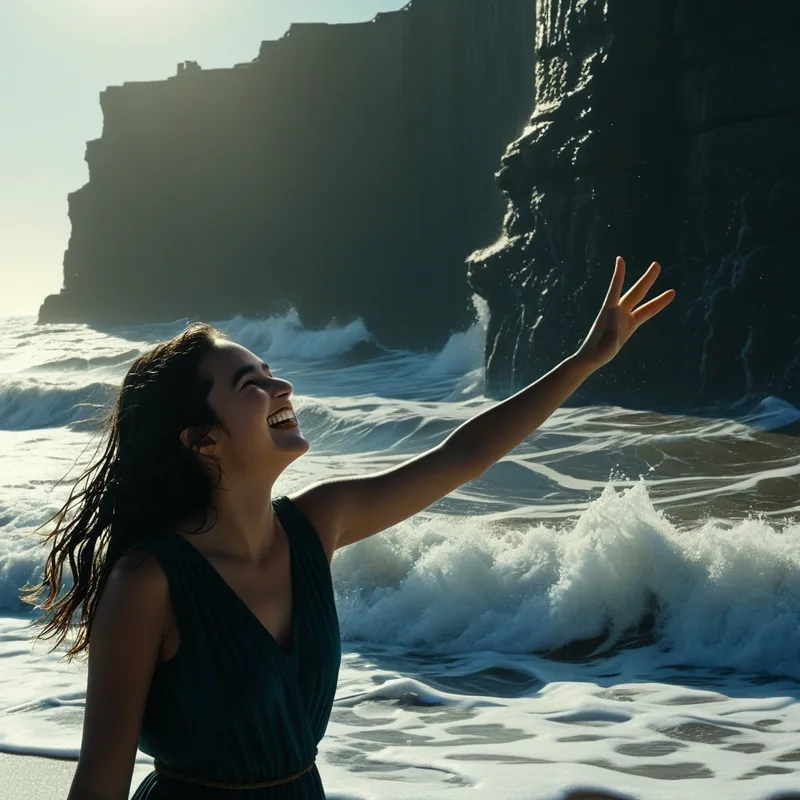
In the dawn-time of the world, when the Emperor Yan walked the earth, he had a daughter. She was not just any child of heaven, but a spirit of fierce joy and curiosity, her laughter like clear water over stones. Her name was Nüwa—or so some say—though we know her now by the name she earned. On a day when the sun painted the Eastern Sea in molten gold, she went to play upon its shore. The sea that day was a beguiling companion, its waves whispering promises of coolness and adventure. She waded in, drawn by the shimmering horizon, a child of earth entranced by the realm of water.
But the sea is an ancient god with a capricious heart. A calm mask can hide a bottomless hunger. Without warning, the playful swell became a towering, emerald wall. The laughing girl was swallowed whole. The sun still shone, the gulls still cried, but the daughter of Yan was gone, claimed by the deep’s cold, silent embrace.
This is where most tales of tragedy end. But the spirit of the emperor’s daughter was not so easily extinguished. From the profound darkness of the abyss, a new life was forged in the crucible of fury and sorrow. Her essence did not dissipate; it transmuted. From the very waters that stole her, a bird emerged. She was given a new name: Jingwei. Her plumage held the colors of her story—a body of deep, mourning blue-black, a beak of pure, resolute white, and claws like drops of hardened blood.
And she spoke. Not with a human tongue, but with a cry that carried across the waves, a vow etched into the wind. “Jingwei! Jingwei!” she would call—her own name became her oath. She turned from the sea, not in flight, but in purpose. She flew to the western mountains, where the stones lay scattered. There, she selected a single pebble, or a dry twig from a mountain tree. Clutching it in her white beak, she beat her wings against the vastness of the sky, returning to the very place of her drowning.
With a final, defiant cry, she dropped her tiny burden into the endless, hungry blue. A plink. A ripple. An insult. Then she turned and flew back for another. And another. And another. An eternal commute between the mountain of resolve and the sea of loss. She does not rage; she works. The sea may roar its laughter, may sweep her offerings away with a single tide, but the next pebble always falls. She is the daughter of memory, the bird of unfinished business, and her labor is forever.
Cultural Origins & Context
The myth of Jingwei is one of the oldest and most enduring narratives in the Chinese canon, preserved in the Shan Hai Jing (Classic of Mountains and Seas). This text, a compendium of mythic geography and strange beings compiled from the Warring States period to the early Han dynasty, is not a storybook but a cosmic map. Jingwei appears not as a fable with a moral, but as a fact of the mythological landscape—a creature that simply is, performing her task as surely as the sun rises.
This context is vital. The tale was not merely entertainment; it was a piece of cosmological data. It explained a feature of the world: the perpetual struggle between land and sea, mountain and abyss. It gave poetic form to the observable phenomena of erosion and deposition—why do stones end up in the sea? Because Jingwei puts them there. On a human level, it served as a profound, pre-philosophical meditation on the nature of catastrophic loss, particularly the loss of the young. It offered no easy comfort of an afterlife in paradise, but something more raw and psychologically true: the transformation of a stolen life into an eternal, active principle.
Symbolic Architecture
Jingwei is not a hero who overcomes. She is a consciousness that continues. Her symbolism is an architecture of profound paradox.
The ultimate rebellion is not a single explosive act, but the commitment to an infinite, quiet labor against an infinite power.
First, she embodies the Spirit of Defiant Grief. Her action is the antithesis of passive mourning. Grief here does not end in acceptance of the void, but in a perpetual engagement with it. The sea represents the overwhelming, impersonal force of fate, chaos, or tragedy—that which consumes meaning without a thought. Jingwei’s pebbles are units of meaning, of will, of “no.” Each one is a memorial, a protest, and a reconstruction of self in the face of annihilation.
Second, she represents Alchemical Transformation. She undergoes a literal metamorphosis, but one that retains the core of her identity. The human daughter becomes a bird, a creature of air, forever navigating the boundary between the solidity of the mountain (spirit, memory, resolve) and the fluidity of the sea (the unconscious, oblivion, emotion). She is the transformed psyche itself, no longer a victim of the depths but an agent operating from a new plane of existence.
Finally, her act is the ultimate symbol of the Sisyphean Task with Soul. Unlike Sisyphus, condemned by the gods, Jingwei chooses her labor. It is a vow, not a punishment. The futility is the point. The value lies not in the goal—filling the sea is impossible—but in the integrity of the gesture itself. It is the work that defines her, that gives her new form its purpose and its name.

The Dreamer's Resonance
When the pattern of Jingwei stirs in the modern dreamer, it signals a profound psychic process. You may dream of a relentless, repetitive task—carrying stones, writing the same word, trying to fill a bottomless hole. There is often a deep somatic feeling of weight, effort, and a haunting, melancholic determination.
This dream is not about literal productivity. It is the psyche’s depiction of integrating a traumatic loss or a "drowned" part of the self. The “sea” is the unconscious that has swallowed a vital aspect of your identity—perhaps innocence, trust, a relationship, or a future self that never was. The “Jingwei” within you has been born from that drowning. It is the part of you that refuses to let that loss be meaningless, that insists on engaging with the wound, not to heal it in the sense of closing it, but to honor it through perpetual, conscious attention.
The labor feels futile because the lost thing cannot be retrieved. But the dream reveals that the work itself—the remembering, the feeling, the small, daily acts of acknowledging the pain—is the transformation. You are no longer the one who drowned; you are the one who flies, who carries, who vows.

Alchemical Translation
For the individual on the path of individuation, Jingwei models a critical stage of psychic transmutation. It is the alchemy of turning victimhood into sacred purpose.
The first stage is The Drowning (Nigredo). This is the inevitable encounter with the devouring sea of the unconscious—a depression, a crisis, a shattering loss that dissolves the former ego-structure. The old “daughter” or “son” dies.
The second is The Metamorphosis (Albedo). From the black waters, a new psychic entity is born. This is not a return to the old self, but the creation of a witness, a carrier. The emotional pain (the drowning) is purified into a focused intention (the bird’s flight). The ego no longer identifies solely as the victim, but as the one tasked with a response.
The final, ongoing stage is The Sacred Labor (Rubedo). This is the red work, the opus of the soul.
The goal of the work is the work itself. By engaging the impossible task, the soul defines itself against the void, and in that definition, finds its eternal, indestructible form.
You do not “solve” your grief or “conquer” your shadow. You learn to fly to the mountain of your resources (memory, insight, community), pick up the small, hard truths (the pebbles), and offer them consciously to the vast, mysterious sea of your own psyche. Each act of conscious engagement—a journal entry, a moment of felt grief, a boundary set—is a pebble dropped. The sea does not diminish. But you are no longer in it. You are above it, defined by your purposeful motion, your vow heard in your own inner ear: Jingwei. Jingwei. I remember. I work. I am.
Associated Symbols
Explore related symbols from the CaleaDream lexicon: