Jingluo System Myth Meaning & Symbolism
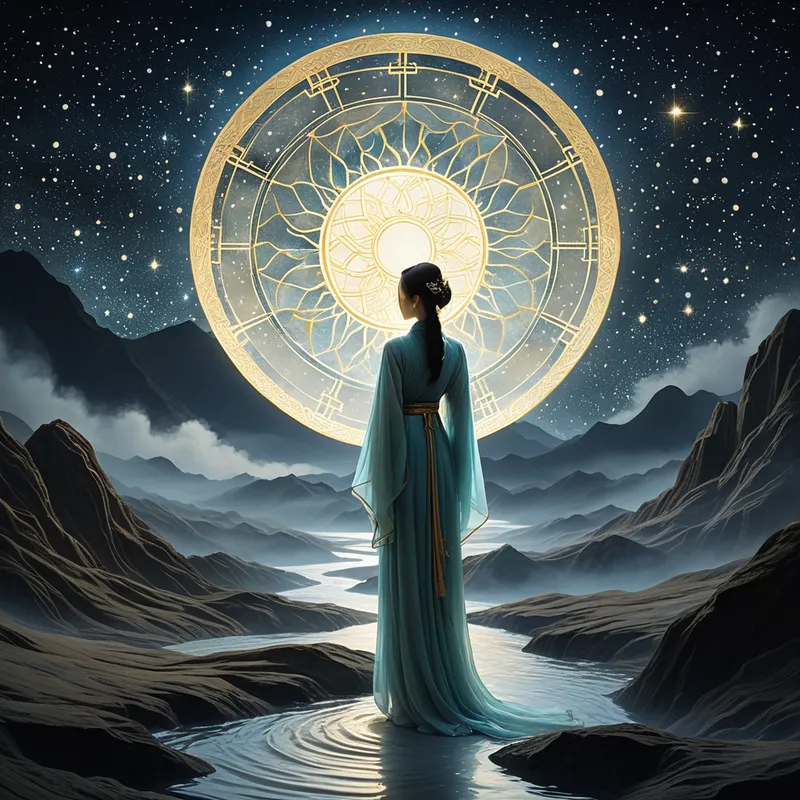
The body as a sacred landscape, where cosmic breath flows through luminous rivers, weaving a living tapestry of spirit and flesh into one harmonious whole.
The Tale of the Jingluo System
Before there were maps of kingdoms, there was a map of the body. Before physicians, there were poets of the pulse. In the time of the Yellow Emperor, when the world was still whispering its secrets to those who would listen, the great sages did not see a mere collection of flesh and bone. They saw a kingdom.
They saw a landscape.
Within the silent darkness of the living form, they perceived a heaven and an earth. Rising like a sacred mountain was the spine, the central pillar. From its peak, the palace of the mind, down to the deep roots of the loins, the realm was ordered. But the true magic, the vital breath of this inner kingdom, was not in its solid forms. It was in the rivers.
These were not rivers of water, but rivers of light, of wind, of the very breath of the cosmos—Qi. Twelve great channels, the Jing Mai, carved their paths like mighty waterways through the body’s terrain. They connected the deepest wells of the organs to the farthest shores of the fingertips and toes. Along these luminous highways traveled the essences of life: the defensive Wei Qi patrolled the surface like a vigilant guard, while the nourishing Ying Qi flowed deep within, tending to the inner palaces.
Yet these twelve rivers were not alone. A vast, finer network—the Luo Mai—spread from them like a celestial fisherman’s net, a web of countless tiny streams and capillaries. This was the connective tissue of spirit, the subtle threads that bound muscle to bone, thought to sensation, emotion to breath. At certain sacred junctures, where the flow gathered and pooled, there lay the wells, the springs, the ponds, and the seas—the Xue. These were portals, places where the inner cosmos touched the outer, where a wise finger or a sliver of silver could whisper to the current, divert a flood, or awaken a drought.
The great drama of this myth was not one of slaying beasts, but of listening to the weather within. The conflict was stagnation—a logjam in a river of the liver, a bitter frost in the sea of the heart. The rising action was the subtle shift when a blockage cleared, when the Qi, long pent-up, began to move again like the first thaw of spring, carrying life back into withered fields. The resolution was harmony: the smooth, silent, powerful flow from crown to root, a human body singing in perfect pitch with the rhythms of the seasons and the turning of the stars. To know the Jingluo was to be the cartographer of a living, breathing universe contained within a single skin.
Cultural Origins & Context
This mythic anatomy did not spring from a single revelation, but was woven over millennia through the practices of early Chinese shamans, astronomers, and natural philosophers. Its earliest threads are found in oracle bone inscriptions and texts like the Huangdi Neijing, a dialogue between the mythical Yellow Emperor and his ministers. This was not a doctrine handed down by gods, but a map discovered through profound observation—of the human body, of landscapes, and of the heavens.
The sages who articulated this system were physician-poets who saw no division between macrocosm and microcosm. They passed this knowledge down through master-disciple lineages, often in secret, oral traditions, using metaphor and analogy as their primary tools. The myth served a vital societal function: it was a practical cosmology of health. It provided a coherent, elegant framework for understanding illness not as an invasion by demons, but as a disruption in the natural order of the inner landscape. It empowered individuals and healers to participate in their own restoration by aligning with these innate, cosmic patterns. The Jingluo myth was, and is, a narrative of ecological belonging, positioning the human being as an integral part of a flowing, intelligent cosmos.
Symbolic Architecture
At its core, the Jingluo myth is a profound symbol of interconnectedness. It dismantles the illusion of the isolated self, depicting the individual as a nexus of flowing relationships.
The body is not a machine, but a watershed. Consciousness is not a pilot in a cockpit, but the weather moving through the valley.
The twelve primary channels symbolize the archetypal phases of life’s energy, mirroring the twelve months, the twelve earthly branches. They represent the complete cycle of expression, from the nascent wood of the liver’s channel to the conserving water of the kidney’s. The Luo Mai network symbolizes the psychic and somatic connective tissue—the often-unconscious web of memories, associations, and habitual patterns that link our major life themes. The Xue, or points, are symbols of potential. They are places where the pattern becomes accessible, where intention can meet the innate intelligence of the system to effect change.
Psychologically, the entire system is a map of the objective psyche as described by Jung—a pre-existing, impersonal structure within which personal consciousness arises. The flowing Qi is libido, psychic energy itself. Blockages represent complexes: knots of traumatic memory or fixated emotion that dam the flow of life, creating symptoms in both psyche and soma.
The Dreamer's Resonance
When the Jingluo pattern emerges in modern dreams, it rarely appears as a literal chart. Instead, it manifests as somatic metaphors of flow and blockage within the dreamer’s own dream-body.
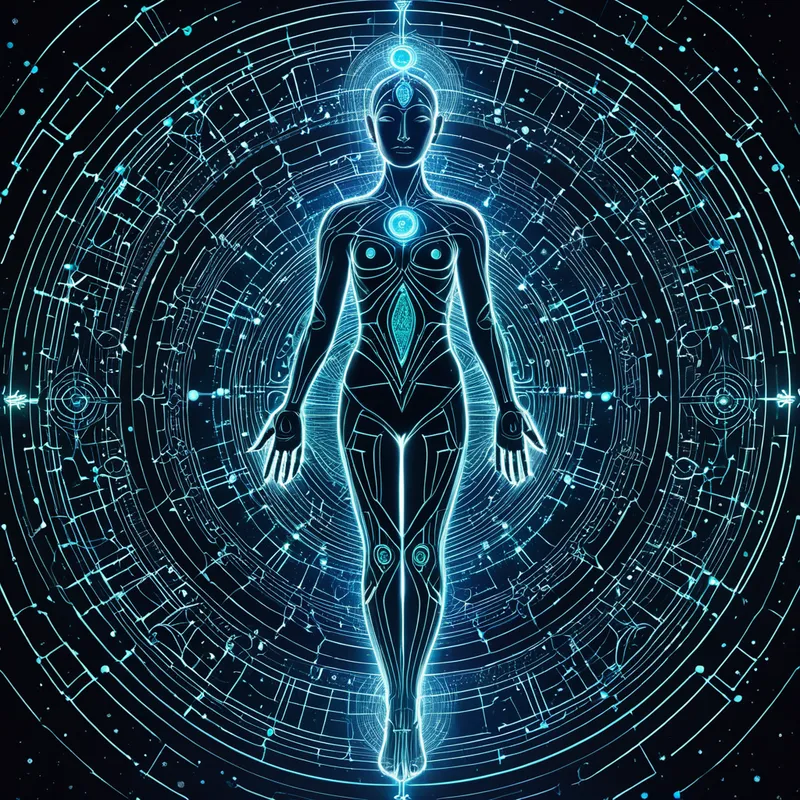
A person may dream of intricate irrigation systems in a garden, where one clogged pipe causes a distant plot to wither. They may dream of traffic networks, with gridlock in one district causing chaos city-wide. They may feel, in the dream, strange currents of warmth or cold moving along specific limbs, or see their skin mapped with glowing lines. These are dreams of systemic awareness. The psyche is illustrating a process of recognizing that a pain in the shoulder is connected to a held resentment (a liver channel issue), or that chronic anxiety (a heart Luo disturbance) is draining vitality from their core.
Such dreams indicate the dreamer is undergoing a process of somatic introspection. The unconscious is attempting to move beyond a purely cognitive understanding of a problem and is speaking the language of the body’s own intelligence. It is a call to attend not just to the symptom—the withered garden—but to the entire flow of energy and information that supports it.
Alchemical Translation
The individuation process, the journey toward psychic wholeness, is perfectly modeled by the Jingluo myth. It is not an ascent to a peak, but a restoration of circulation throughout the entire internal kingdom.
Individuation is not about adding light, but about removing the dams that shadow the light already flowing.
The initial state of modern neurosis is one of fragmentation: the heart is disconnected from the gut, thought is severed from feeling. This is symbolized by blocked or stagnant channels. The alchemical work begins with diagnosis—not a medical label, but a deep listening to where the life flow has been interrupted. Where is the pain, the rigidity, the numbness? This is the modern equivalent of the sage feeling the pulses.
The transmutation occurs through the act of bringing consciousness—the silver needle of attention—to these blocked nodes (complexes). By consciously engaging with a stuck emotion, a traumatic memory, or a neglected aspect of the self, we “stimulate the point.” We invite the dam to break, allowing the pent-up psychic energy to rejoin the greater flow. As these blockages clear, energy is redistributed. A fixation in the mind (an overactive fire element) may settle as vitality returns to the body (the water element). The goal is not a static perfection, but a dynamic, resilient harmony—a system where Qi and consciousness flow freely, adapting to internal and external seasons.
Ultimately, the myth teaches that healing and wholeness are functions of relationship and movement. To know oneself, in the deepest sense, is to become the humble and attentive cartographer of one’s own flowing, star-lit interior.
Associated Symbols
Explore related symbols from the CaleaDream lexicon: