Jibril the Archangel Myth Meaning & Symbolism
The archangel Jibril is the divine messenger who delivers the Quran, embodying the terrifying and sublime moment of revelation that transforms a human soul.
The Tale of Jibril the Archangel
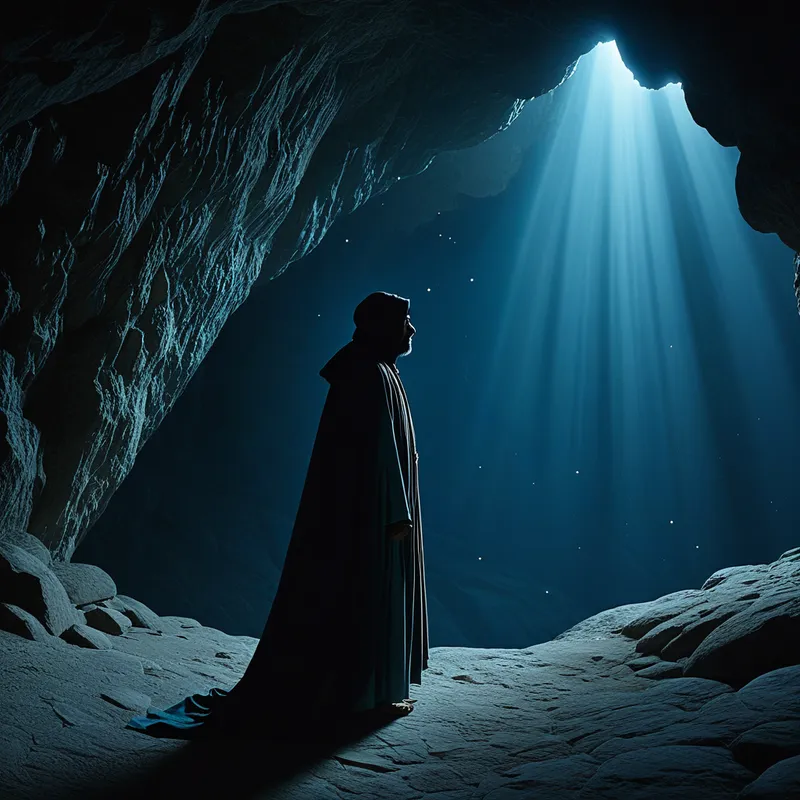
In the silent, star-pierced darkness of the Mount Hira, a man sought solitude. His name was Muhammad, of the tribe of Quraysh, a seeker weary of the idols and the empty noise of the world. He retreated to the cave’s womb, wrapped in the cloak of contemplation, listening only to the wind’s whisper and the beat of his own heart.
Then, the atmosphere changed. It was not a sound, but a pressure—a presence that filled the cavern, dense and absolute. The air grew heavy, humming with a frequency beyond hearing. And He appeared.
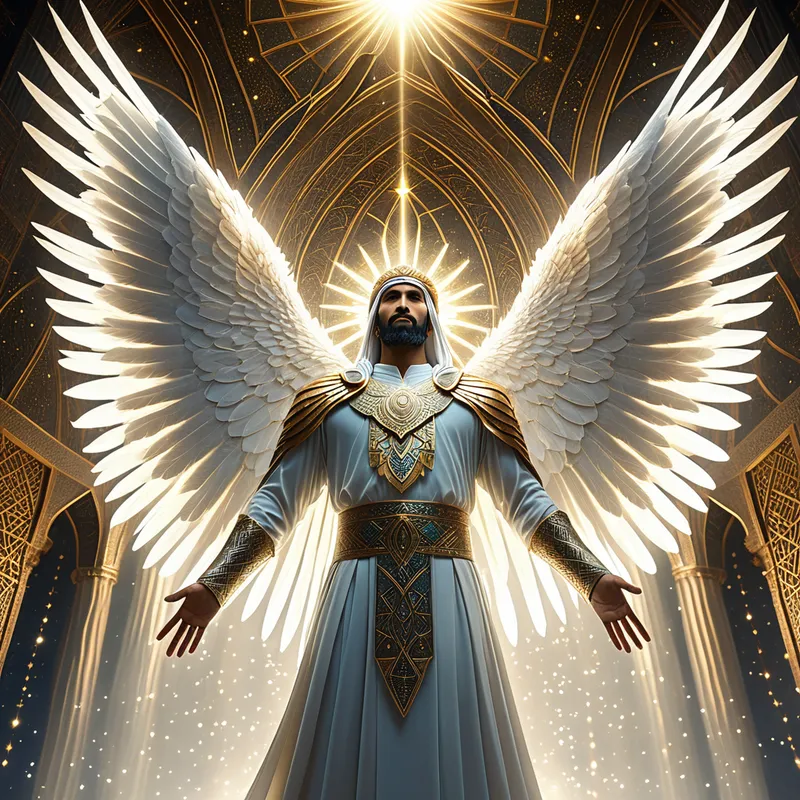
He was not a man. He was a being of terrifying magnitude, filling the horizon of vision and mind. His form was of a majesty that strained the very fabric of perception, a figure of immense wings and unbearable light. This was Jibril, the Spirit of Holiness, the Faithful Spirit. He held forth a cloth inscribed with letters of fire and commanded, in a voice that was not a voice but a vibration in the soul: “Iqra!” — “Read!”
The man trembled, his body seized by a primal awe. “I am not a reader,” he stammered, for he was unlettered. But the command was an imperative of creation itself. The angel embraced him with a strength beyond the physical, a pressure that felt like the universe collapsing into a single point within his chest. The command came again, a divine echo: “Iqra!”
And then, from the depth of that terror, from the crucible of that embrace, words began to flow—not from his mind, but through him. They were not his own. They were a cascade of luminous meaning, a recitation that was at once a command, a declaration, and a creation: “Recite in the name of your Lord who created—Created man from a clinging clot. Recite, and your Lord is the most Generous—Who taught by the pen—Taught man that which he knew not.”
The revelation ceased as suddenly as it had begun. The presence withdrew, leaving behind the echo of the Unseen and a man utterly transformed, his limbs shaking, his soul seared with a truth too vast to contain. He fled the cave, the words burning within him, and climbed the mountain slope. At the summit, the angel appeared again, now filling the entire sky, seated upon a throne between heaven and earth. “O Muhammad,” the voice resonated, “you are the Messenger of God, and I am Jibril.”
The man returned to his world, but he was no longer merely of it. He carried a fire in his heart, a spring in the desert of the soul. The Quran had begun its descent, and with it, the final chapter of prophecy was written upon the human heart, delivered by the hand of the mighty archangel who stands in the presence of the Divine Throne.
Cultural Origins & Context
The mythos of Jibril is not a folktale but the foundational narrative of Islamic revelation, meticulously preserved within the Quran itself and the vast corpus of Hadith. It emerged in 7th century Arabia, a context of tribal polytheism and oral poetic tradition. The story was not “told” in the manner of a legend; it was lived and reported by the Prophet Muhammad and then transmitted by a chain of narrators with scrupulous attention to authenticity.
Its societal function was monumental: it established the divine origin and absolute authority of the Quranic message. Jibril’s role as the sole intermediary authenticated the revelation, separating it from poetic inspiration or jinn-induced whispers—common concepts in the Arabian worldview. The physical and psychological intensity of the encounter, the “closeness of the two bows’ length” described in the Quran, served as proof of its transcendent, non-human source. This narrative formed the bedrock of Islamic theology, spirituality, and the very concept of prophethood, making Jibril a central, revered figure not as an object of worship, but as the ultimate divine courier.
Symbolic Architecture
At its core, the myth of Jibril is an archetypal drama of communication between the absolute, unchanging realm of the Divine (al-Ghayb) and the relative, temporal realm of the human. Jibril is the personified Bridge itself.
The angel is not the message, but the medium through which the formless Word takes form, the terrifying yet necessary compression of the infinite into the syntax of the finite.
Psychologically, Jibril represents the autonomous, overwhelming force of the Self—the central archetype of wholeness in the psyche—breaking into the domain of the conscious ego (Muhammad). The command “Iqra!” (Read/Recite) symbolizes the imperative of consciousness itself: to bring to light what is latent, to articulate the unconscious content. The initial resistance (“I am not a reader”) is the ego’s terror before the magnitude of its own deeper reality. The crushing embrace is the non-negotiable pressure of individuation—the process cannot be refused without fracturing the psyche. The revealed words are the nascent, integrated consciousness emerging from the ordeal.
The Dreamer's Resonance
When this mythic pattern stirs in the modern Dream, it rarely appears as a winged angel. It manifests as an encounter with an overwhelming, non-human intelligence or presence—a vast, silent entity in a dreamscape, a commanding voice with no source, or a sudden, total download of incomprehensible knowledge upon waking. Somaticly, the dreamer may report feeling a crushing weight on the chest, paralysis (akin to sleep paralysis, often linked to the mythic encounter), or a sensation of vibrating or buzzing throughout the body.
Psychologically, this signals a critical threshold. The psyche is presenting a content so fundamental, so authoritative, and so alien to the current ego-structure that it is perceived as wholly Other. The dreamer is undergoing what Jung called a “numinous experience”—a confrontation with an archetypal power that demands a reorientation of the entire personality. The terror is the ego’s rightful fear of dissolution; the revelation is the Self’s blueprint for a more expansive consciousness. The dream asks: What undeniable truth is pressing upon you? What vocation of the soul are you resisting?
Alchemical Translation
The alchemical process mirrored here is the solutio and coagulatio—dissolution and coagulation. The seeker (Muhammad) in the cave (the vas hermeticum or sealed vessel of introspection) is dissolved by the aqua permanens, the “divine water” of Jibril’s presence. His old identity—the unlettered, solitary contemplative—is broken down.
The prima materia of the soul is rendered fluid, capable of receiving a new and indelible imprint.
From this dissolved state, the new substance coagulates around the revealed Word. The “Pen” that teaches man what he knew not is the active, formative principle. For the modern individual, this models the psychic transmutation required for genuine transformation. It is not self-improvement, but a humble, terrifying submission to a process greater than the will. One must retreat to one’s inner “cave,” confront the overwhelming voice of the deeper Self (in therapy, art, crisis, or meditation), endure the crushing pressure of its truth, and allow a new, guiding narrative—one’s own personal “recitation”—to form from the encounter. The ego does not command this process; it becomes the scribe of the Self.
Associated Symbols
Explore related symbols from the CaleaDream lexicon:
- Angel — The embodiment of a direct, transcendent message from the realm of the Self to the conscious ego, representing a call to a higher order of being.
- Light — The illuminating, revelatory quality of the divine message that dispels the darkness of ignorance and unconsciousness.
- Mountain — The elevated, isolated place of retreat and ordeal where the human soul encounters the divine, symbolizing the arduous ascent toward revelation.
- Cave — The womb-like vessel of introspection, the sealed container where the old self is dissolved to make way for the new, representing the unconscious itself.
- Bridge — Jibril as the living connection between the human and the divine, the archetypal function that makes communication between different orders of reality possible.
- Word — The divine speech made manifest, the creative and formative power that structures reality and consciousness, symbolizing Logos.
- Fear — The primal, somatic response of the ego to the overwhelming presence of the numinous, a necessary stage in the dissolution of old structures.
- Sky — The domain of the transcendental, the source from which the angel descends, representing the vast, ordered realm of the archetypal world.
- Book — The collected, codified revelation, symbolizing the law, wisdom, and permanent record that emerges from the transformative encounter.
- Dream — The state of receptive consciousness in which divine communication often occurs, representing the permeable boundary between the conscious and unconscious mind.
- Spirit — The essential nature of Jibril as Ruh al-Qudus (the Holy Spirit), the animating, life-giving breath of divine inspiration.
- Heart — The center of the human being where the revelation is ultimately received and integrated, the seat of understanding beyond intellect.