Jiang Ziya Myth Meaning & Symbolism
An exiled sage waits decades by a river, fishing without a hook, until destiny calls him to orchestrate the fall of a corrupt dynasty and found a new order.
The Tale of Jiang Ziya
Listen, and hear the tale of the man who fished not for fish, but for a kingdom.
The world was out of joint. In the great halls of the Shang, a tyrant king danced to the whispers of a fox-demon, his heart turned from the Mandate of Heaven. The rivers ran bitter, the crops grew thin, and the people’s sighs hung in the air like a perpetual fog. The celestial order itself held its breath, waiting for the pivot, for the one who would set the axis of the world right.
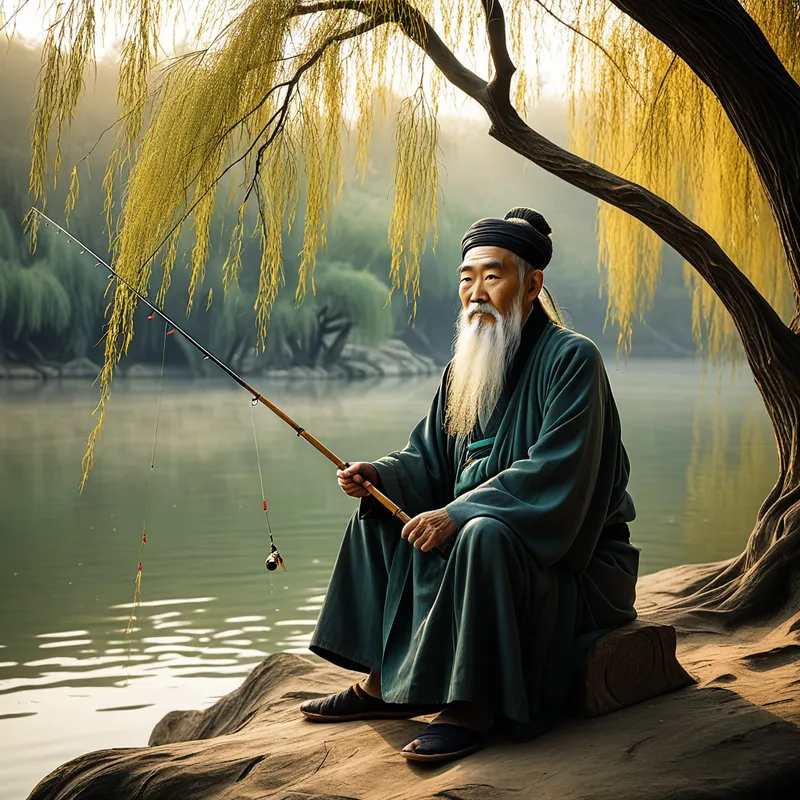
And where was this savior? Not on a battlefield, not in a palace. He was on the banks of the Wei River, an old man with hair like winter frost. His name was Jiang Ziya. For seventy-two years he had studied the patterns of heaven and earth, the arts of war and statecraft, the secrets whispered by the I Ching. And for what? He sat, day after day, season turning into season, with a fishing rod in his hand. But look closer—his hook was straight, not curved. He dangled it above the water, murmuring, “Those who are destined, take the bait.”
The villagers laughed. “The old fool fishes for nothing!” But his eyes were not on the water’s surface; they were fixed on the deep currents of fate. His waiting was not passive; it was a profound act of alignment, a tuning of his spirit to the frequency of a coming storm.
The storm’s name was Ji Chang, Lord of the West. Harried by the Shang tyrant, his heart heavy with the suffering of the land, he dreamed of a great white bear. His seers whispered of a sage who would be the architect of a new age. Journeying forth, he came to the Wei River and saw the old fisherman. He saw the straight hook. In that impossible act, he recognized the signature of destiny.
The lord dismounted his chariot and approached. The old man did not turn. “I have been fishing for a long time,” Jiang Ziya said, his voice like dry reeds. “I have been waiting for you.” In that moment, the contract of ages was sealed. The sage who would catch no fish was caught by a king. Jiang Ziya was lifted into the chariot, and the lord himself took the reins, pulling the sage—his future Prime Minister—back to his kingdom. Thus began the legend of “Taigong Wang.”
The war that followed was not merely of men. It was a war of spirits, of portents, and of celestial mandates. Jiang Ziya, now commander, became the master of the in-between. He enlisted gods and immortals, bound demons, and commanded the elements. His greatest weapon was the Fengshen Bang, a register where he inscribed the names of fallen heroes and spirits, appointing them to posts in the new celestial bureaucracy. He did not just defeat the Shang; he dismantled a corrupt cosmic order and painstakingly rebuilt a new one, brick by divine brick. When the last battle faded, and the Zhou Dynasty dawned, the old sage did not rest on a throne. He was given the land of Qi, which he ruled with the same detached wisdom with which he had once fished, before fading into the mists of legend, his task complete.

Cultural Origins & Context
The myth of Jiang Ziya is woven from the threads of history, folklore, and political ideology. He is believed to be based on the historical figure Lü Shang, a strategist who aided the founding of the Zhou Dynasty (c. 1046–256 BCE). His story was immortalized and fantastically elaborated in the Ming dynasty novel Fengshen Yanyi, which transformed a strategic advisor into a grandmaster of cosmic warfare.
For centuries, his tale was told by storytellers in tea houses, enacted in operas, and studied by statesmen. It served multiple societal functions: as a foundational myth for the Zhou’s legitimacy (the virtuous ruler finding the pre-ordained sage), as a manual of strategic patience for scholars awaiting recognition, and as a folk template for the triumph of latent virtue over arrogant power. Jiang Ziya became the patron of fishermen, strategists, and anyone who felt their talents were unseen, a cultural promise that right timing, not just right action, is sovereign.
Symbolic Architecture
At its core, Jiang Ziya is an archetype of conscious waiting. His straight hook is not a tool for catching, but for being ready to be caught. It symbolizes a refusal to force destiny, to compromise one’s essence (the straight, unbending hook) for mere gain.
The sage does not chase the fish; he prepares the water so that the fish must come to him.
His decades of obscurity represent the essential, often lengthy, period of inner preparation that must precede outer manifestation. He is the embodied union of Wu and Wen—the martial and the civil, strategy and virtue. His command of the Fengshen Bang symbolizes the ultimate psychological task: to consciously organize the chaotic, competing forces within one’s own psyche (the gods, demons, and heroes of our inner world) into a functional, harmonious hierarchy in service of a greater purpose (the new dynasty of the Self).
His advanced age is crucial. He is not a youthful hero, but a ripe fruit of experience. His power comes from integration, not impulse. He represents the wisdom that true authority is not taken, but is bestowed by the alignment of personal readiness with cosmic necessity.
The Dreamer's Resonance
When the pattern of Jiang Ziya stirs in the modern unconscious, it often manifests in dreams of waiting at thresholds. One might dream of sitting by an empty shore, holding a tool that seems useless, watching others actively fish and succeed. There is a somatic feeling of frustrated potential, a sense of time passing without progress.
Psychologically, this marks a critical phase of incubation. The ego feels sidelined, but the Self is conducting deep, unseen work. This dream motif asks the dreamer: Are you waiting with anxiety, or with the poised, watchful certainty of Jiang Ziya? Are you trying to bend your hook to catch smaller fish, or are you holding true to your straight, essential nature, waiting for the destiny that is meant for you alone? The dream calls for a radical trust in one’s own prepared-ness and in the timing of a larger pattern.

Alchemical Translation
The myth of Jiang Ziya is a precise map for the alchemical process of individuation—the forging of an integrated, authentic Self.
The first stage is the Calcination of the Ego: his long, obscure exile by the river. This is the burning away of worldly ambition, social validation, and the need for immediate results. The ego is reduced to its essence, sitting alone with its purpose.
Next is the Dissolution into Purpose: his encounter with King Wen. This is the moment the prepared individual is “dissolved” into a calling greater than themselves. The personal will submits to the transpersonal destiny. The straight hook finally meets the water it was meant for.
The central work is the Coagulation of Order: the war and the use of the Fengshen Bang. This is the active, often chaotic, phase of psychic integration. The dreamer must confront and reorganize their inner “pantheon”—their complexes (demons), talents (heroes), and guiding principles (gods)—assigning each a proper function under the authority of the emerging Self.
The final stage is not conquest, but administration. The new kingdom within must be ruled with the detached, benevolent wisdom of the sage in his fiefdom of Qi.
The ultimate transmutation is from an individual seeking power to an instrument of right order. One becomes, like Jiang Ziya, a conscious participant in the Mandate of Heaven of one’s own life, fishing with a straight hook in the river of time, knowing that what is destined will find its way to the line.
Associated Symbols
Explore related symbols from the CaleaDream lexicon: