Jesus in Gethsemane Myth Meaning & Symbolism
A story of divine anguish and human surrender, where a solitary figure wrestles with destiny in a moonlit garden, accepting a cup he wishes to pass.
The Tale of Jesus in Gethsemane
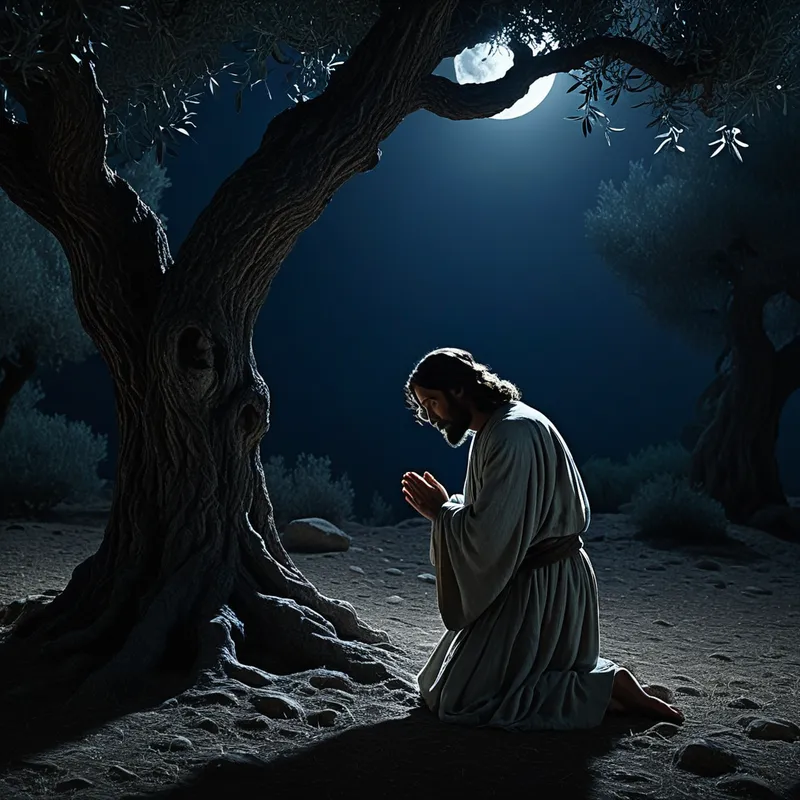
The night was a cloak, heavy and final. Beyond the city walls, in a place of ancient, twisted trees called Gethsemane, the air tasted of dew and dread. He came there, the teacher, with his chosen few—Peter, James, and John. His spirit was a storm contained within flesh. “My soul is crushed with grief to the point of death,” he told them, his voice the quiet before the avalanche. “Stay here and keep watch with me.”
He walked a little farther, until the shadows of the old olives swallowed him whole. Then he fell upon the ground, his form pressed into the cool earth as if seeking to return to it. The prayer that tore from him was not one of piety, but of raw, human terror. “Abba, Father,” he cried, “everything is possible for you. Please take this cup of suffering away from me.”
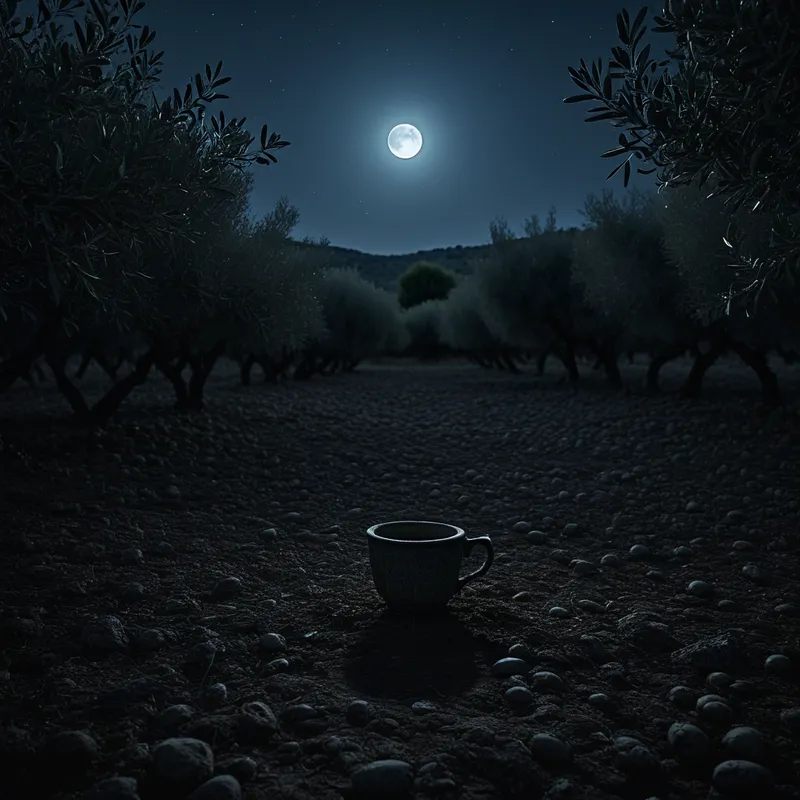
The cup. It was not ceramic or silver, but the full, bitter vintage of the destiny that now pressed upon him—the betrayal, the scorn, the agony of the cross, the terrifying descent into the abyss of death and godforsakenness. He could see its contents, and he recoiled. The divine will within him strained against the human will that screamed for reprieve. He was the hinge between two worlds, and the pressure was splitting him apart.
Yet he did not stop there. Into the silence that followed his plea, he poured a second, more terrible sentence: “Yet I want your will to be done, not mine.” The words cost him everything. Sweat fell like great drops of blood, a sign of the inner crucifixion already underway. An angel from heaven appeared, not to rescue him, but to strengthen him for the journey he had just consented to take.
He returned to his friends, seeking the comfort of human solidarity, and found them asleep, their spirits willing but their flesh unbearably weak. “Couldn’t you keep watch with me for one hour?” The question held more sorrow than accusation. Twice more he retreated, wrestling alone with the same awful prayer, each time returning to the same scene of human frailty. The third time, his face was changed. The anguish was still there, etched deep, but it was now framed by a terrible, luminous resolve. The internal war was over. “Look,” he said, his voice now calm and clear as a deep well, “the time has come. The Son of Man is betrayed into the hands of sinners. Rise, let’s go. Here comes my betrayer.”
And as he spoke, the torchlight flickered through the trees, and the sound of marching feet and clinking armor broke the garden’s stillness. He stepped forward, not as a victim fleeing, but as a king walking toward his appointed throne, having drunk the first, most bitter draft from the cup of his fate.
Cultural Origins & Context
This story is anchored in the Gospel narratives of Matthew, Mark, and Luke, composed in the decades following the events they describe. It functions as the pivotal psychological and theological hinge between Jesus’s public ministry and his passion. For the early Christian communities, often facing persecution, this was not merely history but a living template. It was passed down orally and in written form as the ultimate model for how to face existential terror and violent opposition—not with defiance alone, but through a process of agonized prayer that leads to radical acceptance of a painful, God-willed path.
Societally, it served to humanize the divine figure, presenting a Christ who was fully acquainted with the weakness and dread known to every believer. It validated the experience of spiritual struggle, making it a sacred, rather than shameful, part of the faith journey. The story was told in worship, in catechism, and in art to prepare individuals for their own “hours” of decision and suffering, framing such moments not as abandonment by God, but as a participation in the core mystery of their savior’s journey.
Symbolic Architecture
At its heart, Gethsemane is the myth of the conscious ego confronting the totality of the Self—a destiny so vast and demanding it feels like annihilation. The garden itself is a temenos, a container for this ultimate inner drama.
The cup is the symbol of individuated fate—the unique, non-negotiable life that is yours to drink, filled with both your greatest potential and your most profound suffering.
The sleeping disciples represent the parts of our own psyche—our supportive instincts, our good intentions—that fall asleep at the crucial hour, leaving the central consciousness utterly alone to face its destiny. The “agony” (agonia) is the psychic tension between the personal will (seeking comfort, safety, a different life) and the transpersonal will of the Self (calling one to a wholeness that necessarily includes sacrifice and ordeal). The prayer, repeated three times, signifies the complete, cyclical process of resistance, negotiation, and final surrender. This is not a surrender to an external enemy, but to a deeper, internal truth that one has spent a lifetime both seeking and avoiding.

The Dreamer’s Resonance
When this myth appears in modern dreams, it rarely features biblical figures. Instead, the dreamer finds themselves in a liminal space—a deserted office at night, an empty parking garage, a strange backyard. They are awaiting a verdict, a surgery, a difficult conversation, or they are simply paralyzed by a life decision. The somatic feeling is one of crushing weight, of being “pressed into the earth.” There is often a crucial object: a contract they must sign, a door they must open, a bitter drink they must swallow.
The sleeping figures around them might be family members, colleagues, or even idealized versions of themselves, all oblivious to their inner catastrophe. This dream pattern signals that the psyche is in the throes of what James Hillman called the “cooking” process. The ego is being forced to relinquish its idealized plan for how life should be and is coming face-to-face with the stark reality of how it is. The dream is an enactment of the “dark night of the soul,” where all previous identities and securities are stripped away, and the only path forward is through a terrifying acceptance.

Alchemical Translation
The alchemy of Gethsemane is the nigredo—the blackening, the descent into the prima materia of one’s own suffering and resistance. It is the necessary death of the ego’s illusion of control.
The transmutation occurs not in avoiding the cup, but in the threefold act of naming your terror, presenting it to the greater totality of your being (the “Father”), and finally consenting to drink.
This is the model for psychic individuation. First, we must withdraw to our inner “garden,” separating from the collective expectations (the sleeping world). There, we must consciously hold the tension of the opposites—what I want versus what Life/ the Self wants of me. The sweat like blood is the sign that this is a real, somatic process, costing us our very substance. The strengthening angel is the emergent insight, the numinous support that arises only after the surrender is made, not before. Finally, one rises from prayer fundamentally changed. The conflict is integrated. One can then walk, with clear-eyed resolve, toward the betrayals and trials of the outer world, not as a passive victim, but as an active participant in a destiny one has consciously, agonizingly, embraced. The hero archetype is thus fulfilled not in conquest, but in this ultimate, vulnerable act of acquiescence to a law beyond one’s own.
Associated Symbols
Explore related symbols from the CaleaDream lexicon: