Jesus healing the blind man Myth Meaning & Symbolism
A man born blind receives his sight from a wandering teacher, challenging societal dogma and illuminating the path from darkness to profound inner vision.
The Tale of Jesus healing the blind man
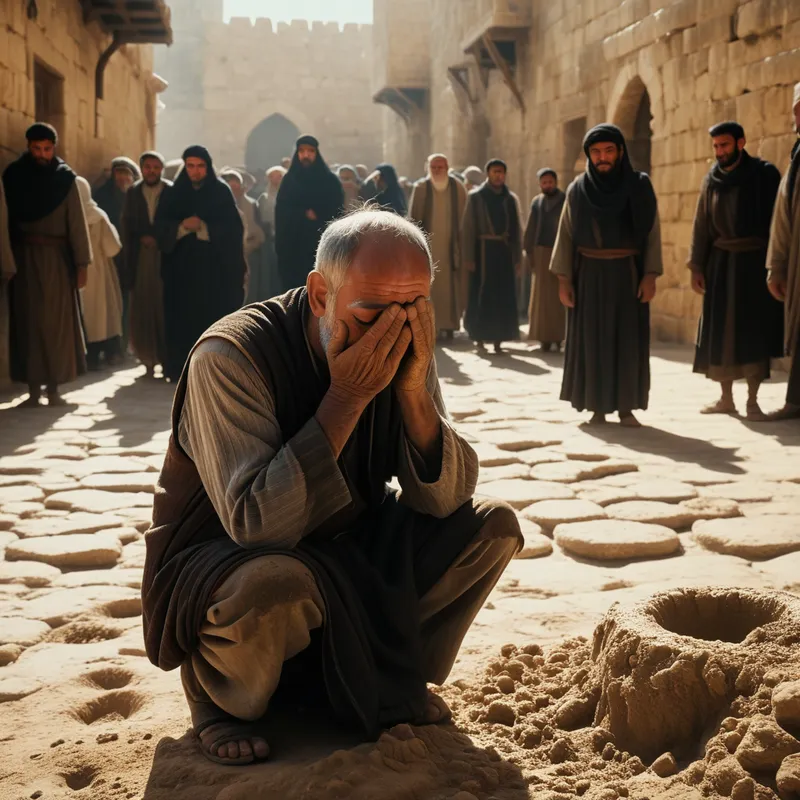
The dust of [Jerusalem](/myths/jerusalem “Myth from Biblical culture.”/) tasted of history and despair. In [the shadow](/myths/the-shadow “Myth from Jungian culture.”/) of the great Temple, where law was etched in stone and whispered in judgment, there sat a man by the Pool of Siloam. He was not a visitor to its waters; he was a fixture, as permanent as the stones. He was born blind. His world was not one of light and form, but of heat and cold, of sound and echo, of the scuff of sandals and the occasional clink of a coin tossed his way—a punctuation mark in a sentence of endless night. His identity was his condition: “the blind beggar.” It was his name, his story, his irrevocable fate, sealed by the theological certainty of those who passed: someone must have sinned.
Then, a different sound cut through the mundane hum. Not the hurried step of a pilgrim, but a pause. A presence. A voice, calm yet carrying an undeniable authority, asked his disciples a question that hung in the air like a challenge: “Who sinned, this man or his parents, that he was born blind?” The answer that came was not of sin, but of purpose. “Neither… but this happened so that the works of God might be displayed in him.”
The man heard movement, the sound of spittle on the ground, the kneading of earth. Then, cool, gritty mud was pressed upon his sealed eyelids. The act was intimate, physical, almost shocking in its earthy simplicity. No incantation to distant heavens, but a sacrament of the immediate. The voice spoke again, a command that was also an invitation: “Go, wash in the Pool of Siloam.” The journey was his to make. Guided by habit, by touch, by the imperative of that voice, he felt his way. He knelt at the [water](/myths/water “Myth from Chinese culture.”/)‘s edge, this place he knew only by sound and smell. He scooped the cool water, washed the clay from his face.
And then—a riot.
A crashing, overwhelming cascade of something invaded his being. Not a slow dawn, but a sudden, glorious, terrifying sunrise from within. Light, color, shape, distance—a universe of information he had no language for exploded into his consciousness. He saw the ripples on the water he had just touched. He saw his own hands, wrinkled and dirty. He saw [the sky](/myths/the-sky “Myth from Persian culture.”/). He was reborn into a world he had only heard tales of.
But his awakening was just the beginning of the conflict. He returned, seeing, to his familiar corner. His neighbors, [the Pharisees](/myths/the-pharisees “Myth from Biblical culture.”/), the very architects of [the world](/myths/the-world “Myth from Tarot culture.”/) that had defined him, did not recognize him. “Isn’t this the man who used to sit and beg?” When he confirmed, “I am the man,” their confusion turned to interrogation. This miracle did not fit their schema. It happened on the [Sabbath](/myths/sabbath “Myth from Judeo-Christian culture.”/). The healer was a controversial rabbi from Galilee. The facts were undeniable, yet they were impossible. They called his parents, who confirmed his birth blindness but feared excommunication. They pressed the man again: “Give glory to God by telling the truth. We know this man is a sinner.”
The once-blind man, now seeing with more than eyes, stood his ground. His logic was impeccable, born of direct experience. “One [thing](/myths/thing “Myth from Norse culture.”/) I do know. I was blind but now I see.” His testimony escalated from witness to theologian to judge. “If this man were not from God, he could do nothing.” For this clarity, for this refusal to deny the reality of his own transformation, they cast him out. Excommunicated. He who had gained the world lost his place in it. And it was there, in [the wilderness](/myths/the-wilderness “Myth from Biblical culture.”/) of his new exile, that the voice found him again. “Do you believe in the Son of Man?” The man, now fully ready, asked, “Who is he, sir? Tell me so that I may believe in him.” The reply was the final revelation: “You have now seen him; in fact, he is the one speaking with you.” The man said, “Lord, I believe,” and he worshipped. His journey was complete: from physical blindness to physical sight, and finally, to the vision of the heart.
Cultural Origins & Context
This narrative is found in the Gospel of John, Chapter 9, a text composed near the end of the first century CE. It emerged from a Johannine community likely in tension with the emerging rabbinic Judaism of the post-Temple period. The story functioned as a powerful apologia (defense) and a boundary marker. For early Christians, it was not merely a miracle story but a foundational parable of their own experience: they were the ones who had been “blind” to the true identity of Messiah and had now received sight through an encounter with [Jesus](/myths/jesus “Myth from Christian culture.”/), often at the cost of social and religious ostracism (being “cast out” of the synagogue).
The tale was told and retold in worship, catechism, and polemic. It served to embolden believers facing persecution, illustrating that true sight—spiritual understanding—could lead to rejection by the established religious order. It also subverted a common theological assumption of the time, encapsulated in the disciples’ initial question, which linked suffering directly to personal sin (a concept found in parts of the Tanakh, like the story of Job). The story boldly re-frames suffering as a potential arena for the revelation of divine works, not as a simple calculus of punishment.
Symbolic Architecture
At its core, this is a myth about the transformation of [perception](/symbols/perception “Symbol: The process of becoming aware of something through the senses. In dreams, it often represents how one interprets reality or internal states.”/) and the cost of [consciousness](/symbols/consciousness “Symbol: Consciousness represents the state of awareness and perception, encompassing thoughts, feelings, and experiences.”/). The blind man represents the unconscious [human](/symbols/human “Symbol: The symbol of a human represents individuality, complexity of emotions, and social relationships.”/) [condition](/symbols/condition “Symbol: Condition reflects the state of being, often focusing on physical, emotional, or situational aspects of life.”/), living within a predetermined, sensory-limited [identity](/symbols/identity “Symbol: Identity represents the sense of self, encompassing personal beliefs, cultural background, and social roles.”/) assigned by [family](/symbols/family “Symbol: The symbol of ‘family’ represents foundational relationships and emotional connections that shape an individual’s identity and personal development.”/) and culture (“the [beggar](/symbols/beggar “Symbol: A symbol representing vulnerability, need, and social inequality, often reflecting the dreamer’s feelings of lack, dependence, or neglected aspects of self.”/),” “the sinner”). His [blindness](/symbols/blindness “Symbol: Represents a lack of awareness, insight, or refusal to see truth, often tied to emotional avoidance or spiritual ignorance.”/) is not a moral failing but a state of being.
The true miracle is not the granting of sight, but the courageous integration of that sight into a world that prefers the comfort of darkness.
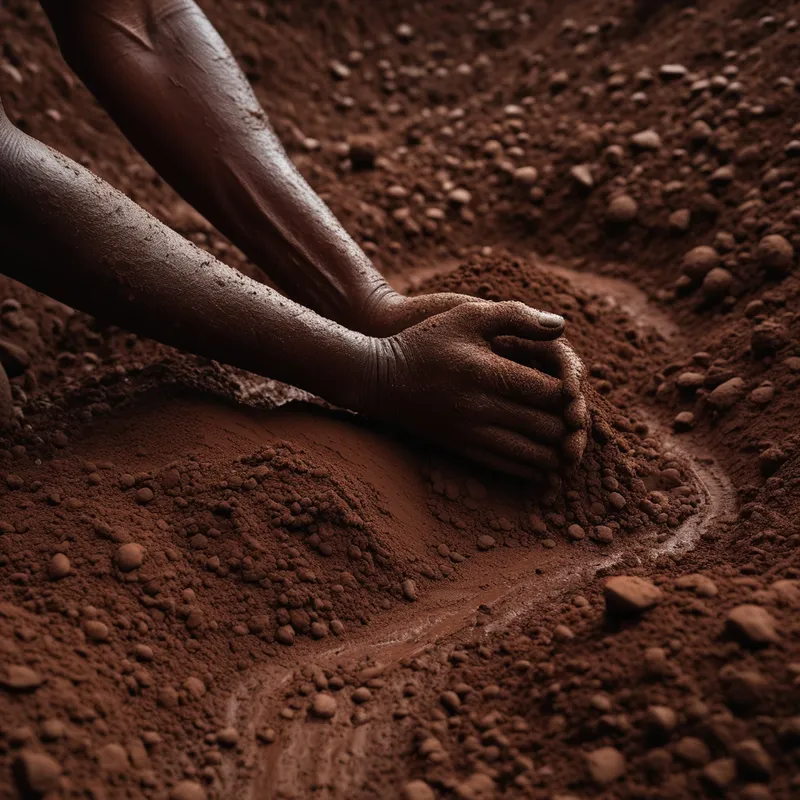
The act of healing is profoundly alchemical. Jesus uses the humblest of materials—spit and [dust](/symbols/dust “Symbol: Dust often symbolizes neglect, forgotten memories, or the passage of time and life’s impermanence.”/)—the very substance of the human [body](/symbols/body “Symbol: The body in dreams often symbolizes the dreamer’s self-identity, personal health, and the relationship they have with their physical existence.”/) (Adamah, [earth](/symbols/earth “Symbol: The symbol of Earth often represents grounding, stability, and the physical realm, embodying a connection to nature and the innate support it provides.”/)). This signifies that the divine work happens through the earthly and the embodied, not by escaping it. The instruction to wash in Siloam completes the act; the healing requires the man’s own participation, his [journey](/symbols/journey “Symbol: A journey in dreams typically signifies adventure, growth, or a significant life transition.”/) of [faith](/symbols/faith “Symbol: A profound trust or belief in something beyond empirical proof, often tied to spiritual conviction or deep-seated confidence in people, ideas, or outcomes.”/). The gained [sight](/symbols/sight “Symbol: Sight symbolizes perception, awareness, and insight, representing both physical and inner vision.”/) symbolizes [gnosis](/symbols/gnosis “Symbol: Direct, intuitive spiritual knowledge or enlightenment that transcends ordinary understanding, often associated with mystical experiences and esoteric traditions.”/)—direct, experiential [knowledge](/symbols/knowledge “Symbol: Knowledge symbolizes learning, understanding, and wisdom, embodying the acquisition of information and enlightenment.”/) that shatters old paradigms.
The Pharisees symbolize the rigid, ruling consciousness—the egoic [structure](/symbols/structure “Symbol: Structure in dreams often symbolizes stability, organization, and the framework of one’s life, reflecting how one perceives their environment and personal life.”/) built on law, tradition, and categorical certainty. They are “the ones who see” yet are revealed to be truly blind because they refuse to accept the [evidence](/symbols/evidence “Symbol: Proof or material that establishes truth, often related to justice, guilt, or validation of beliefs.”/) that challenges their [system](/symbols/system “Symbol: A system represents structure, organization, and interrelated components functioning together, often reflecting personal or social order.”/). Their [interrogation](/symbols/interrogation “Symbol: A process of questioning, often intense or formal, seeking truth, confession, or deeper understanding through dialogue or artistic expression.”/) is the [psyche](/myths/psyche “Myth from Greek culture.”/)‘s [resistance](/symbols/resistance “Symbol: An object or tool representing opposition, struggle, or the act of pushing back against external forces or internal changes.”/) to transformative [insight](/symbols/insight “Symbol: A sudden, deep understanding of a complex situation or truth, often arriving unexpectedly and illuminating hidden connections.”/). Being “cast out” is the essential, painful step of individuation: leaving the collective consensus to stand in the [truth](/symbols/truth “Symbol: Truth represents authenticity, honesty, and the quest for knowledge beyond mere appearances.”/) of one’s own experience.
The Dreamer’s Resonance
When this myth pattern appears in modern dreams, it signals a profound shift in the dreamer’s perception. Dreaming of being blindfolded, of having obscured vision, or of a guide applying a substance to one’s eyes points to an unconscious readiness for a revelation. The psyche is preparing to “see” something that has been hidden—a repressed memory, a shadow aspect of [the self](/myths/the-self “Myth from Jungian culture.”/), the true nature of a relationship, or a calling that has been ignored.
The somatic experience might be one of frustration in the dream, followed by a moment of startling clarity or even overwhelming sensory overload upon “seeing.” This reflects the psychological process of insight breaking through defense mechanisms. The dream may also feature figures of authority (bosses, parents, internal critics) denying or interrogating the dreamer’s new perspective, mirroring the internal conflict between the emerging self and the old, internalized rules. Such a dream marks a critical threshold in the process of moving from a life lived by default to one lived by conscious design.

Alchemical Translation
The myth models the complete arc of psychic transmutation, or individuation. The [nigredo](/myths/nigredo “Myth from Alchemical culture.”/), the initial blackening, is the man’s lifelong blindness—the felt sense of lack, limitation, and unconsciousness. The albedo, the whitening, begins with the application of mud (the mixing of opposites: spirit/spit and matter/dust) and culminates in the washing—a purification through one’s own action. This is the stage of insight, the “aha” moment where a complex is made conscious.
The real alchemical fire, the [rubedo](/myths/rubedo “Myth from Alchemical culture.”/) or reddening, is not the healing itself, but the subsequent confrontation and exile. The new consciousness must endure the searing trial of the old order’s rejection. The man’s logical, steadfast testimony represents the conscious ego fortifying itself around the new truth. Being cast out is the necessary death of the old identity attached to the collective.
The ultimate gold produced is not mere sight, but sovereign witness. It is the unshakeable “I know” born of direct experience, which allows the individual to finally recognize and unite with the source of the transformation (“Lord, I believe”).
For the modern individual, this translates to any profound awakening—psychological, spiritual, or creative. It begins with a nagging sense of blindness in some life domain. A catalyst (therapist, crisis, book, encounter) applies the “mud” of uncomfortable truth. The individual must then actively engage (“wash”) by integrating this insight. The true test follows: facing the internal and external voices that deny the change. The [triumph](/myths/triumph “Myth from Roman culture.”/) is the stabilization of a new, more authentic identity, no longer defined by the old wound or the world’s judgment, but grounded in hard-won, personal truth. The myth assures us that the journey from darkness to light, though isolating, ends in a deeper communion with the authentic self.
Associated Symbols
Explore related symbols from the CaleaDream lexicon: