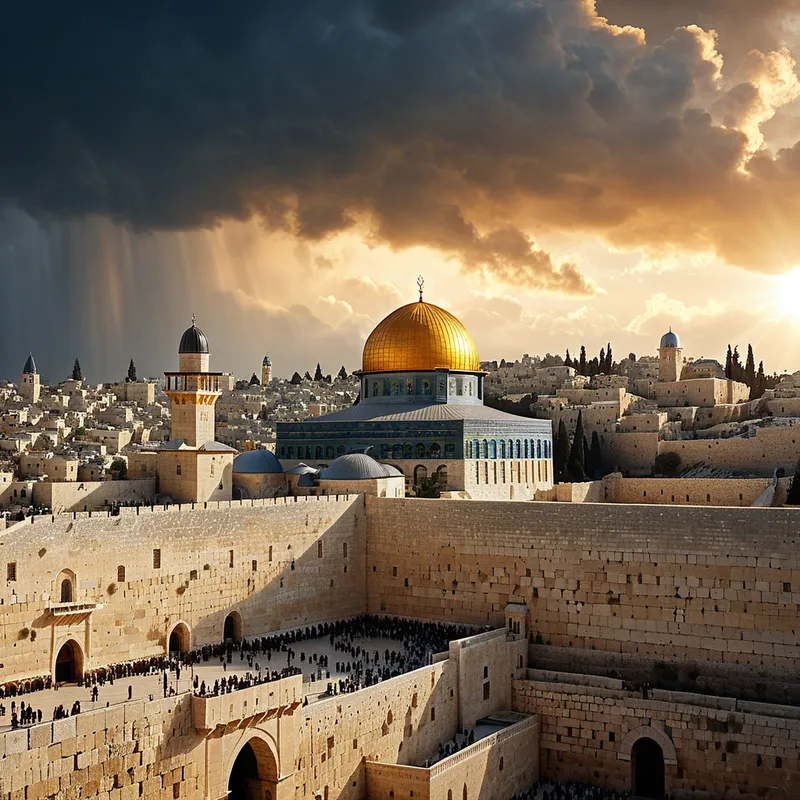
Jerusalem Myth Meaning & Symbolism
A city of stone and spirit, eternally built, destroyed, and rebuilt, embodying humanity's quest for divine presence and the sacred center of the self.
The Tale of Jerusalem
Hear now the tale of the city that is a mountain, and the mountain that is a promise.
In the beginning, it was a threshing floor. A place of chaff and grain, of simple, earthly toil, perched on a wind-scoured ridge called Moriah. But the earth remembered a cry. It remembered the binding of a son, the raised knife, and the voice that stayed the hand. The stone drank that terror and that faith, and became holy.
Centuries flowed like desert rivers, sometimes flooding, often dry. Then came a king, a man of blood and psalms, who saw not a threshing floor but a center. David, the shepherd who felled giants, captured the stronghold of Zion. He brought the Ark of the Covenant into the city with dancing and shouting, and the very stones trembled with a new frequency—the pulse of a unified kingdom, a heart for the people.
His son, Solomon, the man of peace, built a house not of war, but of presence. For seven years, the ridge rang with the sound of hammer on stone, of cedar being fitted, of gold being beaten thin as breath. He built the First Temple upon that same rock of Moriah, and when it was done, a cloud filled the house—a thick, palpable silence of the divine descending to dwell. Jerusalem was no longer just a city; it was a dwelling place. The navel of the world.
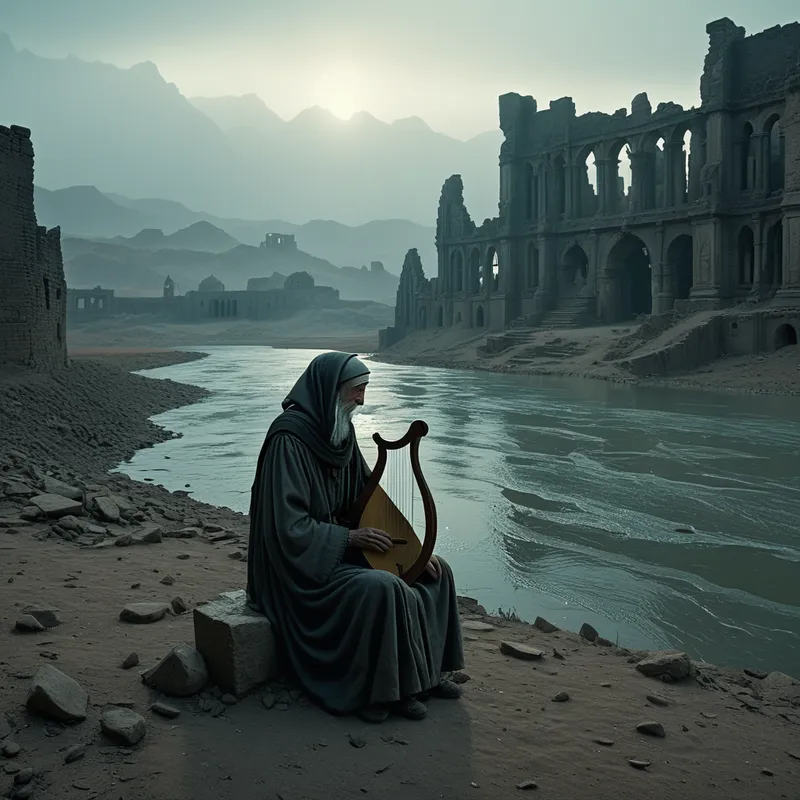
But hearts turned to other gods. The unity shattered like pottery. Prophets arose, voices raw as the wind, crying Jerusalem, Jerusalem! They saw not gold and glory, but a whited sepulcher, a faith grown cold. And the Babylonians came. They came with fire and iron. They shattered the carved cherubim, looted the gold, and burned the House to the ground. The people were dragged away, and by the rivers of Babylon, they sat and wept, hanging their harps on the willow trees. Zion was a memory, a ghost in the smoke.
Yet, the ghost would not die. A remnant returned, heartsick and determined. With trowels in one hand and swords in the other, they rebuilt the walls under Nehemiah's fierce gaze. A smaller, humbler temple rose under Haggai's urging. Jerusalem was resurrected, not in its former glory, but in stubborn hope.
Centuries more, and a different king rode through its gates, humble and on a donkey. He taught in its courts, wept over its future, and was broken outside its walls. In this, the myth deepened: the city that kills the prophets became the altar for the ultimate sacrifice. It was destroyed again, by Rome, the temple burned, leaving only a wall of weeping stones.
And so the tale cycles: building, dwelling, forgetting, shattering, weeping, returning. Jerusalem is not a place that is, but a place that is yearned for. It is the song by the river, the tear on the cheek, the next stone laid in the wall. It is always being lost, and always being found.
Cultural Origins & Context
The myth of Jerusalem is not a single story but a living tapestry woven over millennia by poets, prophets, priests, and pilgrims. Its origins are entwined with the tribal confederacy of ancient Israel and its evolution into a monarchy. It functioned as the ultimate political and theological symbol: the divinely chosen capital for a divinely chosen people. The myth was passed down through the Torah, the historical books, the Psalms (which are essentially the city's lyrical soul), and the prophetic literature.
Its primary tellers were the prophets—figures like Isaiah, Jeremiah, and Ezekiel—who acted as the city's psychoanalysts, diagnosing its spiritual illnesses and envisioning its future healing. The myth served critical societal functions: it provided a rationale for political unity under the Davidic king, a focal point for religious ritual (especially pilgrimage festivals), and, most crucially after the destruction of the Temple, a powerful narrative of identity and hope for a dispersed people. It answered the existential crisis of exile with a story of eternal return.
Symbolic Architecture
Psychologically, Jerusalem is the archetype of the Axis Mundi—the center of the world and the self. It represents the longed-for state of psychic integration, where the divine (the transcendent function) dwells in harmony with the human (the ego).
Jerusalem is the soul's attempt to build a permanent structure for the ephemeral experience of the sacred.
The cyclical destruction and rebuilding mirror the necessary deconstruction and renewal of the personality. The ego's proud, Solomon-like temples must be burned by the Babylonians of the unconscious—by repressed shadow, by neurosis, by life's tragedies—so that a more authentic, humbler structure can be raised from the ashes. The Even Shetiyah (Foundation Stone) symbolizes the indestructible core of the Self, the bedrock of identity beneath all the historical and personal cataclysms.
The city’s dual nature—heavenly Jerusalem versus earthly Jerusalem—reflects the tension between our ideal self (the perfect, peaceful vision) and our actual, flawed condition (the city of conflict and betrayal). The myth insists that wholeness is found not by escaping the earthly, but by bringing the heavenly vision down into the very stones of our daily reality.
The Dreamer's Resonance
To dream of Jerusalem is to dream of one's own center. It often appears when the dreamer is in a state of transition, exile, or seeking deeper meaning.
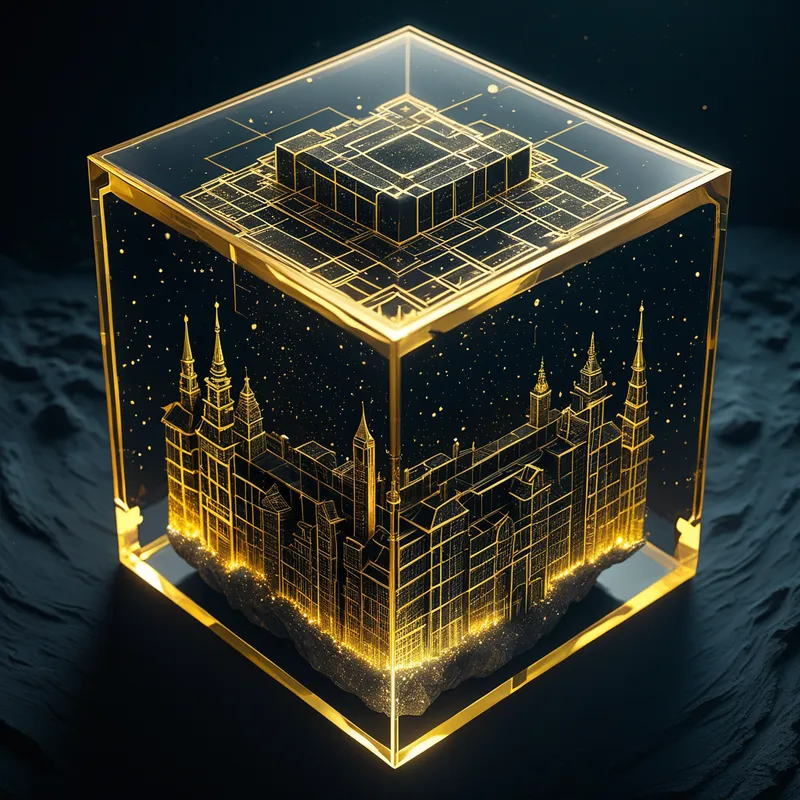
- Dreaming of a glorious, golden city on a hill may signal an awakening to one's potential or a call toward a higher purpose or integration.
- Dreaming of a ruined, desolate, or besieged Jerusalem often correlates with feelings of spiritual emptiness, a crisis of faith (in oneself, a relationship, or a life path), or a period of profound personal deconstruction. The somatic feeling is often one of deep longing or grief.
- Dreaming of trying to find or return to the city, but being lost or blocked, speaks to the struggle of the individuation journey—knowing wholeness exists but finding the path fraught with obstacles.
- Dreaming of building or repairing its walls indicates active, conscious work on ego boundaries, values, and personal integrity after a period of violation or collapse.
The dream city is a mirror of the psyche's current relationship to the Self. Is it accessible, distant, in ruins, or under construction? The dream prompts the dreamer to ask: Where is my sacred center? What in me needs to be rebuilt?

Alchemical Translation
The alchemical process mirrored in the Jerusalem myth is the Opus Magnum—the Great Work of turning lead into gold, fragmentation into wholeness.
Nigredo (The Blackening): The destruction by Babylon or Rome. This is the necessary descent, the exile by the rivers of despair. In life, it is the loss, failure, depression, or shock that utterly dismantles our conscious worldview. The temple burns. This stage feels like death, but it is the first, crucial dissolution of the old, rigid structures of the personality.
Albedo (The Whitening): The weeping by the rivers, the mourning, the honest accounting of loss represented by the Western Wall. This is the stage of reflection, purification, and the emergence of lunar consciousness—the quiet, reflective light in the darkness. It is the tears that wash the eyes to see anew.
Citrinitas (The Yellowing): The dawn of a new understanding. The voice of the prophets shifts from judgment to consolation. "Isaiah's vision of a peaceable kingdom emerges. This is the first glint of solar wisdom, the intellectual and spiritual insight that guides the return.
Rubedo (The Reddening): The return and rebuilding. This is the integration of the spirit into matter, the passionate, committed labor of Nehemiah and Haggai. It is not a return to the old, grandiose glory, but the construction of something humbler, more resilient, and more authentic. The blood, sweat, and tears of conscious effort unite the heavenly vision with the earthly stone.
The goal is not to live in an untouchable, golden city, but to become the living temple where the divine and the human converse.
For the modern individual, the myth teaches that our wholeness is not a static achievement but a dynamic, cyclical process of building, dwelling, losing, grieving, and rebuilding. Our true Jerusalem is not a geographic location, but the ongoing, courageous act of making a dwelling place for meaning at the very center of our being, again and again.
Associated Symbols
Explore related symbols from the CaleaDream lexicon: