Jericho Myth Meaning & Symbolism
A city of stone falls not to swords, but to a sacred procession and a final, shattering cry of faith, revealing the power of the unseen.
The Tale of Jericho
Hear now of the walls that fell to a shout.
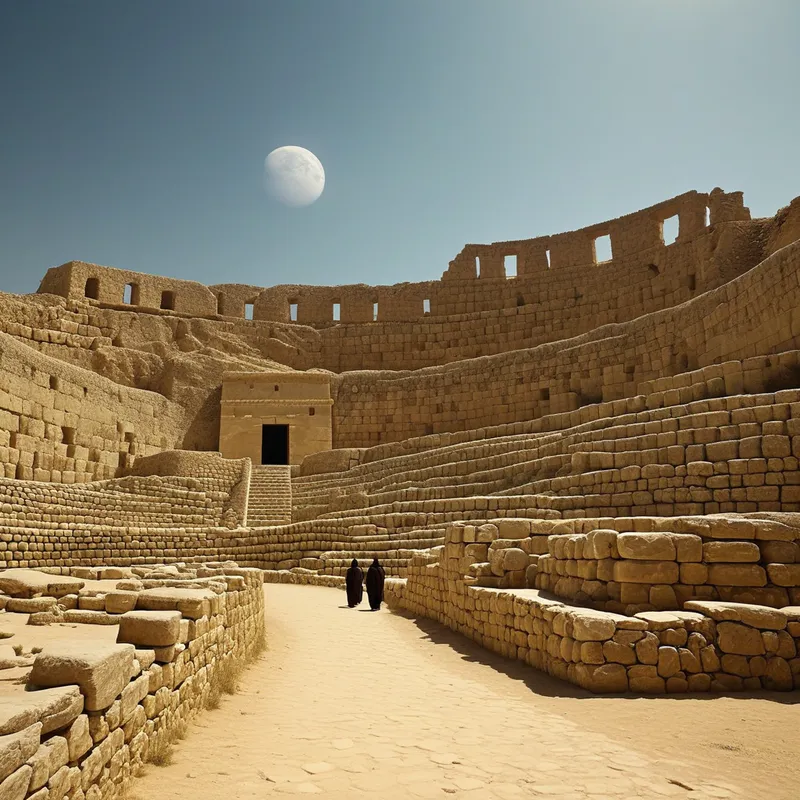
For forty years, the dust of the wilderness had clung to them, a people forged in the crucible of sand and promise. Now, they stood on the plains of Canaan, and before them rose Jericho. Not a city, but a mountain of worked stone, a clenched fist against the sky. Its gates were shut, barred tight against the world. Behind those walls, breath was held. Fear was a taste in the dry air.
But the command came not for siege engines, nor for scaling ladders. It came as a strange and sacred rhythm. Joshua, his face like weathered leather from a lifetime of looking toward a far-off land, spoke the divine strategy. It was a liturgy of encirclement.
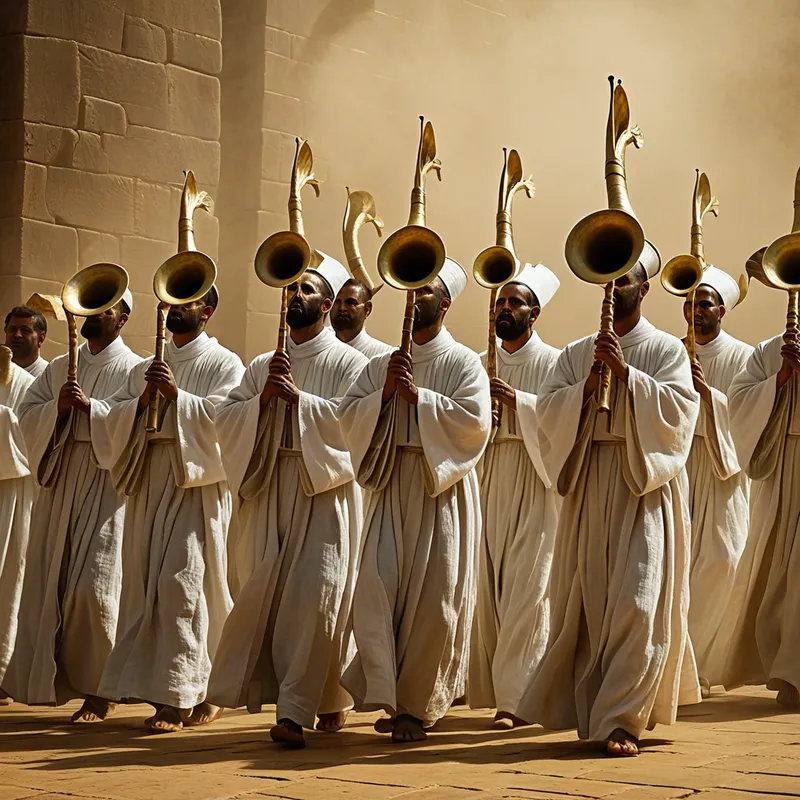
For six days, as the sun beat its timeless drum, a silent procession unfolded. Armed men walked first, a river of determined quiet. Behind them came seven priests, bearing seven trumpets of rams' horns, their instruments silent. And in the center, borne on the shoulders of priests, was the Ark of the Covenant—the terrible and glorious presence of the Lord. They marched once around the immense wall, a single, solemn circuit, and returned to their camp. The only sound was the shuffle of sandals on grit and the pounding of hearts. From the battlements, watchful eyes saw only a bizarre, silent parade.
On the second day, they did it again. And the third. A creeping, tightening ritual. The silence grew heavier than the stones. By the sixth circuit on the sixth day, the air itself seemed pregnant with a coming storm. The people of Jericho peered down, confusion curdling into a deeper dread. What kind of warfare was this?
Then came the seventh day. They rose in the violet pre-dawn and began to march. Not once, but seven times they traced the city’s perimeter. The world held its breath for the first six circuits. On the seventh, as the procession completed its final turn, Joshua raised his hand. The priests put the horns to their lips.
And the silence shattered.
A raw, blaring cry from the seven horns tore the morning. At that signal, Joshua’s voice boomed out to the people: “Shout! For the Lord has given you the city!”
Then a sound rose from thousands of throats—not a battle cry, but a great, collective roar of release, of faith made audible. It was a thunder born of human breath, crashing against the stone.
And the wall answered.
From its foundations to its highest parapet, the mighty wall of Jericho trembled. A deep groan echoed from within the earth. Stones ground against stones. Then, with a roar that drowned the shout, the wall fell. It fell flat, every section collapsing inward and outward at once, as if the ground beneath it had simply opened its mouth. The people charged, not over the walls, but straight forward, over the rubble that was now a ramp.
The city, sealed tight as a tomb, was laid open to the sky. The fist unclenched. The shout had done what armies could not.
Cultural Origins & Context
The story of Jericho is embedded in the Pentateuch and the Book of Joshua, forming a cornerstone of the Conquest narrative. It functions as a foundational etiological myth, explaining how the Israelites came to possess the land promised to them. Historically, while archaeological evidence for a massive, simultaneous Late Bronze Age collapse at Jericho is debated, the myth’s power is not in its literal historicity but in its theological and social function.
Passed down orally and later codified by priestly and deuteronomistic editors, this tale was told at campfires and in temples to solidify a collective identity. It served as a potent reminder that the community’s strength and survival were not rooted in conventional military might or superior technology, but in radical obedience to a divine covenant. The story established Joshua’s legitimacy as Moses’s successor and framed the possession of the land as an act of divine gift, not merely human conquest. It reinforced a worldview where the natural order—even the laws of physics embodied by a city wall—could be suspended by sacred protocol and collective faith.
Symbolic Architecture
Psychologically, Jericho represents the ultimate projection. It is the seemingly impregnable fortress of the Other, the externalized obstacle that appears absolute, permanent, and alien. Its walls symbolize the hardened structures of a psyche or a society: rigid defenses, fossilized beliefs, entrenched complexes, and old identities that feel as solid as stone.
The most formidable walls are not made of stone, but of the conviction that they cannot fall.
The Israelite strategy is a blueprint for a psychological operation that bypasses direct, ego-driven assault. The silent marching represents the patient, ritualistic work of consciousness circling the problem—observing it, containing it, without engaging it on its own terms. The seven priests with horns signify the call (the shofar blast) that awakens and marshals unconscious, numinous energies. The Ark is the symbolic center of the Self, the guiding transcendent principle.
The seven days and seven circuits are the archetypal pattern of complete, sacred process. The final shout is the critical moment of integration, where the focused intention of the conscious mind (the strategy) merges with the raw, eruptive power of the collective unconscious (the roar of the people). The collapse is not a destruction from without, but a dissolution from within—the moment a complex, when fully confronted and surrounded by conscious attention, loses its power and simply disintegrates, revealing that its substance was never as solid as it seemed.

The Dreamer's Resonance
When this myth stirs in the modern unconscious, it often manifests in dreams of impossible barriers: endless walls, locked doors with no key, or vast fortresses one must enter. The dreamer may find themselves walking in circles around a problem or hearing a distant, compelling sound. There is a somatic quality of mounting tension, a pressure that builds over a seemingly repetitive, futile action.
This dream pattern signals that the psyche is engaged in a profound process of de-structuring. The ego is confronting a defense system—perhaps a lifelong pattern of avoidance, a core belief like “I am not worthy,” or a traumatic memory walled off from access. The conscious mind is doing the “silent marching”: the therapy sessions, the journaling, the mindful observation. The dream is the symbolic field where this ritual containment is playing out. The eventual “shout” in the dream might be a sudden insight, an emotional breakthrough, or a somatic release like shaking or crying. The collapse of the wall is the felt sense of the complex losing its charge, the liberation that comes when what was perceived as an eternal, external obstacle is recognized as an internal construct that can be traversed.

Alchemical Translation
The alchemy of Jericho is the transmutation of opus contra naturam—work against nature—into a revelation that the “natural” obstacle was an illusion. For the individual on the path of individuation, the myth models the necessary stages of confronting the shadow and dismantling the persona.
First, the Recognitio: Seeing the “Jericho” in one’s life—the career that feels like a prison, the relationship pattern that is a closed circuit, the addiction that is a walled city. One must name it and approach it, not with brute force, but with sacred intent.
Second, the Circumambulatio: The patient, often frustrating work of circling. This is the analysis, the repetition of healthy habits, the daily meditation that seems to change nothing. It is the gathering and focusing of psychic energy around the issue, starving the complex of its chaotic power by containing it in conscious ritual.
The work is in the walking, not the falling. The collapse is merely the truth becoming audible.
Third, the Clamor: The critical, active gesture of the will aligned with the Self. This is the moment of speaking one’s truth after years of silence, the creative act that breaks a lifelong block, the forgiveness that releases an ancient grudge. It is a vote of no confidence in the reality of the wall.
The final Ruina is the alchemical solve—the dissolving of the old form. The ego does not achieve this; it witnesses it as a grace born of the completed work. The rubble is the prima materia for the new life. One does not live in the rubble of Jericho; one uses its stones to build a new path forward. The triumph is not in the conquest of an other, but in the reclamation of a land within—the fertile ground of the psyche that was always there, waiting behind the wall of illusion.
Associated Symbols
Explore related symbols from the CaleaDream lexicon: