
Jason and the Golden Fleece Myth Meaning & Symbolism
A prince's quest for a magical fleece becomes a perilous journey of betrayal, impossible tasks, and the high cost of a promised throne.
The Tale of Jason and the Golden Fleece
Hear now the tale of a stolen throne and a fleece of sun. In the shadowed halls of Iolcus, a usurper king, Pelias, trembled at an oracle’s whisper: beware the man with one sandal. And so he came, a stranger from the mountain wilds, [Jason](/myths/jason “Myth from Greek culture.”/), who had lost a shoe crossing a raging river. His eyes held the clear, untamed light of the hero. Pelias, feigning welcome, spun a trap of glittering poison. “The throne is yours,” he said, “if you bring back to Colchis the fleece of the golden ram, that which saved the children of the cloud.”
Thus the great quest was born. From every corner of Hellas, the mightiest of men answered the call: [Heracles](/myths/heracles “Myth from Greek culture.”/), the divine musician [Orpheus](/myths/orpheus “Myth from Global/Universal culture.”/), the swift sons of the North Wind. They built the first true ship, the Argo, from timber that spoke prophecy. Its prow was hewn from [the sacred oak](/myths/the-sacred-oak “Myth from Celtic culture.”/) of Dodona, and it whispered warnings on [the wind](/myths/the-wind “Myth from Various culture.”/).
Their voyage was a tapestry of wonders and terrors. They fought the Gegeines on a lonely shore. They outwitted the seductive, soul-snatching songs of the [Sirens](/myths/sirens “Myth from Greek culture.”/) only because Orpheus’s lyre sang a sweeter, truer strain. They navigated the Symplegades, the crashing rocks that devoured ships, releasing a dove to chart their path and rowing with the strength of desperation as the stone jaws snapped at their stern.
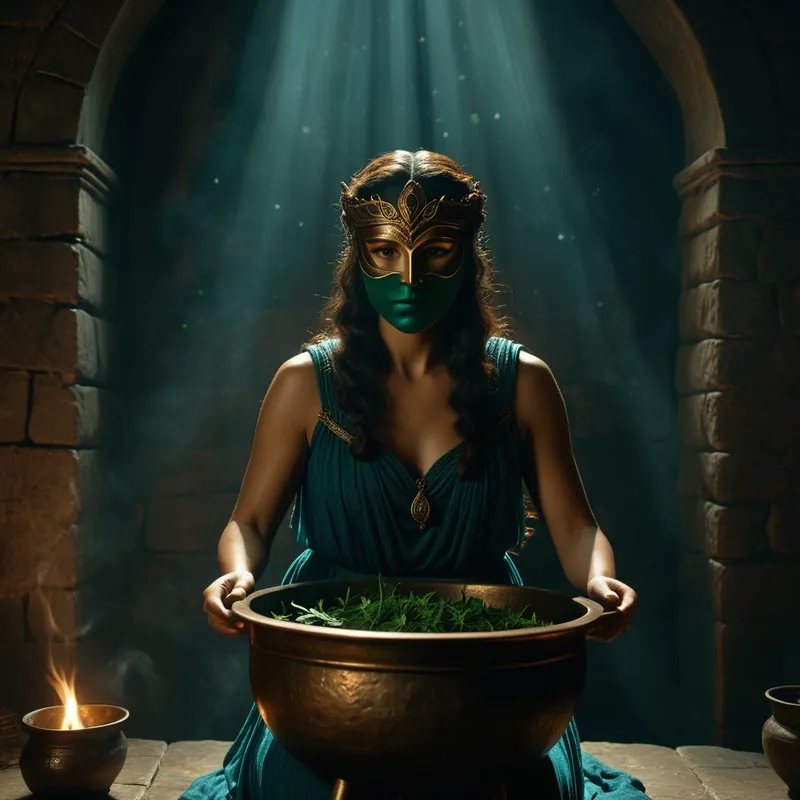
In Colchis, under the cold gaze of King Aeëtes, Jason’s true trial began. The price for the Fleece was impossible: yoke fire-breathing bulls of bronze, plow a field with them, and sow the teeth of [the dragon](/myths/the-dragon “Myth from Chinese culture.”/) of Cadmus, which would sprinto armed men he must then slay. Here, the story turns. For the king’s daughter, the witch-priestess [Medea](/myths/medea “Myth from Greek culture.”/), was pierced by the arrows of Aphrodite. She looked upon Jason and saw her destiny, and in that seeing, betrayed her father and her home.
With Medea’s arts—a potion to make him invulnerable to fire and bronze, a stone to turn the sown men against each other—Jason conquered the field. But the Fleece still hung in [the sacred grove](/myths/the-sacred-grove “Myth from Celtic culture.”/) of Ares, guarded by a sleepless dragon that never closed its coils. Again, Medea acted. With a drugged potion and a whispered spell, she lulled the great serpent into a deep, enchanted sleep. And there, in the hushed, holy darkness, Jason reached out. He took the Fleece from the ancient oak. It shone with a light that was not of fire or sun, but of a promise fulfilled and a doom invoked. Their flight was swift, bloody, and paved with further betrayal, as Medea dismembered her own brother to delay her father’s pursuit. They returned to Iolcus, but the golden prize was already tarnished with the blood of kin.
Cultural Origins & Context
The saga of Jason is one of the oldest and most complex strands in the Greek mythological tapestry, a foundational “road movie” of the ancient world. Its most complete surviving version comes from the Hellenistic poet Apollonius of Rhodes in his Argonautica, but the story’s roots dig far deeper, likely into pre-Homeric oral traditions. It belongs to the cycle of tales concerning the generation of heroes before [the Trojan War](/myths/the-trojan-war “Myth from Greek culture.”/), a time of exploration and the pushing of boundaries, both geographical and moral.
The myth functioned as a charter story for Greek colonization and interaction with the distant, “barbaric” East, symbolized by Colchis (modern Georgia). The voyage of [the Argo](/myths/the-argo “Myth from Greek culture.”/) mapped a psychic and physical frontier, cataloging the monstrous and marvelous wonders believed to exist at the edges of the known world. It was told not just as entertainment, but as a narrative that explored the tensions between raw heroic ambition (arete) and the cunning intelligence ([metis](/myths/metis “Myth from Greek culture.”/)) needed to survive, between the claims of the individual quest and the devastating collateral damage it often required.
Symbolic Architecture
At its [heart](/symbols/heart “Symbol: The heart symbolizes love, emotion, and the core of one’s existence, representing deep connections with others and self.”/), [the Golden Fleece](/myths/the-golden-fleece “Myth from Greek culture.”/) is an [emblem](/symbols/emblem “Symbol: A symbolic design representing identity, authority, or ideals, often used in heraldry, logos, or artistic expression.”/) of stolen legitimacy and the [soul](/symbols/soul “Symbol: The soul represents the essence of a person, encompassing their spirit, identity, and connection to the universe.”/)’s lost integrity. It is the [prima materia](/myths/prima-materia “Myth from Alchemical culture.”/) of [the Self](/myths/the-self “Myth from Jungian culture.”/), a numinous object that represents rightful kingship, divine [favor](/symbols/favor “Symbol: ‘Favor’ represents the themes of acceptance, goodwill, and the desire for approval from others.”/), and wholeness, but it is kept in a faraway land, guarded by [chaos](/symbols/chaos “Symbol: In Arts & Music, chaos represents raw creative potential, uncontrolled expression, and the breakdown of order to forge new artistic forms.”/) (the [dragon](/symbols/dragon “Symbol: Dragons are potent symbols of power, wisdom, and transformation, often embodying the duality of creation and destruction.”/)) and a hostile, [trickster](/symbols/trickster “Symbol: A boundary-crossing archetype representing chaos, transformation, and the subversion of norms through cunning and humor.”/) [king](/symbols/king “Symbol: A symbol of ultimate authority, leadership, and societal order, often representing the dreamer’s inner power or external control figures.”/). Jason’s [quest](/symbols/quest “Symbol: A quest symbolizes a journey or search for purpose, fulfillment, or knowledge, often representing life’s challenges and adventures.”/) is not for something new, but for the [recovery](/symbols/recovery “Symbol: The process of returning to health, strength, or normalcy after illness, injury, or loss; a journey of healing and restoration.”/) of something that is rightfully his, yet impossibly distant.
The quest is always for what has been lost, forgotten, or stolen away to the edge of the world. The hero does not invent his destiny; he remembers it, and in remembering, must undertake the perilous journey to reclaim it.
Jason himself is an intriguingly “hollow” [hero](/symbols/hero “Symbol: A hero embodies strength, courage, and the ability to overcome significant challenges.”/). Unlike Heracles with his brute [strength](/symbols/strength “Symbol: ‘Strength’ symbolizes resilience, courage, and the ability to overcome challenges.”/) or [Odysseus](/myths/odysseus “Myth from Greek culture.”/) with his guile, Jason is often a passive figure, a [vessel](/symbols/vessel “Symbol: A container or structure that holds, transports, or protects something essential, representing the self, emotions, or life journey.”/) for the will of others—Pelias’s challenge, [the Argonauts](/myths/the-argonauts “Myth from Greek culture.”/)’ loyalty, and most crucially, Medea’s magic. He is [the ego](/myths/the-ego “Myth from Jungian culture.”/)-[consciousness](/symbols/consciousness “Symbol: Consciousness represents the state of awareness and perception, encompassing thoughts, feelings, and experiences.”/) setting out with a collective mandate, utterly unequipped for the unconscious, magical, and ruthless realities of the deep [psyche](/myths/psyche “Myth from Greek culture.”/) (Colchis). His success is entirely dependent on his [alliance](/symbols/alliance “Symbol: A formal or informal union between individuals or groups for mutual benefit, support, or protection.”/) with Medea, who embodies the rejected, instinctual, and chthonic feminine wisdom—the [anima](/symbols/anima “Symbol: The feminine archetype within the male unconscious, representing soul, creativity, and connection to the inner world.”/) in its most potent and dangerous form.
Medea is the true catalyst and the myth’s tragic core. She represents the transformative power of the unconscious that can enable the ego’s [triumph](/myths/triumph “Myth from Roman culture.”/), but at a catastrophic price: the severing of roots, the [betrayal](/symbols/betrayal “Symbol: A profound violation of trust in artistic or musical contexts, often representing broken creative partnerships or artistic integrity compromised.”/) of the old order (her [father](/symbols/father “Symbol: The father figure in dreams often symbolizes authority, protection, guidance, and the quest for approval or validation.”/)), and the unleashing of a feral, unbound power that the conscious hero cannot ultimately integrate or control.
The Dreamer’s Resonance
When this myth stirs in the modern dreamer, it often signals a profound, life-altering quest has been activated in the psyche. Dreaming of a sacred, unattainable object (the Fleece) points to a deep yearning for authenticity, purpose, or a sense of rightful place that feels just out of reach. The dreamer may feel like Jason at the start: one-shoed, unprepared, but compelled by an inner or outer “king” to prove themselves.
Dreams of impossible tasks—yoking monstrous beasts, fighting self-generated armies (the sown men)—mirror somatic feelings of being overwhelmed by primal energies (anger, passion, ambition) or internal conflicts that seem to multiply. The appearance of a guiding but morally ambiguous helper figure (the Medea archetype) suggests the dreamer is encountering, or will need to rely upon, powerful instinctual knowledge, creative fury, or a part of the self they have previously feared or rejected. This is not a gentle process; it feels like betrayal of old ways and often carries the chilling, exhilarating scent of magic and ruthlessness necessary for survival and breakthrough.

Alchemical Translation
The myth of Jason is a brutal alchemical recipe for individuation. The [nigredo](/myths/nigredo “Myth from Alchemical culture.”/), the initial blackening, is the usurped throne—the state of inner dislocation and stolen authority. The call to quest is the stirring of the Self, demanding the reclamation of the golden, integrated state.
The voyage itself is the albedo, the whitening or purification through ordeal. Each monster overcome—the clashing rocks, the seductive sirens—represents the confrontation with and integration of a psychic complex, refining the ego’s ability to navigate the turbulent waters of the unconscious.
Colchis is [the crucible](/myths/the-crucible “Myth from Alchemical culture.”/) of the [rubedo](/myths/rubedo “Myth from Alchemical culture.”/), the reddening or final transmutation. Here, the conscious ego (Jason) must submit to and unite with the transformative, non-rational power of the soul (Medea) to accomplish the impossible. The fire-breathing bulls are the raw, destructive passions that must be yoked and directed into creative work (plowing the field). The dragon’s teeth are the seeds of old, armored defenses and habitual conflicts that, when sown, rise up as adversaries; they can only be overcome by cunning (the stone) that turns them against each other—a process of allowing internal contradictions to cancel each other out.
The ultimate treasure is always guarded by what we fear most: the dormant, coiled power of our own instinctual nature. To gain the Fleece, one must not slay the dragon, but learn its secret language and persuade it to sleep.
The triumphant return with the Fleece is not a happy ending, but the beginning of a more complex and shadowed phase of [the opus](/myths/the-opus “Myth from Alchemical culture.”/). The golden prize is now stained with the blood of betrayal (Medea’s brother, later her own children). This teaches the final, sobering lesson of alchemy: the integrated Self is not a state of pure light, but a wholeness that includes the darkness of the methods used to achieve it. The throne may be regained, but the kingdom within is forever changed, bearing the scars and the terrible wisdom of the journey. The quest ends not in simple victory, but in a hard-won, costly sovereignty.
Associated Symbols
Explore related symbols from the CaleaDream lexicon: