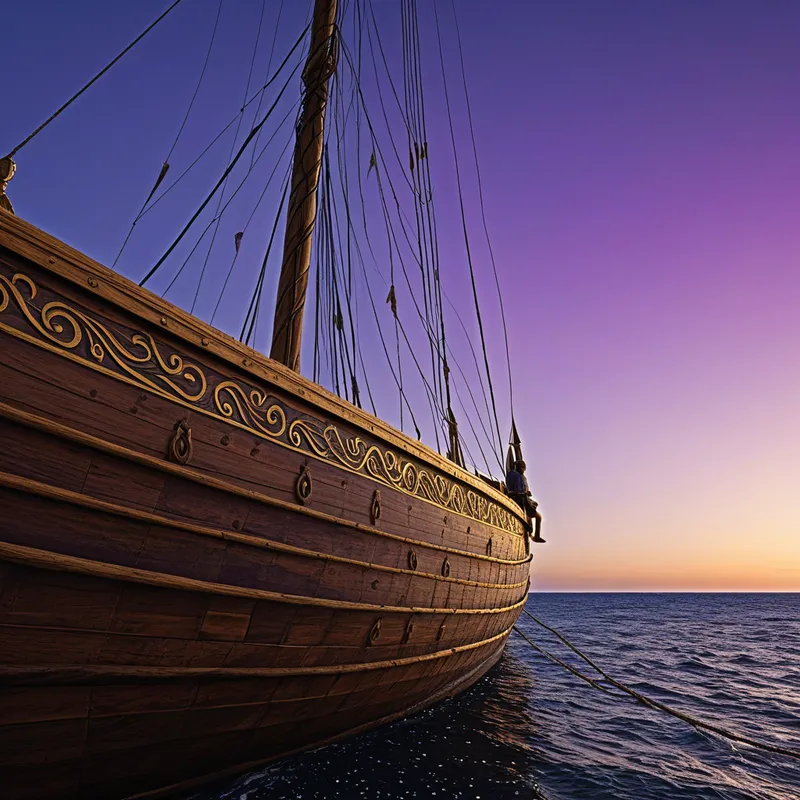
Jason and the Argonauts depart Myth Meaning & Symbolism
A usurped prince gathers a legendary crew to reclaim his throne, launching a perilous sea voyage that becomes the archetype of the collective quest.
The Tale of Jason and the Argonauts depart
The salt air of Iolcus was thick with the scent of pine pitch and destiny. On the pebbled shore, a ship unlike any other rested, its hull singing a silent hymn to the forest and the axe. This was the Argo, born of sacred timber and divine craft. And before it stood a man with one sandal, his eyes holding the storm of a stolen throne.
He was Jason, son of Aeson, rightful king, raised in the shadowed valleys by the wise centaur Chiron. His return was an omen, his missing sandal a sign that the usurper, his uncle Pelias, could not ignore. "What would you do," Pelias had asked, his voice slick as oil, "if a one-sandaled man threatened your rule?" And Jason, young, aflame with the hero's unthinking fire, had declared, "I would send him to fetch the impossible." Thus, the trap was sprung: bring back the Golden Fleece from the land of Colchis, a prize guarded by a dragon and a sorcerer-king, and the throne would be his.
But a call had gone out, a vibration through the marrow of the age. It sang to the restless, the wronged, the glory-hungry. From every corner of the known world, they came. Here was Heracles, his lion-skin cloak a testament to conquered nightmares. Here were the Dioscuri, Castor and Polydeuces, one mortal, one divine, bound in brotherhood. The swift Atalanta stood among them, a woman in a world of men, her presence a quiet revolution. The seer Idmon foretold both glory and loss. The musician Orpheus carried a lyre that could soothe stones and still storms. Fifty souls, a constellation of might and magic, each a legend in their own right, yet bound now to a single mast, a single purpose.
As the first light of dawn gilded the Pelion peaks, they gathered. Libations were poured to Poseidon, patron of the deep. Prayers were whispered to Athena, whose own hand was said to have placed the ship's sacred, speaking beam from the grove of Dodona. The air crackled with the tension of a bowstring about to be loosed. Jason raised a horn. A final, collective breath was drawn from the land. Then, with a great heave and a cry that split the morning, the Argo slid into the wine-dark sea. The oars dipped as one, and the water churned into a path of foam and farewell. They did not look back. The shore receded, and with it, the world of the known. Ahead lay only the whispering horizon, the Symplegades' clashing rocks, and the distant, glittering promise of a fleece that held not just wool, but the very fabric of a king's destiny. The voyage had begun. The first great quest was underway.

Cultural Origins & Context
The saga of Jason and the Argonauts is a foundational pillar of Greek mythology, with its earliest literary crystallization found in Apollonius Rhodius's epic poem, the Argonautica, from the 3rd century BCE. However, its roots are far older, woven from a rich oral tradition of bardic songs and local legends that circulated for centuries. This was a tale told by rhapsodes at feasts and in city squares, a story that served as a cultural map of the known (and imagined) world. The catalog of heroes—drawn from every major Greek region—transformed the narrative into a Panhellenic epic, a mythic project that united the disparate city-states in a shared, glorious past.
Societally, it functioned on multiple levels. It was an adventure story of the highest order, reinforcing ideals of heroism, arete, and glory (kleos). It was also a geographical and ethnographic exploration, populating the edges of the Black Sea with monsters, magic, and formidable kingdoms, thus defining Greek identity against the "other." Most profoundly, it modeled the concept of the collective endeavor. Unlike the solitary trials of Odysseus or Heracles, Jason's quest is inherently collaborative. His heroism is not in unparalleled strength, but in his ability to gather, to lead, and to rely on the specialized gifts of a community. The Argo itself becomes a microcosm of society, a fragile wooden world holding together a volatile mix of egos, destinies, and divine favor, sailing into the unknown.
Symbolic Architecture
At its heart, the departure of the Argonauts is the mythic enactment of the Call to Adventure, the irrevocable step across the threshold from the familiar into the realm of trial and transformation. Jason is not the completed hero at the outset; he is the potential for heroism, catalyzed by injustice and a seemingly impossible task.
The quest does not begin with a hero, but with a crew. The true vessel is not the ship, but the assembled psyche.
The Argo symbolizes the integrated Self under construction. Its talking beam, a gift from Athena, represents the guiding voice of intuition and wisdom embedded in the very structure of our endeavor. The fifty Argonauts are the disparate, often conflicting, faculties of the individual and collective psyche: brute strength (Heracles), prophetic insight (Idmon), artistic harmony (Orpheus), swift action (Atalanta), and brotherly love (the Dioscuri). Jason's role as leader is not to be all of them, but to provide the central purpose—the reclaiming of his rightful throne (authentic selfhood)—that temporarily unites their wild diversity. The Golden Fleece itself is the ultimate symbol of the numinous, elusive goal: it is kingship, wholeness, spiritual enlightenment, and the prize that can only be won by integrating the monstrous and the magical (the dragon and the sorceress Medea, who awaits later in the tale).

The Dreamer's Resonance
When this mythic pattern stirs in the modern unconscious, it often manifests in dreams of collective departure. One might dream of boarding a bus, a spaceship, or a raft with a group of familiar-yet-strange companions, setting off without a clear map. The somatic feeling is one of tense anticipation, a mixture of excitement and profound anxiety in the pit of the stomach.
Psychologically, this dream signals that the ego (Jason) has accepted a profound challenge from life—a new career, a creative project, a journey of healing—that is too vast to be undertaken alone. The "Argonauts" in the dream represent the internal and external resources being mobilized. The dreamer is in the process of gathering their inner "crew": their courage, their skill, their intuition, their supportive relationships. The anxiety reflects the ego's correct understanding that it is no longer in full control; it must rely on these other forces. It is the psyche's way of rehearsing the launch of a complex, life-altering endeavor where success depends on collaboration, both within oneself and with others. The dream is a snapshot of the soul preparing to weigh anchor.

Alchemical Translation
The alchemical process mirrored in the Argonauts' departure is the initial stage of nigredo—the dissolution of the old, comfortable state. Jason's comfortable life with Chiron is shattered by the confrontation with Pelias. The call to quest is the corrosive agent that breaks down the inert matter of a life lived by others' rules.
The voyage begins not when you find the goal, but when you lose the shore.
For the modern individual, this is the terrifying, necessary step of committing to one's own individuation journey. It is quitting the secure job to start the business, ending the lifeless relationship to face solitude, or finally dedicating oneself to the long-avoided creative work. The "building of the Argo" is the conscious preparation for this voyage: acquiring skills, building a support network (the crew), and installing that inner guiding voice (the talking beam of self-knowledge or therapy). The act of departure is the critical, irreversible operation. It is the moment the alchemist seals the flask and applies the first heat, knowing the contents will be transformed forever. One does not return from the quest for the Golden Fleece the same person who left. The shore of the old self must be lost to sight for the new, more authentic self to have any hope of being born on a distant, unknown coast. The myth assures us that while the hero may lead, he is never alone; the entire psyche embarks together into the transformative sea.
Associated Symbols
Explore related symbols from the CaleaDream lexicon: