Jasmine Myth Meaning & Symbolism
A celestial maiden's descent to earth, her love for a mortal, and her transformation into the jasmine flower, an eternal symbol of sacred fragrance and soulful yearning.
The Tale of Jasmine
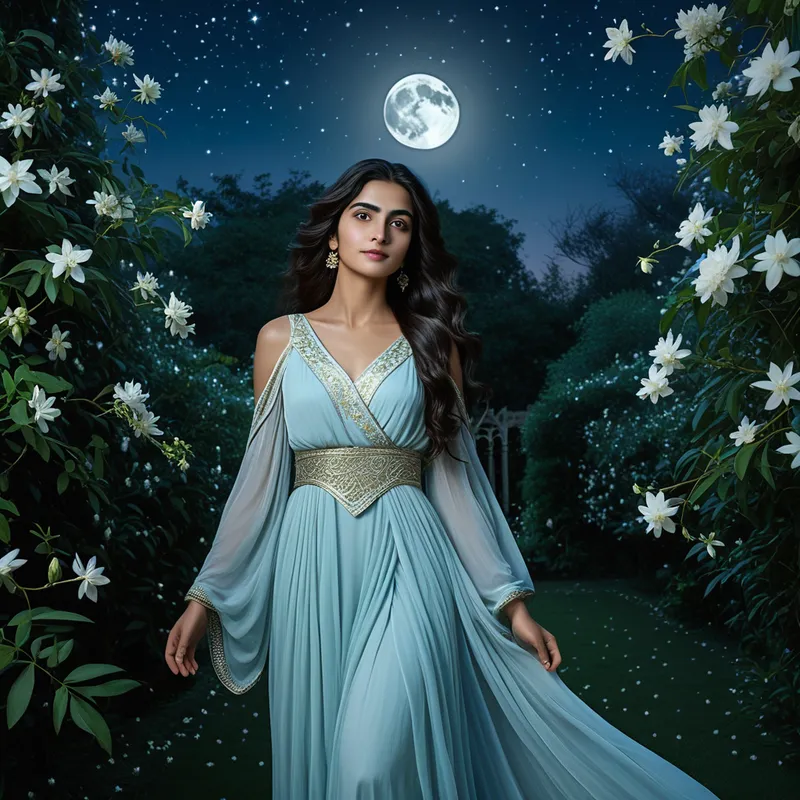
Before the world knew the scent of longing, the heavens were a silent garden of light. Among the constellations, there dwelled a maiden of such grace that the stars themselves paused in their dance to admire her. She was known as Yasamin, and her essence was the very fragrance of divine joy, a perfume so pure it could mend a fractured soul.
But the heavens, for all their splendor, are a realm of perfect stillness. Yasamin would gaze down through the veil of twilight to the vibrant, tumultuous earth below. She saw the green fire of life in the forests, the passionate strife and laughter of mortals, and the deep, aching love that bloomed and withered like desert flowers. In her celestial home, she knew only eternal serenity; on earth, she witnessed the beautiful, painful poetry of the ephemeral.
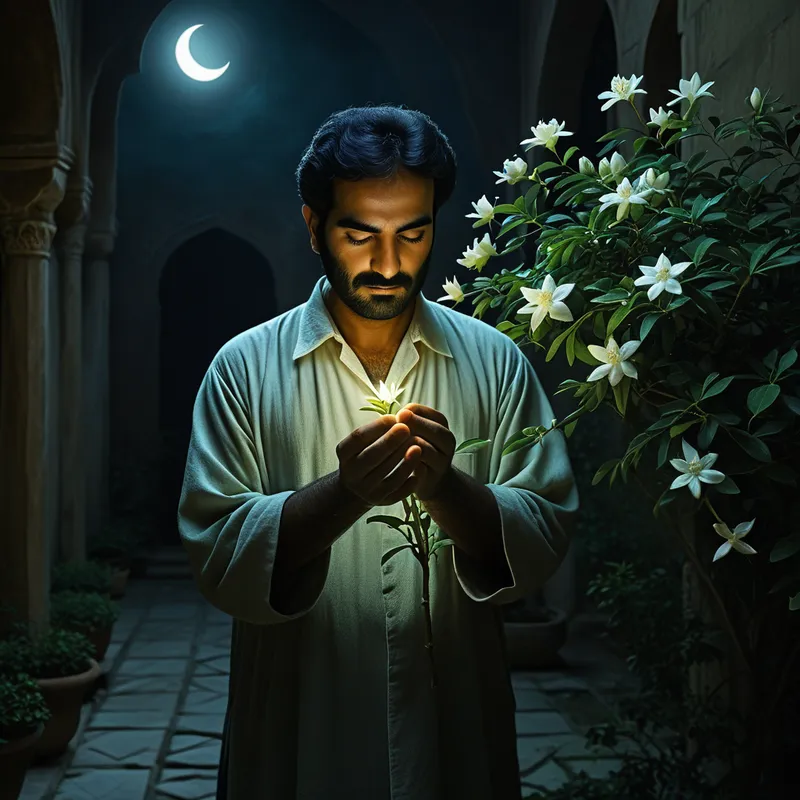
One evening, as the sun bled saffron into the indigo west, her gaze fell upon a young gardener in a walled Bagh. His name was Parviz, and he tended his roses and nightingales with a devotion that was itself a form of prayer. Yasamin watched him sing to the soil, his hands dark with earth, his heart full of a quiet, generative love she had never known. A yearning awoke in her—a desire not to observe, but to feel.
Driven by this sacred hunger, Yasamin gathered her courage. She plucked a thread from the Milky Way and began her descent, a cascade of silvery light and nascent fragrance flowing toward the sleeping world. She stepped into Parviz’s garden as the first star appeared. Her feet touched the damp grass, and the shock of mortality—the cool air, the scent of loam, the weight of gravity—filled her with both terror and ecstasy.
Parviz, sensing a presence sweeter than all his roses, turned. There she stood, a vision woven of moonlight and the promise of scent. No words were needed. In his eyes, she saw the reflection of her own longing, and in her presence, he felt the peace of a prayer answered. They loved in the silent language of the garden, a union of heaven and earth, spirit and soil.
But the cosmos abhors such a mixing of realms. The keepers of celestial order, the Fereshtegan, saw the emptiness where Yasamin had been. A law was broken; a balance was undone. They issued a decree: she must return or be forever severed from her divine source.
Yasamin faced an impossible choice. To return was to live forever in silent perfection, forever haunted by the memory of a mortal touch. To stay was to watch her luminous essence fade, to become mortal, to know sickness, age, and death. Parviz, seeing her anguish, offered his own life, but the law was immutable.
In a moment of transcendent sacrifice, Yasamin found a third path. She would not leave, nor would she remain as she was. Embracing Parviz one final time, she let her celestial form dissolve. Her spirit did not vanish but transmuted. Where she stood, a humble, climbing vine burst from the earth. From its dark green leaves sprang clusters of small, star-like buds that opened under the moon. They released her essence—no longer the silent perfume of heaven, but the intoxicating, heartbreakingly beautiful fragrance of jasmine, the scent of sacred love forever yearning for the earth it chose.
Parviz tended this vine until the end of his days. And to this night, when the jasmine blooms, it is said her fragrance seeks him still, a love letter written on the wind, an eternal bridge between the longing soul and the divine.
Cultural Origins & Context
The story of Yasamin is not found in a single, canonical text like the Shahnameh, but is woven into the rich tapestry of Persian oral tradition, poetry, and Sufi mysticism. It is a Hekayat passed down through generations, often told by grandmothers in courtyards scented with the very flower of the tale, or recited by poets as a metaphor within a metaphor.
Its roots are deeply embedded in the Persian cosmological view, which often contemplates the relationship between Getig and Menog. This myth served a societal function far beyond simple entertainment. It was a narrative vessel for exploring profound themes: the soul’s descent into the material world, the bittersweet nature of earthly love, and the concept of Ishq—a sacred, burning desire that is itself a path to the beloved, often identified as God.
In the Persian garden, the Bagh, every element is symbolic. The jasmine, often planted near seating areas or windows, was not merely a decorative plant. Its evening fragrance was a daily re-enactment of this myth—a reminder of the invisible, fragrant presence of the divine in the mundane world, and of the beauty that arises from a soul’s conscious sacrifice for love.
Symbolic Architecture
At its core, the myth of Jasmine is an alchemical map of the soul’s journey. Yasamin represents the pristine, unconscious spirit—pure, beautiful, but unfulfilled. Her celestial home is the state of potential, of being unlived and untested.
The descent is not a fall, but a choice to incarnate; the fragrance is the spirit made palpable through experience.
The earth and the gardener, Parviz, symbolize the realm of matter, feeling, and human connection—the necessary crucible for the spirit to know itself. Their love is the sacred marriage of opposites: spirit and body, eternity and time, heaven and earth. The conflict with the Fereshtegan represents the inevitable crisis of incarnation: the painful tension between our transcendental origins and our earthly commitments.
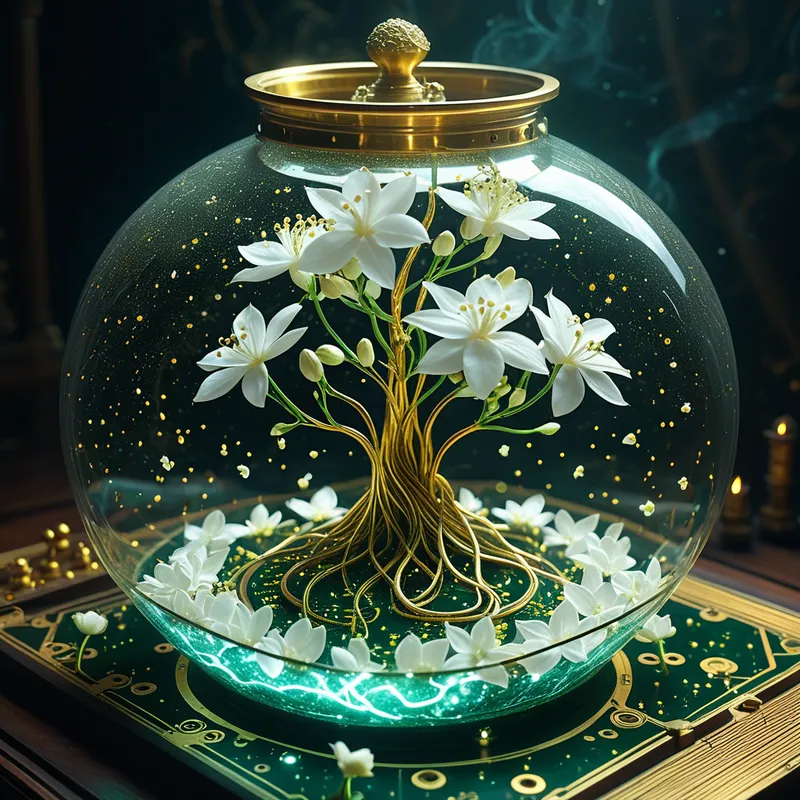
The ultimate transformation into the jasmine vine is the key. She does not die, nor does she abandon her love. She transmutes. The white, star-shaped flower is her celestial origin remembered. The intense, nocturnal fragrance is her embodied soul—her essence, now active in the world, affecting all who encounter it. It symbolizes how a supreme value (divine love, the Self) can survive the death of its original form by becoming a pervasive, guiding presence.
The Dreamer's Resonance
When this myth stirs in the modern unconscious, it often manifests in dreams of profound, fragrant longing. To dream of a haunting, beautiful scent with no source, or to seek a loved one in a moonlit garden, is to touch this archetypal pattern.
Psychologically, this signals a process of sacrificial transformation. The dreamer may be at a point where an old identity, a pristine but limiting self-concept (the celestial maiden), must be surrendered for a deeper, more embodied existence. There is a somatic feeling of sweet ache—a longing to merge with something or someone that feels both deeply familiar and tragically out of reach. This is the pain of growth, the necessary grief of leaving a higher, simpler state for a more complex, fragrant, and mortal life. The dream is the soul negotiating its own "descent," its own commitment to a meaningful life in the world, with all the vulnerability that entails.

Alchemical Translation
For the individual on the path of Individuation, the Jasmine myth is a manual for psychic transmutation. The first stage, the descent, is the conscious decision to engage fully with life—to embrace one's relationships, wounds, passions, and creative work, however messy. This is the hero's journey inward and downward.
The crisis of the decree is the pivotal moment when the ego realizes it cannot have it all. It cannot retain its innocent, spiritual self-image while fully loving the world. A sacrifice is demanded.
The alchemical gold is not found by rejecting the base metal, but by submitting it to the transformative fire of conscious choice.
The final, vegetative transformation is the goal of the process. It is the point where the ego's attachment to a specific form of happiness dies, but the essential value does not. The individual's central passion or love (for another, for art, for justice, for the divine) ceases to be a possession and becomes a quality of being. Like the jasmine's fragrance, it becomes how they move through the world—an invisible, affecting presence that comforts, inspires, and reminds others of beauty. The Self is no longer a distant star to be worshipped, but a living vine, rooted in the earth of daily life, blooming with fragrant purpose in the shared darkness. The myth teaches that true wholeness is found not in ascension alone, but in a sacred descent that perfumes the very ground of our being.
Associated Symbols
Explore related symbols from the CaleaDream lexicon: