Jamshid and the Jeweled Cup Myth Meaning & Symbolism
A legendary king sees the world in a magical cup, but pride shatters his vision and his reign, a timeless parable of hubris and lost connection.
The Tale of Jamshid and the Jeweled Cup
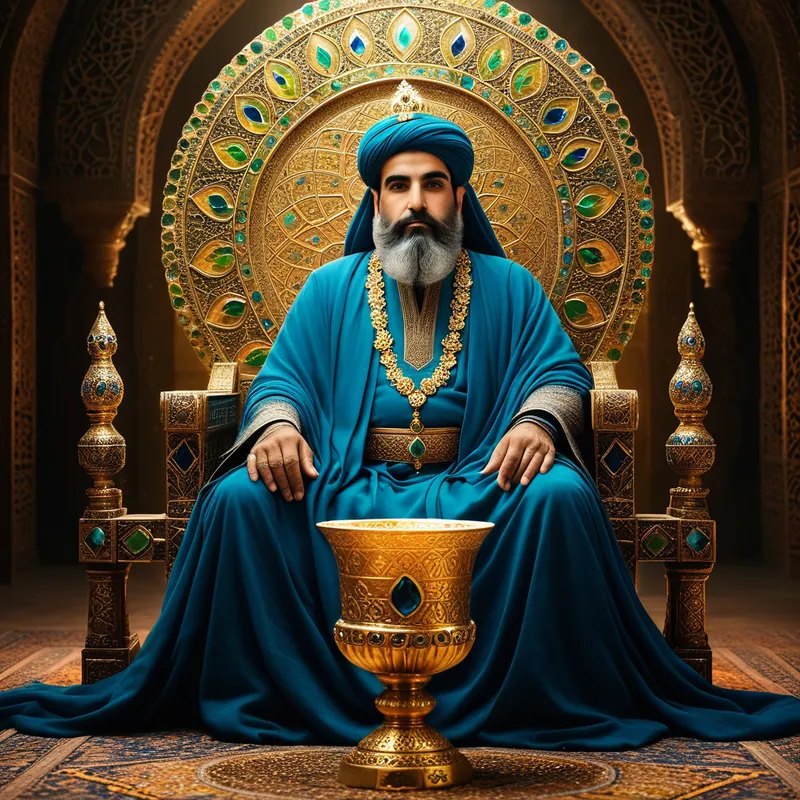
Hear now the tale of Jamshid, he who wore the Farr like a second skin of light. For seven hundred years, the world bent to his will, not through tyranny, but through a wisdom that seemed to flow from the heavens themselves. He taught men to weave armor from iron, to build with brick and mortar, to sail ships upon the wild sea, and to distill the perfumes of roses. Order was his craft, and civilization his masterpiece. The earth was at peace, and pain and death were held at bay.
In the heart of his sun-drenched palace, among towers that scraped the firmament, Jamshid possessed his greatest treasure: the Jām-e Jam, the Cup of Jamshid. Fashioned from a single celestial crystal and set with seven jewels that held the light of the seven planets, it was no mere drinking vessel. It was an eye. When the king peered into its depths, the whole of creation was laid bare within its circle. He could see the hidden thoughts in the hearts of his counselors, the movements of armies beyond the farthest mountains, the secrets whispered in the darkest valleys, and the celestial dance of the stars themselves. It was the cup of total knowledge, the mirror of the world-soul. With it, he ruled not just a kingdom, but reality.
But the years, long and glorious, began to weave a subtle poison: certainty. The line between the divine Farr that shone through him and the mortal man who wore it grew faint in his own sight. The whispers of his court—"He is like a god!"—ceased to be blasphemy and began to sound like simple truth. One fateful day, at the height of the New Year festival of Nowruz, as the sun stood directly above his throne in a sign of perfect balance, Jamshid addressed his assembled people. He looked out over the sea of faces, over the fruits of his centuries of labor, and he spoke not as a steward of the divine, but as its source.
"I have done this," he declared, his voice echoing in the sudden silence. "Not Ahura Mazda, but I. I have banished death and sorrow. I have built this world. There is no god but me."
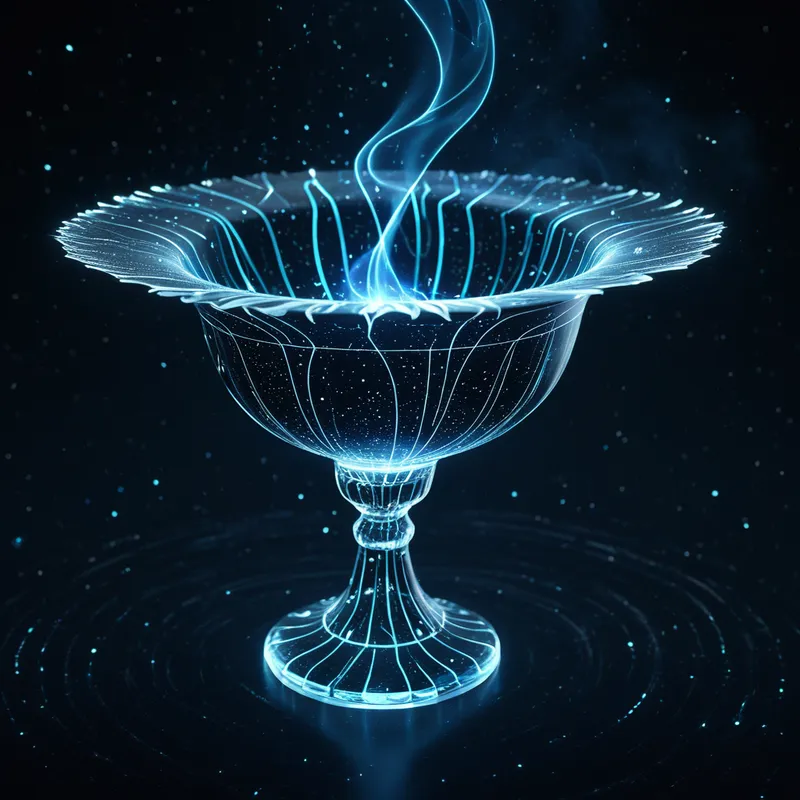
The moment the words left his lips, the light around him changed. The palpable, warming glow of the Farr shuddered, like a flame in a sudden wind. It did not explode; it simply withdrew, peeling away from him like a gilded shadow retreating from the sun. A chill entered the air where there had been none. In his hand, the Jām-e Jam, which had moments before teemed with the vibrant life of the cosmos, clouded over. The visions within it fractured and fled. When he stared into it now, desperate, he saw only the reflection of his own, suddenly mortal, and terribly alone, face.
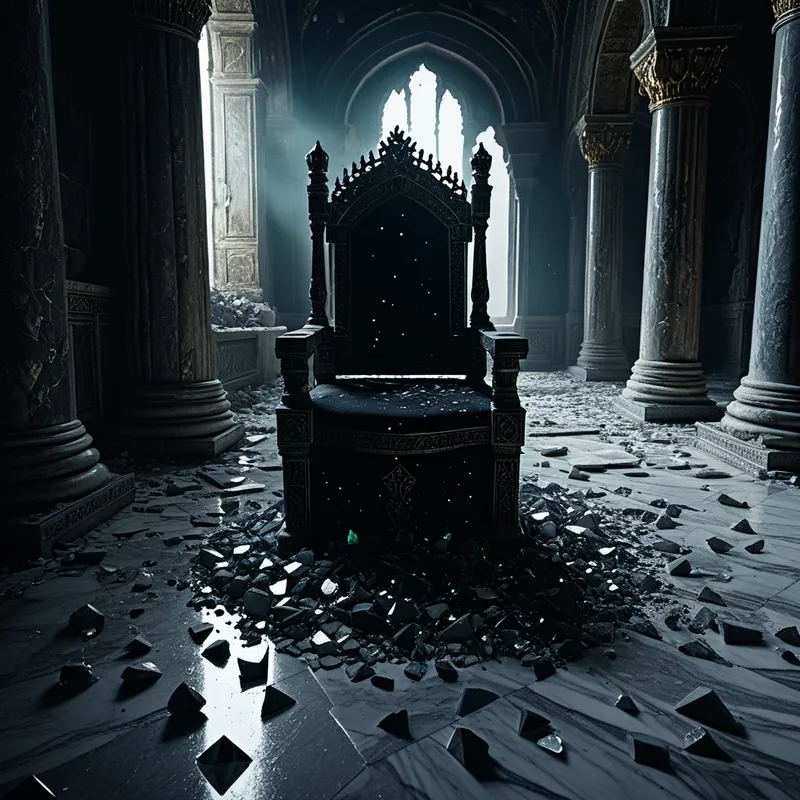
With the departure of the Farr, the cosmic order he had sustained unraveled. Plague and conflict returned to the lands. The seasons turned hostile. And from the eastern deserts came Zahhak, the dragon-shouldered usurper, borne on a tide of chaos Jamshid could no longer repel. The great king fled, a hunted man, his kingdom, his wisdom, and his magical cup shattered. His reign of vision ended in a blindness of his own making, a cautionary echo in the long halls of time.
Cultural Origins & Context
The myth of Jamshid is a cornerstone of the Persian epic tradition, most magnificently preserved in Ferdowsi's 10th-century masterpiece, the Shahnameh. However, its roots dig far deeper, into the pre-Zoroastrian and Zoroastrian cosmology of ancient Iran. Jamshid (originally Yima in the Avesta) was originally a pastoral king who ruled over a perfect world without death or decay. The Jām-e Jam itself may find echoes in the ritual vessels of Zoroastrian priesthood used for divination and maintaining cosmic order (Asha).
Ferdowsi, writing in the wake of the Arab conquest, was not merely a poet but a cultural conservator. He gathered these ancient Iranian myths and welded them into a national epic, a "Book of Kings" that preserved Persian language, identity, and ideals of kingship under foreign rule. The story of Jamshid was told in courts and coffeehouses, serving as a foundational narrative about the nature of legitimate power. It defined the ideal ruler as one who is a vessel for divine fortune and a shepherd of his people, and it presented a terrifyingly clear model of how that sacred contract could be broken. The myth functioned as both a mirror for princes and a philosophical exploration of the human condition in relation to the divine.
Symbolic Architecture
At its core, the myth is an intricate map of the relationship between consciousness, the psyche, and the cosmos. The Jām-e Jam is the ultimate symbol of reflective consciousness—the mind's capacity not just to perceive the world, but to contain it, to understand its interconnectedness.
The Cup is the Self as a vessel: to be filled, one must first be empty. To reflect the cosmos, one must not mistake the reflection for one's own face.
Jamshid, in his prime, represents the ego in proper alignment with the Self. He is a capable administrator of the psyche, integrating its diverse elements (the visions in the cup) into a functioning, creative whole (his civilization). The Farr is the numinous energy of this alignment, the psychic fuel of authentic being that flows when one serves a principle greater than oneself.
His fatal speech is the moment the ego declares itself the source of the numinous, rather than its recipient. This is psychological inflation: the ego, dazzled by the contents of the unconscious (the visions), identifies with them. It claims authorship of the archetypal forces that merely flow through it. The result is not punishment from an external god, but an inevitable psychic reality: when the ego swallows the Self, the connection is severed. The cup clouds because the ego, now opaque in its self-absorption, can no longer serve as a transparent medium for the wholeness of the psyche.
The Dreamer's Resonance
When this myth stirs in the modern soul, it often manifests in dreams of shattered mirrors, corrupted technology, or sudden, inexplicable loss of talent or insight. A dreamer might find a magical tool—a telescope, a computer, a book—that once showed them wondrous things, now rendered blank or glitchy. The setting is often one of fallen grandeur: a decaying office they once ruled, a mansion now filled with dust.
Somatically, this can feel like a profound "drop" in energy, a depression that follows a period of intense success or creative flow. It is the psyche's embodiment of the Farr withdrawing. The psychological process is one of painful de-integration. The dreamer is experiencing the consequences of hubris in their own life: perhaps taking sole credit for a team's success, believing their professional identity is their entire self, or using knowledge (the cup's vision) for manipulative control rather than wise stewardship. The dream forces a confrontation with the inflation, initiating a necessary, if brutal, humbling that is the first step toward re-establishing a genuine connection to the deeper Self.

Alchemical Translation
The myth of Jamshid models the entire alchemical cycle of psychic transmutation, with a stark warning about its central peril. The early part of his reign represents the albedo, the whitening: the establishment of order, clarity, and conscious structure within the psyche. The Jām-e Jam in operation is the symbol of the coniunctio, the sacred marriage of conscious and unconscious, where the ego beholds the totality of the Self.
His fall is the failed rubedo, the reddening. In alchemy, the rubedo is the final stage where the perfected substance is achieved, but it requires the ego's surrender. Jamshid attempts to seize the rubedo for himself, turning it not into the philosopher's stone, but into base, narcissistic pride. This triggers the nigredo—the blackening, the descent into chaos, fragmentation, and the "death" of the old kingly consciousness.
Individuation is not about building a perfect kingdom called the Self and then sitting on its throne. It is the perpetual, humble act of polishing the cup so it may reflect a truth that forever transcends the polisher.
For the modern individual, the alchemical work implied is one of relentless differentiation: "This is me (the ego), and this is not me (the archetypal energy, the talent, the divine spark)." The goal is to become a more resilient and transparent vessel. The shattered cup is not a final tragedy but a necessary stage. One must gather the fragments—the insights from the fall, the humility born of failure—and consciously, painstakingly, re-form the vessel. This new cup will never claim to be the source of the wine, but in its scars and repairs, it may hold the vision with a deeper, more grateful wisdom.
Associated Symbols
Explore related symbols from the CaleaDream lexicon:
- Cup — The central vessel of consciousness and reflection; it represents the capacity of the psyche to contain and reveal the totality of the world, but only when held with humility.
- Vision — The divine sight granted by the cup, symbolizing integrated knowledge and the connection to the transpersonal Self, which is lost when the ego claims it as a personal possession.
- Pride — The fatal flaw that clouds the cup; it represents the ego's inflation, its identification with archetypal power, which severs the connection to the nourishing unconscious.
- Sun — Represents the divine glory (Farr), kingly consciousness, and the illuminating power that, when aligned with, brings order, but when claimed as one's own, becomes scorching and isolating.
- Order — The civilization built by Jamshid, symbolizing the hard-won structure of the conscious psyche, which is fragile and collapses when its foundational connection to the unconscious is broken.
- Shadow — The repressed darkness that returns with Zahhak; it is the chaotic, neglected, and demonic aspect of the psyche that rises to overthrow an inflated, tyrannical consciousness.
- Fall — The inevitable descent following hubris; it signifies the necessary de-integration and humbling of the ego required for any potential future renewal or rebirth.
- King — The archetype of the ruling ego-consciousness, whose legitimacy depends entirely on his relationship to a higher principle (the Farr), not on his personal will.
- Temple — The ordered, sacred space of the integrated psyche that Jamshid builds and then desecrates with his declaration, representing a state of inner alignment that must be maintained through reverence.
- Mirror — The reflective function of the jeweled cup, showing the dreamer not what they wish to see, but the objective truth of their relationship to the world and the divine.
- Gold — The incorruptible value of the divine Farr and the potential for psychic wholeness, which is mistaken by Jamshid for a personal attribute to be owned, rather than a sacred trust.
- Chaos — The state of the inner and outer world following the loss of the Farr, representing the psyche in a state of disintegration and the raw material from which a new, more conscious order must eventually be forged.