Jade Emperor's Ladder Myth Meaning & Symbolism
A myth of a celestial ladder connecting Heaven and Earth, built by a hero whose ambition challenges the cosmic order, only to be struck down.
The Tale of Jade Emperor’s Ladder
Hear now the tale of the Ladder that touched [the sky](/myths/the-sky “Myth from Persian culture.”/), and of the pride that built it and the wrath that shattered it.
In the time when [the world](/myths/the-world “Myth from Tarot culture.”/) was still raw and the borders between realms were but a whisper, there existed a being of immense power and turbulent spirit: Gong Gong. He was no humble god. His domain was the wild, churning waters, and his heart held the tempest’s fury. He gazed upon the serene, unchanging order of the [Jade Emperor](/myths/jade-emperor “Myth from Chinese culture.”/)‘s court with a seething envy. Why should the high heavens be forever separate? Why should the destiny of all things be decreed from an untouchable throne?
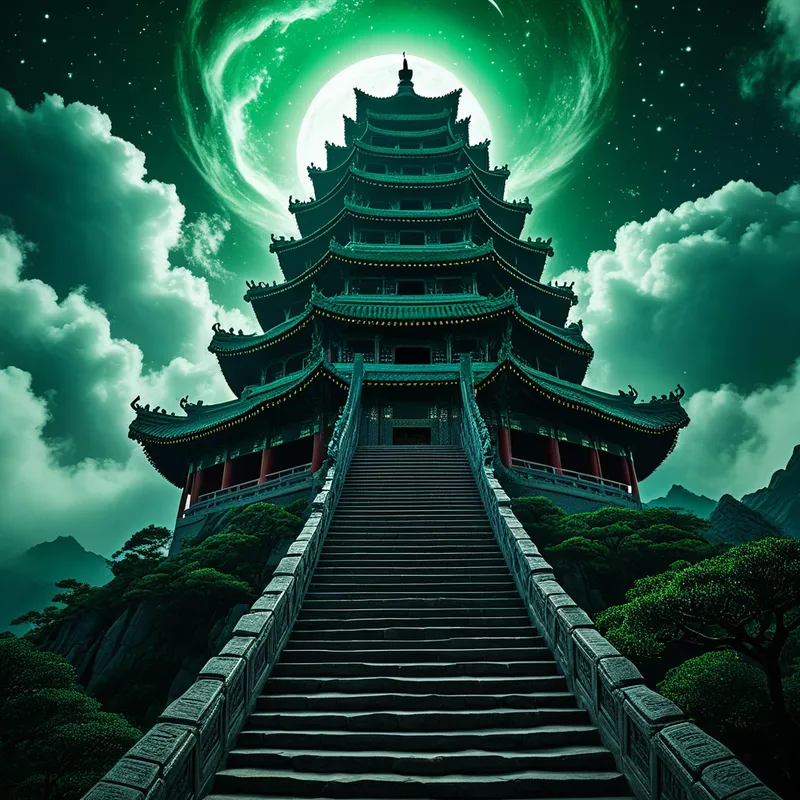
A monumental ambition took root in him. He would not wait for invitation or ascension through virtue. He would build a road. From the sacred peak of Buzhou Mountain, the very pillar that held up the heavens, he would construct a ladder. Not of wood or rope, but of stones pulled from the mountain’s heart and fused with his own formidable magic—a ladder of jade and adamantine intent, each step a defiance of celestial law.
The work shook [the earth](/myths/the-earth “Myth from Hindu culture.”/). Gong Gong, with his followers of lesser spirits, labored with a fury that dimmed the sun. The ladder grew, a stark, glittering scar against the azure sky, piercing the lower mists, then the cloud realms, climbing ever upward toward the silvery gates of the Heavenly City. The scent of ozone and crushed rock filled the air. On Earth, mortals and immortals alike watched in a mixture of awe and terror. The very fabric of reality groaned, feeling the strain of this forced connection.
In his Jade Capital, the Emperor felt the disturbance. The harmonious [music of the spheres](/myths/music-of-the-spheres “Myth from Various culture.”/) developed a discordant note. Looking down from his alabaster balcony, he saw the audacious spire of ambition aiming straight for his domain. This was not the orderly path of a cultivated sage; this was an assault on the cosmic principle itself—the sacred separation that maintained balance. A cold, righteous anger, calm as deep space, settled within him.
He did not send an army. He summoned a verdict.
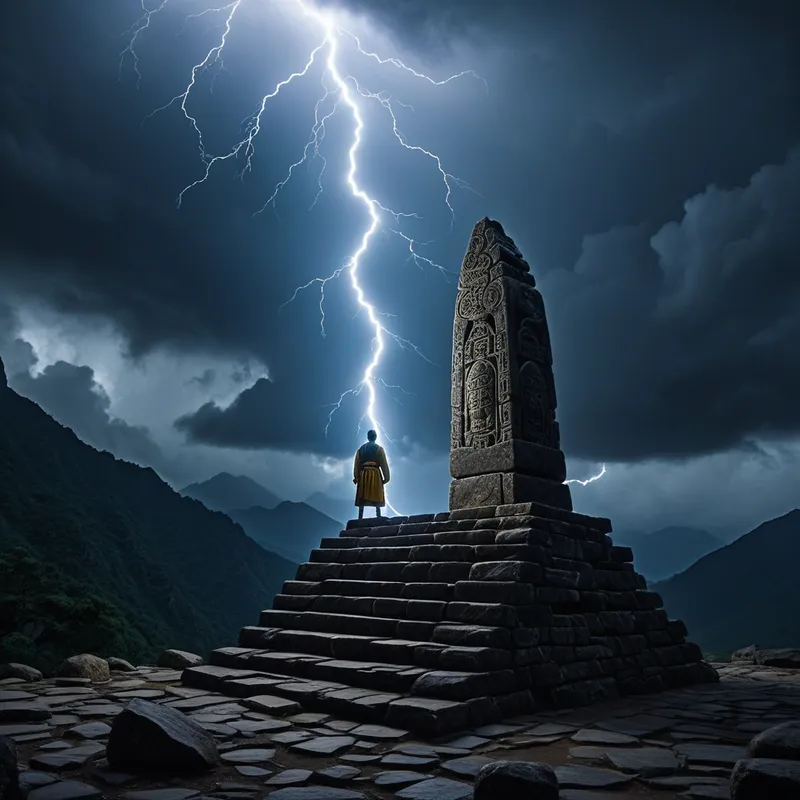
As Gong Gong placed the final, crowning stone, his hand reaching for the very edge of the celestial precincts, the sky darkened. Not with clouds, but with a profound, silent judgment. Then, it spoke. A single, cataclysmic bolt of divine lightning, white-hot and silent, descended not upon the builder, but upon the foundation. It struck the peak of Buzhou Mountain.
The sound was the world breaking. The mighty pillar of the sky shuddered, cracked, and collapsed. The magnificent ladder, the work of an age of pride, shattered into a million glittering fragments that rained down like bitter hail. The heavens themselves tilted, tearing a great rent in the northwest corner of the sky. And Gong Gong, his ambition in ruins, was cast down, not in glorious battle, but in the utter ruin of his work, destined to rage in the floods below, a perpetual reminder of the cost of overreaching.
Cultural Origins & Context
The myth of the Jade Emperor’s Ladder is not a single, codified story from a classic text like the Shanhaijing (Classic of Mountains and Seas), but rather a powerful narrative strand woven into the broader tapestry of Chinese cosmogonic myths. It exists in fragments and variations, often told in conjunction with the more famous tale of Gong Gong’s rebellion and his fateful crash into Buzhou Mountain, causing the heavens to tilt and the floods to rise.
These stories served a vital societal function in ancient China, a culture deeply invested in the concept of the <abbr title=“The concept of the “Mandate of Heaven,” the divine right to rule based on virtue and order”>Mandate of Heaven and cosmic harmony (he). They were likely transmitted orally by shamans, storytellers, and later recorded by Daoist and folk historians as cautionary parables. The myth reinforced a fundamental principle: the celestial order, presided over by the Jade Emperor (a deity whose prominence grew during the imperial era), is inviolable. Ascent is not earned through brute force or personal will alone, but through alignment with virtue (de), ritual propriety (li), and the natural flow of the Dao. The ladder represents a dangerous shortcut, a hubristic attempt to bypass the cosmic bureaucracy and the slow, steady work of self-cultivation.
Symbolic Architecture
At its core, the myth is a profound [meditation](/symbols/meditation “Symbol: Meditation represents introspection, mental clarity, and the pursuit of inner peace, often providing a pathway for deeper self-awareness and spiritual growth.”/) on the [tension](/symbols/tension “Symbol: A state of mental or emotional strain, often manifesting physically as tightness, pressure, or unease, signaling unresolved conflict or anticipation.”/) between boundless [human](/symbols/human “Symbol: The symbol of a human represents individuality, complexity of emotions, and social relationships.”/) aspiration and the necessary structures of existence. The Ladder is the ultimate [symbol](/symbols/symbol “Symbol: A symbol can represent an idea, concept, or belief, serving as a powerful tool for communication and understanding.”/) of [the ego](/myths/the-ego “Myth from Jungian culture.”/)‘s drive for absolute transcendence, for unmediated access to the [source](/symbols/source “Symbol: The origin point of something, often representing beginnings, nourishment, or the fundamental cause behind phenomena.”/) of power and [knowledge](/symbols/knowledge “Symbol: Knowledge symbolizes learning, understanding, and wisdom, embodying the acquisition of information and enlightenment.”/) (the Heavenly Court).
The ladder does not connect; it invades. It is ambition made architecture, a linear thrust against a spherical cosmos.
[Gong](/symbols/gong “Symbol: A ceremonial percussion instrument symbolizing transitions, announcements, and spiritual awakening across cultures.”/) Gong embodies the [shadow](/symbols/shadow “Symbol: The ‘shadow’ embodies the unconscious, repressed aspects of the self and often represents fears or hidden emotions.”/) [aspect](/symbols/aspect “Symbol: A distinct feature, quality, or perspective of something, often representing a partial view of a larger whole.”/) of the [Hero](/symbols/hero “Symbol: A hero embodies strength, courage, and the ability to overcome significant challenges.”/)—raw, undifferentiated power, chaotic creativity, and a rebellious [spirit](/symbols/spirit “Symbol: Spirit symbolizes the essence of life, vitality, and the spiritual journey of the individual.”/) that refuses to acknowledge limits. He is the necessary force of disruption, but one utterly devoid of the Sage’s wisdom or the Ruler’s sense of [responsibility](/symbols/responsibility “Symbol: Responsibility in dreams often signifies the weight of duties and the expectations placed upon the dreamer.”/). The [Jade](/symbols/jade “Symbol: A precious stone symbolizing purity, protection, and spiritual connection, often associated with wisdom, longevity, and harmony.”/) Emperor represents the superordinate principle of Order, [the Self](/myths/the-self “Myth from Jungian culture.”/) in its cosmic [aspect](/symbols/aspect “Symbol: A distinct feature, quality, or perspective of something, often representing a partial view of a larger whole.”/) that maintains the integrity of the whole [system](/symbols/system “Symbol: A system represents structure, organization, and interrelated components functioning together, often reflecting personal or social order.”/), even if it means ruthlessly curtailing a part. His [lightning](/symbols/lightning “Symbol: Lightning symbolizes sudden insights or revelations, often accompanied by powerful emotions or disruptive change.”/) bolt is not merely [punishment](/symbols/punishment “Symbol: A dream symbol representing consequences for actions, often tied to guilt, societal rules, or internal moral conflicts.”/); it is a reassertion of ontological law. The shattered [mountain](/symbols/mountain “Symbol: Mountains often symbolize challenges, aspirations, and the journey toward self-discovery and enlightenment.”/) and the tilted heavens signify the inevitable collateral damage when the individual’s [inflation](/symbols/inflation “Symbol: A dream symbol representing feelings of diminishing value, loss of control, or expansion beyond sustainable limits in one’s life or psyche.”/) threatens the psychic ecology of the whole.
The Dreamer’s Resonance
When this myth stirs in the modern unconscious, it often manifests in dreams of impossible ascension or catastrophic structural failure. One might dream of climbing an endless, precarious staircase to a gleaming corporate headquarters or academic pinnacle, only for it to turn to glass and splinter beneath them. Or they may dream of building a grand project—a business, a relationship, an artistic masterpiece—that is obliterated by a single, unforeseen event from “on high,” like a market crash, a betrayal, or a sudden loss of inspiration.
Somatically, this can feel like a tightening in the chest—the ambition—followed by a sudden, hollow drop in the stomach—the collapse. Psychologically, the dreamer is encountering their own “Gong Gong” complex: a driving, perhaps obsessive, ambition that has become disconnected from the wider needs of their [psyche](/myths/psyche “Myth from Greek culture.”/) and life. The dream is the psyche’s “lightning bolt,” a shocking but necessary correction from the inner Jade Emperor, forcing a confrontation with inflated self-image and the violation of personal or natural limits.

Alchemical Translation
The individuation process modeled here is not one of triumphant ascent, but of humbling integration. The myth warns that the direct assault on the heights of the Self (symbolized by the Heavenly Court) is doomed if it is an act of egoic will alone. The true alchemical work lies in the aftermath of the collapse.
The shattered jade of the ladder must be gathered not to rebuild it, but to mosaic the ground at one’s feet.
The first step is to acknowledge the “Gong Gong” within—the potent, chaotic, ambitious energy—and to thank it for its power and drive. Then, one must make peace with the inner “Jade Emperor”—the principle that enforced the collapse not out of cruelty, but to preserve the larger psyche from disintegration. The alchemical translation is from linear ambition to spherical cultivation. Instead of building a ladder to the heavens, one learns to find the celestial order within the tilted world. The repaired cosmos, now with its waters (emotions) flowing differently and its sky (perspective) forever altered, is the transformed Self. The ambition is not destroyed; its energy is transmuted. It becomes the disciplined effort to align one’s personal life with a greater, more harmonious order, understanding that true authority is not seized from above, but grown from within through integrity and respect for the natural law of one’s own being. The journey continues, not upward on a stolen path, but outward and inward in a reconciled world.
Associated Symbols
Explore related symbols from the CaleaDream lexicon: