Jade Emperor's Celestial Court Myth Meaning & Symbolism
The supreme deity rules a heavenly bureaucracy mirroring imperial China, governing cosmic law and human destiny from a palace of jade and cloud.
The Tale of Jade Emperor’s Celestial Court
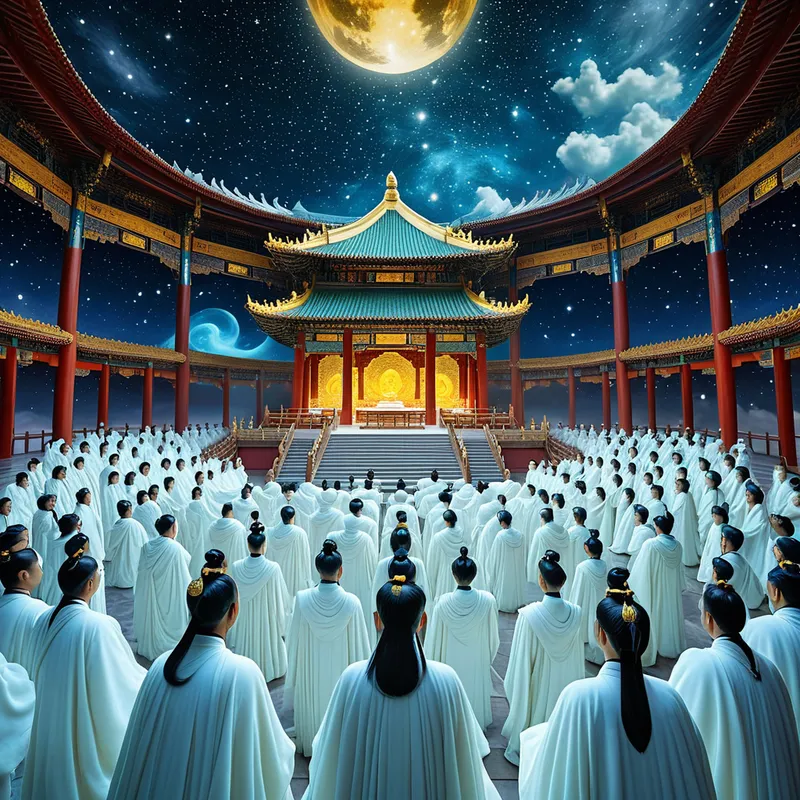
Before the mountains were bones and the rivers were veins, there was the [Hundun](/myths/hundun “Myth from Chinese culture.”/). From its formless swirl, order crystallized, and at the apex of that order, upon the highest tier of the Thirty-Three Heavens, rose a palace that was not built but manifested. Its pillars were carved from the essence of mountains, its tiles were the frozen light of [the Milky Way](/myths/the-milky-way “Myth from Greek culture.”/), and its foundations rested upon the breath of dragons. This was the Celestial Court, and upon its throne of cosmic jade sat its sovereign: the [Jade Emperor](/myths/jade-emperor “Myth from Chinese culture.”/)</abtitle=“The supreme deity and ruler of Heaven and all realms of existence”>.
His countenance was neither young nor old, but bore the patience of epochs. To look upon him was to see the turning of seasons in a single glance, the birth and death of stars in the stillness of his eyes. He did not speak often, for in his court, silence was the canvas upon which destiny was painted. Around him moved the host of heaven: the Star Officials with their ledgers of fate, the Kitchen God ascending with his annual report, [the dragon](/myths/the-dragon “Myth from Chinese culture.”/)-kings who commanded the rains, and the generals who marshaled the elements.
The drama of this court was not one of clashing swords, but of unfolding scrolls. A mortal’s plea for rain in a parched village would arrive as a whisper on [the wind](/myths/the-wind “Myth from Various culture.”/), weighed against the cosmic accounts of merit and demerit. A rebellion in the ghostly Diyu was quelled not by armies, but by the issuance of a celestial decree, its characters blazing with authority. The greatest conflicts were often internal—a deity’s compassion for humanity straining against the immutable laws of the Dao.
One such tale whispers of the Guanyin, who would kneel before the jade throne to advocate for souls caught in suffering, her arguments as gentle and persistent as [water](/myths/water “Myth from Chinese culture.”/) wearing stone. Another tells of the [Monkey King](/myths/monkey-king “Myth from Chinese culture.”/), [Sun Wukong](/myths/sun-wukong “Myth from Chinese culture.”/), whose explosive defiance shook the very pillars of the court, a chaos that had to be integrated, not destroyed. Through every petition, rebellion, and cosmic adjustment, the Jade Emperor presided, his judgment the final brushstroke on the vast, living tapestry of existence. The court was eternal, its rhythm the very heartbeat of the cosmos—a symphony of absolute order, playing forever in the palace at the center of all things.
Cultural Origins & Context
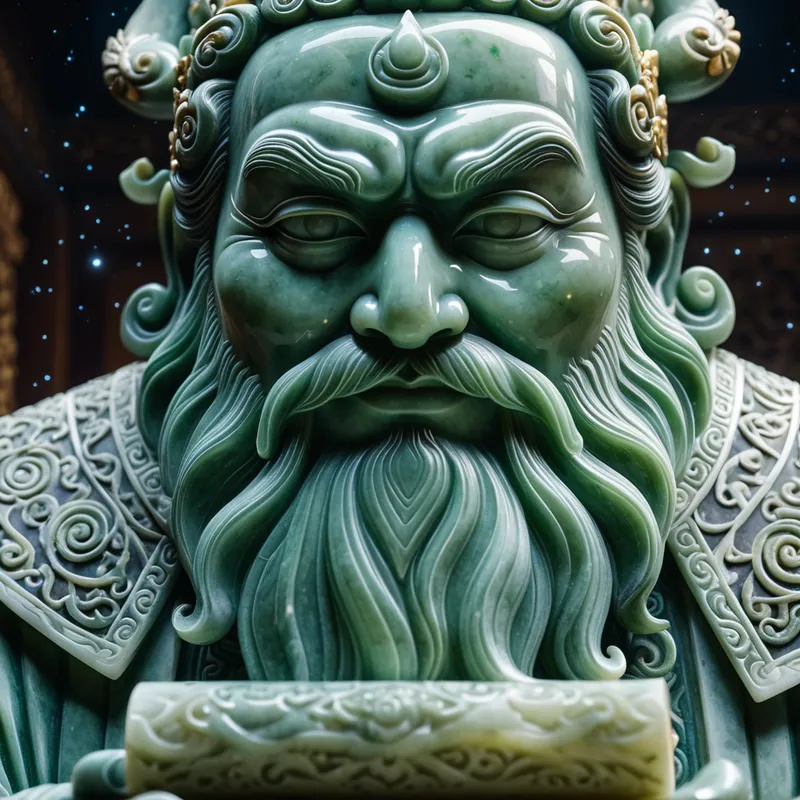
The myth of the Jade Emperor’s Celestial Court is not the product of a single moment or text, but a slow, majestic accretion. Its roots intertwine with ancient Chinese ancestral worship and Zhou Dynasty concepts of the Tianming. However, its full bureaucratic splendor crystallized during the imperial Han and Tang dynasties, mirroring the earthly Chinese empire’s own complex administrative machinery. The celestial court became a divine validation of the imperial structure, a cosmic blueprint for the Son of Heaven’ rule on earth.
It was propagated not by a priestly class alone, but through a rich tapestry of mediums: Daoist liturgical texts that detailed the heavenly hierarchy, popular vernacular novels like [Journey to the West](/myths/journey-to-the-west “Myth from Chinese culture.”/), village operas, and the oral traditions of storytellers in tea houses. For the common person, the court was both awe-inspiring and intimately bureaucratic. One did not simply pray; one filed a petition through the correct divine channels, whether via the Kitchen God or local Tudigong. The myth served a profound societal function: it presented the universe as fundamentally orderly, just, and accountable, even if its workings were inscrutable. It offered a framework where both cosmic law and personal moral conduct (De) had ultimate meaning and consequence.
Symbolic Architecture
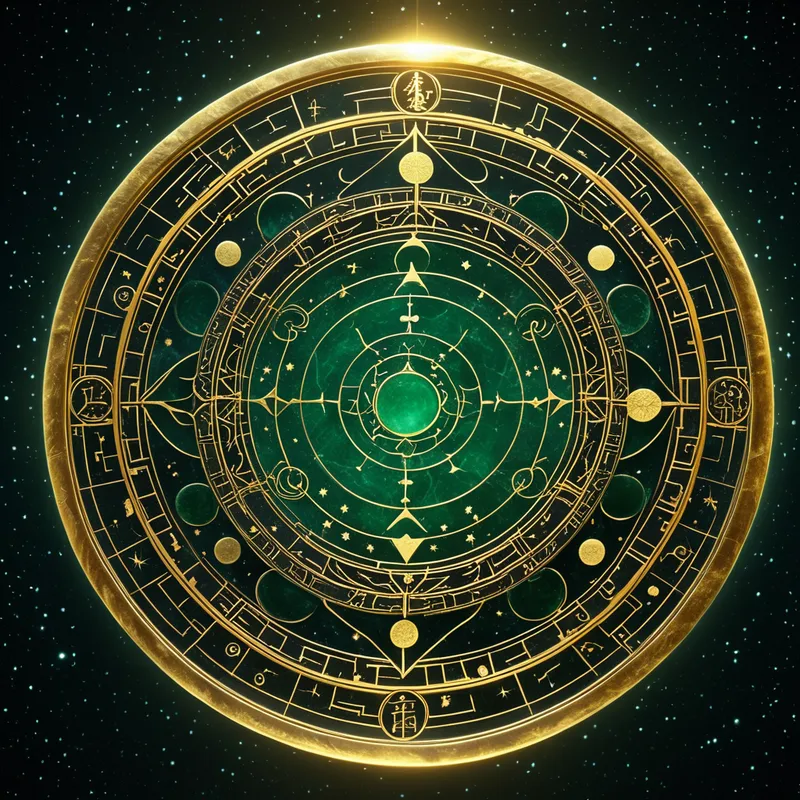
The Celestial Court is a grand [mandala](/symbols/mandala “Symbol: A sacred geometric circle representing wholeness, the cosmos, and the journey toward spiritual integration.”/) of the [psyche](/myths/psyche “Myth from Greek culture.”/), representing the [archetype](/symbols/archetype “Symbol: A universal, primordial pattern or prototype in the collective unconscious that shapes human experience, behavior, and creative expression.”/) of [the Self](/myths/the-self “Myth from Jungian culture.”/) in its most organized, transcendent form. The [Jade](/symbols/jade “Symbol: A precious stone symbolizing purity, protection, and spiritual connection, often associated with wisdom, longevity, and harmony.”/) Emperor is not a personal god but the symbolic center of a vast psychic [system](/symbols/system “Symbol: A system represents structure, organization, and interrelated components functioning together, often reflecting personal or social order.”/)—the coordinating principle of [consciousness](/symbols/consciousness “Symbol: Consciousness represents the state of awareness and perception, encompassing thoughts, feelings, and experiences.”/) itself.
The throne is not a seat of power, but the axis mundi where the personal will surrenders to the impersonal pattern of the whole.
The court’s intricate [bureaucracy](/symbols/bureaucracy “Symbol: Dreams of bureaucracy often represent feelings of powerlessness, frustration with rigid systems, or anxieties about societal structures and personal agency.”/) symbolizes the mind’s own inner governance: [memory](/symbols/memory “Symbol: Memory symbolizes the past, lessons learned, and the narratives we construct about our identities.”/), reason, value judgments, and instinctual drives, all organized into a functioning [hierarchy](/symbols/hierarchy “Symbol: A structured system of ranking or authority, often representing social order, power dynamics, and one’s position within groups or institutions.”/). The various deities are personified complexes—the Wenchang as the scholarly drive, the Guandi as the moral and protective instinct. The conflict between rigid celestial law (as upheld by the Emperor) and compassionate intervention (as advocated by Guanyin) mirrors the eternal psychic [tension](/symbols/tension “Symbol: A state of mental or emotional strain, often manifesting physically as tightness, pressure, or unease, signaling unresolved conflict or anticipation.”/) between the superego’s demands and the [heart](/symbols/heart “Symbol: The heart symbolizes love, emotion, and the core of one’s existence, representing deep connections with others and self.”/)’s pleas. The court, in its perfect, remote order, represents the psyche’s yearning for a coherent, meaningful [structure](/symbols/structure “Symbol: Structure in dreams often symbolizes stability, organization, and the framework of one’s life, reflecting how one perceives their environment and personal life.”/) amidst the [chaos](/symbols/chaos “Symbol: In Arts & Music, chaos represents raw creative potential, uncontrolled expression, and the breakdown of order to forge new artistic forms.”/) of lived experience.
The Dreamer’s Resonance
To dream of the Celestial Court is to encounter the psyche’s own highest authority. The dreamer may find themselves a supplicant in a vast, solemn hall, unable to speak or be heard, representing feelings of being judged by an impersonal system (societal, professional, or internal). Alternatively, they may dream of being a minor official, overwhelmed by celestial paperwork—a somatic metaphor for anxiety, the burden of responsibility, or a life choked by administrative details devoid of soul.
The somatic experience is often one of awe mixed with paralysis: the body feels heavy, the air thin, movement is slow and ceremonial. This is the psyche processing encounters with overwhelming external authority (a parent, a boss, a government) or, more profoundly, confronting the internalized “inner emperor”—the tyrannical aspect of one’s own conscience or perfectionist drive. The dream signals a critical moment of reckoning with the laws one lives by, asking: Whose mandate do I serve?
Alchemical Translation
The individuation process modeled here is not the hero’s slaying of a dragon, but the integration of the bureaucracy. The modern individual’s journey is often into the “celestial court” of their own constructed personality—the complex, self-imposed rules, roles, and judgments that govern behavior. The initial stage is identification with a single, minor role in the system (the loyal official). The crisis comes with the realization of this system’s cold, impersonal nature, which may manifest as burnout, a sense of meaninglessness, or the rebellious “Sun Wukong” energy that seeks to smash it all.
The alchemical goal is not to destroy the court, but to become its conscious sovereign—to sit in the seat of the Jade Emperor.
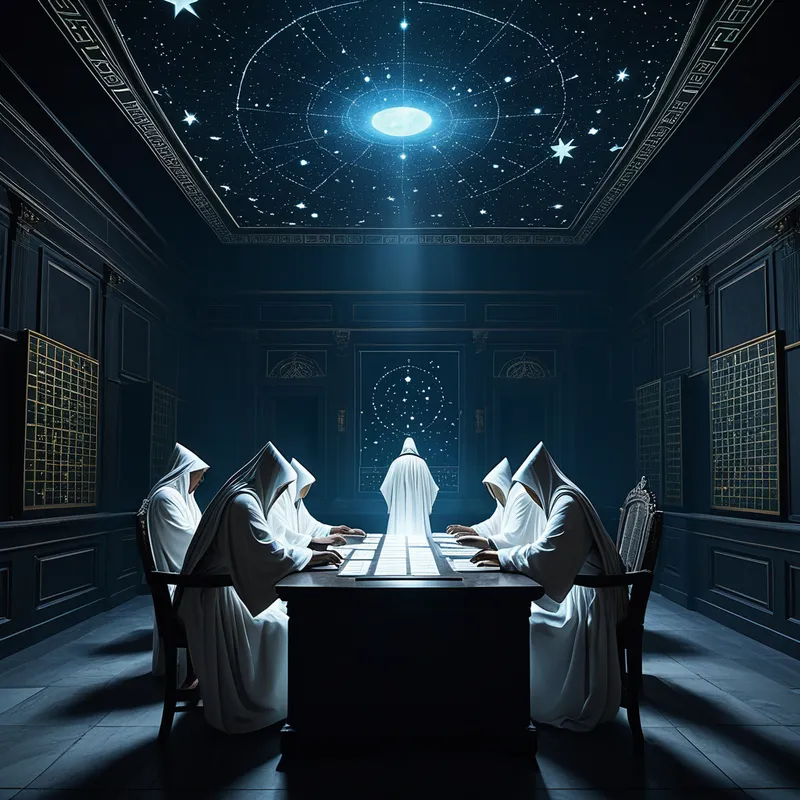
This requires a terrifying descent from identification with one complex (e.g., “the achiever” or “the caregiver”) to becoming the silent, observing center that can witness all complexes without being ruled by any. It is the transmutation of personal will into aligned action, where one’s decisions arise not from egoic desire or fearful obligation, but from a place of inner authority that understands its place within a larger, cosmic order. One does not become a god; one becomes responsible for the entire inner kingdom. The sealed celestial decrees become one’s own authentic choices, and [the star](/myths/the-star “Myth from Tarot culture.”/)-charts of fate are rewritten with the ink of conscious, embodied life.
Associated Symbols
Explore related symbols from the CaleaDream lexicon: