Jade Emperor Myth Meaning & Symbolism
The myth of the celestial sovereign who, through profound cultivation and cosmic trials, establishes the eternal order of heaven, earth, and the human realm.
The Tale of Jade Emperor
In the time before time, when the Hundun was still and the Yin and Yang had not yet begun their eternal dance, there existed a luminous potential. From this potential was born a prince of a mortal kingdom, a child of profound virtue named Zhang Denglai. Yet his heart was not for earthly rule. The clamor of the palace, the weight of the crown—these were chains to his spirit, which yearned for the silence at the heart of all things.
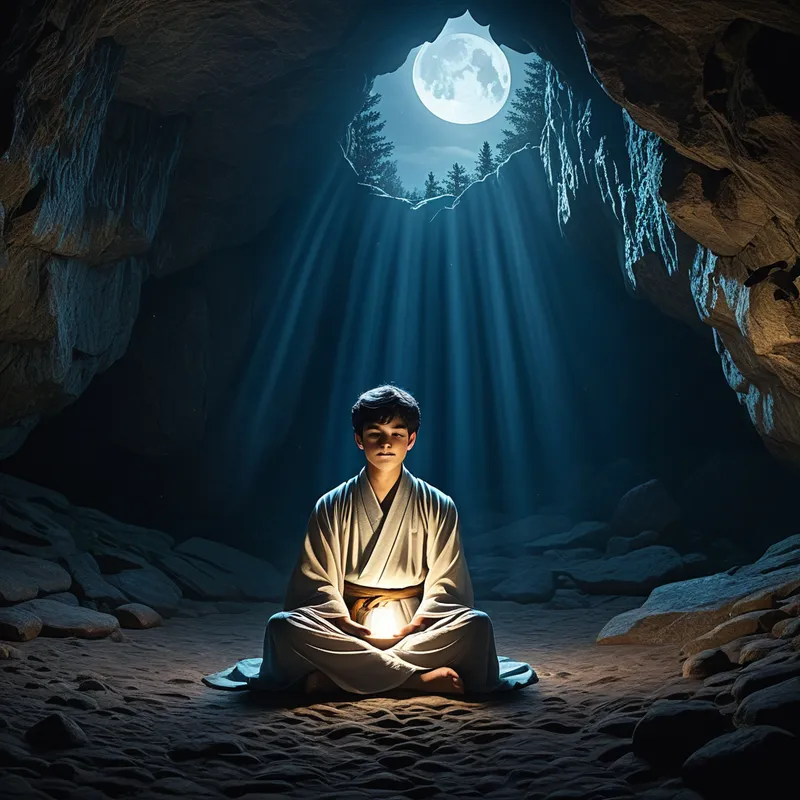
He renounced his throne, leaving behind silks and jewels for the rough hemp of an ascetic. He walked until the roads ended, climbing into the mist-wreathed mountains where immortals were said to dwell. There, in a cave where sunlight was a rare guest, he sat. He cultivated the Qi, not for power, but for purity. He stilled his mind, not for knowledge, but for emptiness. The world outside his cave spun through its cycles: dynasties rose and fell like tides, forests grew over cities, and stars traced new paths across the heavens. He sat through it all, for one thousand and seven hundred kalpas—each kalpa an acon of creation and destruction. His body became like the mountain itself, patient and enduring; his spirit refined like jade in a river, smoothed of all impurity.
His virtue became a light that pierced the heavens. In the celestial realms, a great disorder had taken hold. Deities and spirits vied for supremacy; the pathways between heaven, earth, and the underworld were in chaos. The cosmic order, the Dao itself, was threatened. The primordial deities, the Sanqing, perceived the luminous ascetic in his mountain. They descended, not in thunder, but in a profound quiet, and presented him with a challenge not of combat, but of compassion and judgment.
They led him to a bridge of rainbows spanning an abyss of swirling chaos. “Cross,” they said. As he stepped onto the bridge, it transformed into a raging torrent of fire. He walked, his compassion a cooling balm, and the fire became blossoms. Next, the bridge became a chasm of howling, icy winds that could flay a soul. He walked, his inner peace an unshakable hearth, and the winds became a gentle zephyr carrying the scent of pine. Finally, the bridge vanished altogether, leaving him suspended over the infinite void. With neither fear nor desire, embodying pure being, he took the step that was not a step. And he did not fall. He ascended.
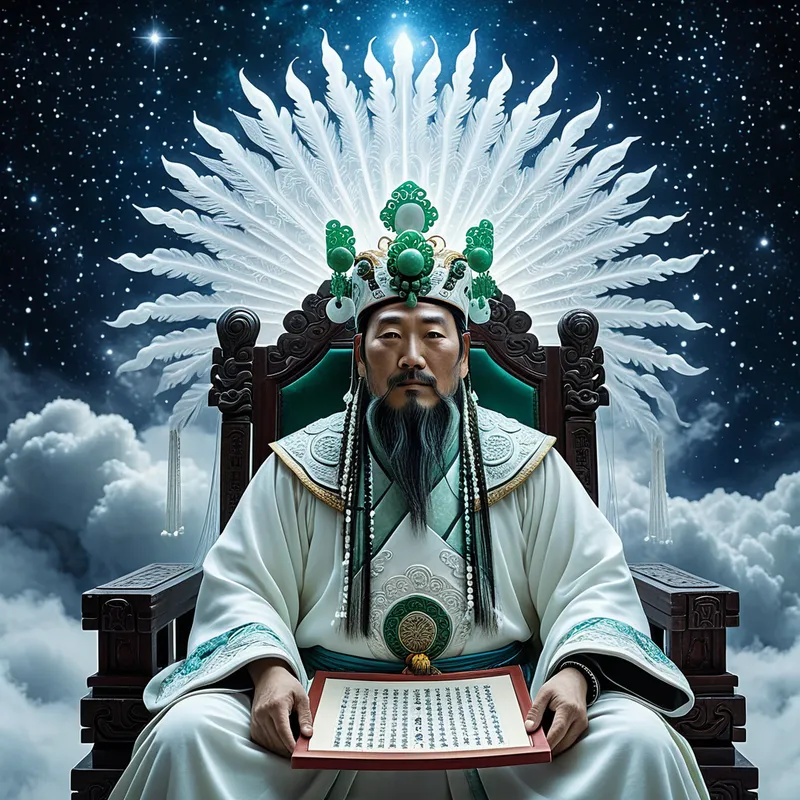
Thus, from the crucible of ultimate cultivation and trial, Yu Huang was enthroned. He took his seat in the Yujing, the palace of supreme clarity. With serene and impeccable authority, he established the celestial bureaucracy, appointing deities to oversee every facet of existence—from the thunder and rain to the fates of mortals and the records of virtue. He did not conquer chaos with force, but ordered it with the inherent virtue forged in endless stillness. The cosmos found its sovereign, and the eternal administration of heaven began.
Cultural Origins & Context
The myth of the Jade Emperor is not the product of a single moment or text, but a tapestry woven over millennia, central to the syncretic spiritual landscape of China. His figure evolved from ancient Shangdi (Lord-on-High) concepts of a supreme celestial power, merging with Taoist cosmological frameworks and later gaining narrative flesh through popular folklore and vernacular novels like Journey to the West. While state cults and imperial decrees sometimes promoted his worship to legitimize earthly rule, his story was truly kept alive by the people. It was told by village elders, enacted in temple festivals during his birthday on the ninth day of the Lunar New Year, and visualized in vibrant mural paintings. His myth functioned as a cosmic mirror to the imperial Chinese state, explaining the natural and social order through a divine bureaucracy. More deeply, it offered a template for personal cultivation, suggesting that the highest authority—over one’s own life and destiny—could be earned through relentless inner work and ethical refinement.
Symbolic Architecture
At its core, the myth of Yu Huang is an allegory for the emergence of consciousness from the unconscious, and of order from the primal chaos within. The protagonist begins not as a warrior, but as a renunciant. His journey is inward.
The true throne is not taken by force, but manifested from the stillness within. Sovereignty is first an interior condition.
The mountain cave represents the temenos, the sacred enclosed space of the psyche where the ego dissolves into the larger Self. The 1,700 kalpas of meditation symbolize the incomprehensibly long and patient process of psychological integration, where one must sit with all the contents of the unconscious—the personal and collective “dynasties” of thought and emotion—without identifying with them. The final trials on the rainbow bridge are the ultimate tests of this integrated state. Fire represents passion and aggression; ice represents cold intellect and isolation; the void represents the terror of annihilation or meaninglessness. To pass through them unchanged is to achieve a consciousness that can contain all opposites, a state of psychic wholeness that Jung termed the Self. The Jade Emperor thus symbolizes the Self as the central, ordering principle of the psyche—the inner ruler who administrates the complex “bureaucracy” of our instincts, emotions, thoughts, and intuitions into a harmonious, functional whole.
The Dreamer’s Resonance
When this mythic pattern stirs in the modern unconscious, it often manifests in dreams of profound responsibility emerging from a period of retreat or confusion. One might dream of being unexpectedly promoted to lead a vast, chaotic organization they feel unprepared for. Or of finding a silent, empty control room for a complex system—a city’s infrastructure, or even planetary weather—and intuitively knowing how to operate it. The somatic sensation is often one of a deep, calm center amidst external turbulence, a solidity in the spine. Psychologically, this indicates a critical transition: the ego is being called to serve a higher, more complex order of the personality. The dreamer may be in a life phase where disparate parts of their life—career, relationships, personal values—demand not just management, but integration under a new, self-authored principle. The anxiety in the dream is the ego’s fear of this immense responsibility; the calm authority is the emergent Self, the nascent Jade Emperor consciousness, asserting itself.

Alchemical Translation
The alchemical process modeled here is the transmutation of the personal into the transpersonal. The base material is the individual ego with its desires and attachments (the prince’s royal life). The first operation is mortificatio or negredo: the deliberate withdrawal and dissolution into the “cave” of the unconscious, a dark night of the soul where all former identities are stripped away. The long meditation is the albedo, the whitening, where insights are purified and condensed into a coherent essence—the “jade” of the spirit.
The ultimate authority one can wield is over one’s own inner chaos. To govern the self is to participate in the ordering of the cosmos.
The final trials represent the rubedo, the reddening or final test, where the newly formed consciousness must prove it can withstand the full spectrum of human experience without fragmenting. The enthronement is the individuation complete: the ego is now in proper relation to the Self. It does not vanish but becomes the capable administrator of the inner realm. For the modern individual, this translates to the arduous work of self-knowledge, shadow integration, and the development of an inner ethical compass so unwavering that it can bring order to one’s internal and external life. One becomes the author, ruler, and benevolent administrator of one’s own destiny, not through dominating others, but through having first mastered the chaos within. This is the sacred mandate of the inner Yu Huang.
Associated Symbols
Explore related symbols from the CaleaDream lexicon: