Jade Bi Discs Myth Meaning & Symbolism
A myth of celestial artisans, a fractured sky, and the jade discs that mend heaven, embodying the sacrifice required to restore cosmic and inner harmony.
The Tale of Jade Bi Discs
Listen, and hear the tale whispered by the river stones and sighed by the wind through ancient pines. In the time before time was measured, when the Hundun had just begun to stir, the sky was not a dome, but a living, breathing membrane—a tapestry woven from the breath of Dao. It was a perfect, seamless whole, holding the sun, moon, and stars in their silent dance.
But perfection is a state, not a story. A story requires a crack.
From the deepest well of the cosmos, a force of pure Hun stirred—a great, formless sigh of discord. It was not evil, but essential, the necessary counterpart to order. This sigh became a tremor, and the tremor became a rent, a jagged, weeping fissure that split the celestial tapestry from the Eastern horizon to the Western zenith. Through this wound, the harmonious Qi of heaven began to leak, bleeding into the formless below. Stars trembled in their courses. The seasons stuttered. A great disharmony echoed through all realms.
The Celestial Emperor, his countenance as grave as mountain peaks, summoned his artisans. These were not mere craftsmen; they were the Shen of mountain cores and riverbeds, beings whose essence was the very patience of stone. He showed them the wound. “The sky is broken,” he said, his voice the sound of distant thunder. “It cannot be sewn with thread, nor patched with cloud. It requires a substance of both earth and spirit, of time and timelessness.”
The artisans knew. Only one substance held the necessary virtues: Jade. Not just any jade, but the heart-jade from the deepest veins of the Kunlun, stone that had dreamed for eons under the weight of the world. To mend heaven, they would have to become it. They descended, not with tools, but with their own luminous hands. They did not quarry; they communed. They asked the mountain for its heart, and the mountain, understanding the need of the sky, gave it.
The labor was an alchemy of spirit. An artisan would press his hands against a raw, green stone, and through his fingers would flow not heat, but intention—the pure idea of Circle, of Wholeness, of Gateway. The stone would respond, singing a low, crystalline note as it shed its rough skin, revealing a perfect disc: a Bi. But with each disc shaped, a piece of the artisan’s own luminous essence was transferred, sealed within the jade. They grew quieter, their light dimming, as the discs glowed with an inner, captured sky-light.
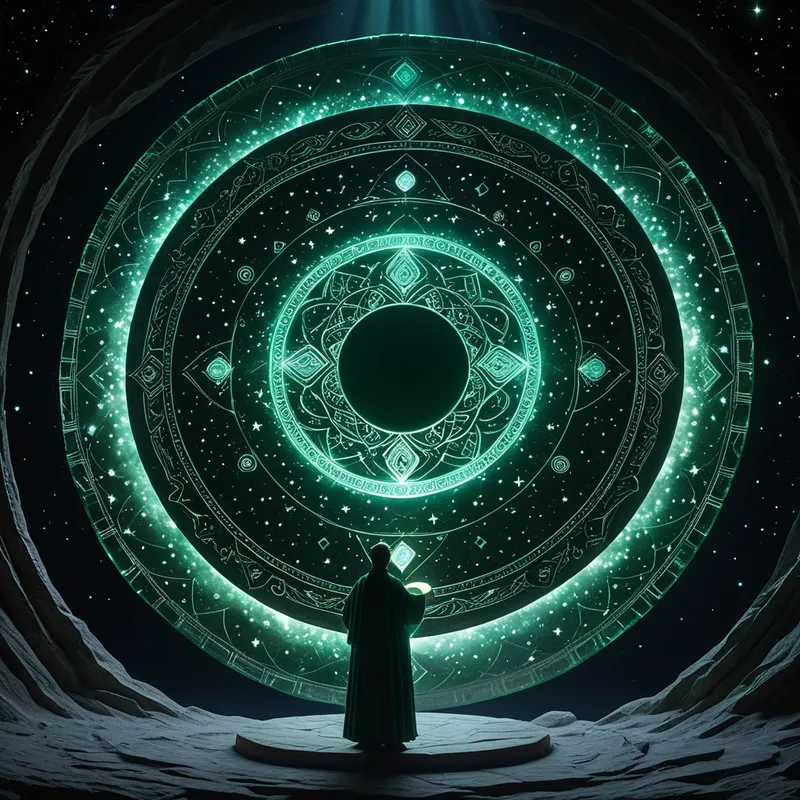
One by one, they ascended. The fissure was a dark, hungry mouth. An artisan would take a newly forged Bi, and with a final surge of his remaining spirit, press it into the jagged edge of the wound. The disc would fuse, its perfect circle stabilizing the chaos, its jade body staunching the leak of Qi. The artisan, his essence spent, would become a wisp of mist, dissolving into the harmony he restored. Disc by disc, sacrifice by sacrifice, the great rent was drawn closed. The final Bi was placed at the zenith, directly below the Shangdi. With a sound like a giant bell being struck once and forever, the sky was whole again—but now patterned with the faint, greenish constellations of the mended places, a testament to the cost of order.
And so the sky held. But below, in the rivers where the artisans had worked, smooth, circular stones began to appear, echoes of that perfect form. These, the people knew, were the earthly shadows of the celestial discs, fallen reminders of the great mending.
Cultural Origins & Context
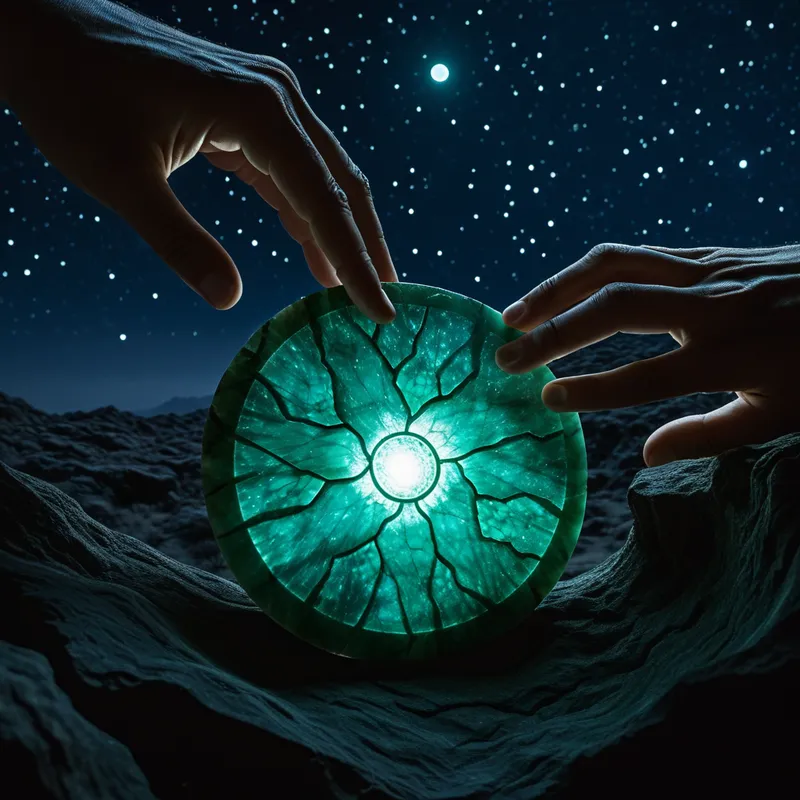
The myth of the Jade Bi Discs is not a single, codified narrative from one text, but a deep, collective story woven from the fabric of Chinese Neolithic and Bronze Age material culture. Its “telling” was not in words, but in objects. For over 6,000 years, from the Liangzhu culture onward, jade Bi discs were painstakingly crafted and placed in the graves of the elite, positioned on the chest or around the body. They were ritual implements for communicating with heaven and the ancestors.
The myth arises as the numinous explanation for this profound cultural practice. It is the story told by the shaman-king, the Wu, to explain why this particular shape, this impossible circle of impossibly hard stone, held such power. Its societal function was foundational: it explained cosmic order (Li) as something actively maintained through ritual sacrifice and virtuous craft. The Bi was a model of the heavens, a conduit for prayer, and a passport for the soul. The myth justified the immense social effort of jade production and positioned the ruling class as the earthly analogs of the celestial artisans, responsible for maintaining harmony between heaven and earth through correct ritual—their version of “mending the sky.”
Symbolic Architecture
At its core, the myth is a profound meditation on Wholeness, crafted from the substance of Sacrifice. The symbols are stark and powerful.
The Fractured Sky represents a rupture in the cosmic and psychological order. It is the trauma, the deep flaw, the fundamental anxiety that the world or the self is not as it should be—that it is leaking vitality, meaning, or coherence.
The perfect circle is not a given; it is an achievement carved from the rough stone of chaos through conscious, costly effort.
The Jade itself is the perfect symbolic material: harder than steel, yet formed by water over eons. It represents virtue, durability, and the integration of opposites—earth and sky, toughness and beauty, mortality and eternity. The Celestial Artisans are the archetypal force of the conscious ego or the dedicated Self, tasked with the impossible repair. Their tool is not brute force, but focused intention and spiritual essence.
The central, haunting symbol is the act of fusion: the artisan pressing the disc into the wound and dissolving. This is the ultimate image of meaningful sacrifice. The artifact of wholeness (the Bi) only gains its power to mend by containing a piece of the mender’s own life-force. The circle is closed, but the cost is the dissolution of the separate self into the larger, restored order.

The Dreamer’s Resonance
When this myth stirs in the modern unconscious, it often manifests in dreams of profound repair or fragile wholeness. A person may dream of painstakingly gluing together a shattered porcelain plate, only for the cracks to glow with a soft, green light. They may find themselves in a vast, dark space, holding a smooth, cool stone disc that feels both incredibly heavy and vitally important, with the urgent sense that it must be placed somewhere to stop a terrible, silent bleeding.
Somatically, this can correlate with a feeling of a “crack” in the chest or a sense of vital energy leaking away—a modern experience of the fractured sky. The dream process is one of active reconciliation. The psyche is identifying a deep, perhaps ancient, rupture in its own structure—a core wound, a foundational betrayal, a split between spirit and instinct. The dreaming mind is not just identifying the crack; it is searching for the “jade”—the durable, virtuous, timeless part of the self that can be shaped into a tool for mending. The labor in the dream is the somatic recognition of the effort, patience, and personal cost that genuine healing requires.

Alchemical Translation
For the individual on the path of individuation, the myth of the Bi discs models the alchemical process of solve et coagula—dissolve and coagulate—applied to the psyche itself.
First, one must confront the Fractured Sky within: the recognition of one’s own fundamental contradictions, wounds, and splits. This is the “solve,” the breaking down of the illusion of a seamless, perfect self. Then begins the labor of the Inner Artisan. This is the conscious ego, no longer king, but becoming a dedicated craftsperson. Its material is the “jade” of one’s own lived experience, virtues, and hard-won insights—the durable core of character.
The individuated Self is not the artisan who survives the work, but the perfect Bi disc that remains—a whole, functional symbol forged from the sacrifice of the ego’s claim to sovereignty.
The shaping of the Bi is the long, patient work of therapy, reflection, art, or spiritual practice—applying focused attention to rough experience to find the latent pattern of wholeness. The critical, transformative phase is the Fusion. This is the moment when an insight, a forgiveness, or an acceptance is not just understood intellectually, but is embodied. The ego “dissolves” its rigid stance, its grievance, or its self-image, and invests that energy into the new, more complex structure of the Self. The wound is not erased; it is filled with a piece of one’s own transformed substance, becoming a site of strength and resonance, a mended place in the personal cosmos. The goal is not to return to a naive, pre-fractured state, but to become a living Bi disc—a whole, centered being whose very structure is a testament to the sacred labor of mending.
Associated Symbols
Explore related symbols from the CaleaDream lexicon: