Jacob's Well Myth Meaning & Symbolism
A weary traveler meets a stranger at a sacred well, leading to a revelation that shatters boundaries and promises living water for the soul.
The Tale of Jacob's Well
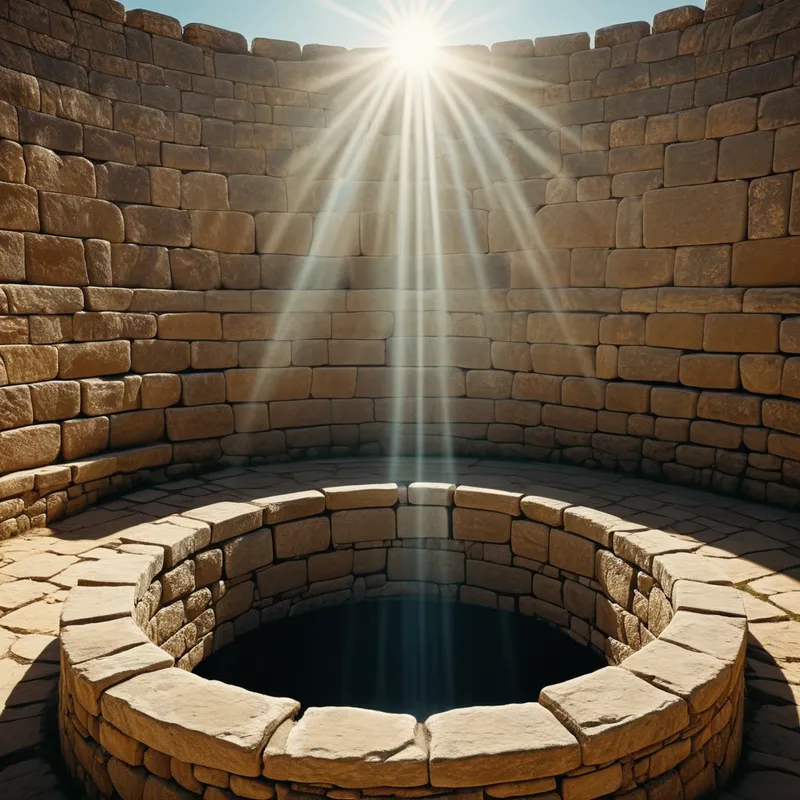
The sun is a hammer on the land of Samaria. It beats the hills into dust and bleaches the sky to a pale, aching blue. At the sixth hour, when shadows are swallowed whole and the world holds its breath in the heat, a solitary figure walks the road to Sychar. He is footsore, human-thirsty, and he comes to a place of ancient memory: the well that Jacob dug, a gift of water in a gift of land to his son Joseph. The stones of its rim are smooth from a thousand years of ropes, a mouth in the earth that has swallowed the thirst of generations.
He sits by the well, alone. The silence is a presence.
Then, a shift in the light. A woman of Samaria approaches, jar balanced on her shoulder. She comes at this hour, the hour of solitude, when no other women draw water. Her steps are measured, her eyes avoid the stranger—a Jew. Boundaries of stone and blood stand between them: this well, this land, their peoples.
"Give me a drink," he says. The words break the covenant of silence, shatter the unspoken rule. A man, speaking to a woman, alone. A Jew, asking a Samaritan. The hierarchy of the world is inverted.
She stops, jar poised. "How is it that you, a Jew, ask for a drink from me, a Samaritan woman?" Her voice holds centuries of grievance, the memory of shattered temples and mixed blood.
He looks at her, a gaze that seems to see past her skin, past the jar, into the deep cistern of her life. "If you knew the gift of God, and who it is that is saying to you, 'Give me a drink,' you would have asked him, and he would have given you living water."
She gestures to the well, deep and dark. "Sir, you have nothing to draw water with, and the well is deep. Where do you get that living water? Are you greater than our father Jacob, who gave us this well?"
"Everyone who drinks of this water will thirst again," he replies, his voice quiet yet filling the space. "But whoever drinks of the water that I will give him will never be thirsty again. The water that I will give him will become in him a spring of water welling up to eternal life."
A spark ignites in her, a hope buried under the dust of daily survival. "Sir, give me this water, so that I will not be thirsty, nor have to come here to draw."
"Go, call your husband, and come here," he says.
The air stills. The heat becomes a weight. "I have no husband," she says, the practiced words a shield.
"You are right in saying, 'I have no husband'; for you have had five husbands, and the one you now have is not your husband. What you have said is true."
The revelation strikes like lightning. He sees her. Not her role, not her stigma, not her history—but her. The hidden pattern of her life, laid bare in the merciless noon light. In shock and awe, she recognizes a prophet. The conversation spirals upward, from water to worship, from personal history to the cosmic quarrel of mountains—Gerizim versus Zion.
And then, the final, staggering revelation. He speaks of a worship in spirit and truth, beyond mountain and temple. "I who speak to you am he," he says. The Messiah. The words hang in the air, a truth so vast the well itself seems to echo it.
She leaves her water jar—the very reason she came, the symbol of her labor and her need—and runs back to the city. Her voice, once cautious, now rings with certainty: "Come, see a man who told me all that I ever did. Can this be the Christ?"
The one who asked for a drink has given a drink that forever quenches. The outcast woman becomes the first herald. At the well of the patriarch, a new covenant is whispered, not of stone and lineage, but of spirit and truth.

Cultural Origins & Context
This narrative is found in the Gospel of John, a text composed in the late 1st century CE. It operates within a complex web of Second Temple Jewish and early Christian thought, but its setting is deliberately charged with older tribal tensions. The well near Sychar was a known geographical landmark, traditionally associated with the patriarch Jacob (Genesis 33:19). This connection roots the story in the foundational memory of Israel, making it sacred ground.
The societal function of the story is multifaceted. For the early Christian community, it served as a theological treatise, portraying Jesus as the fulfillment of Jewish hope (the Messiah) and simultaneously transcending its ethnic and ritual boundaries. The Samaritan woman represents the "other"—a group considered religiously syncretic and ethnically suspect by Jews. By making her the recipient of the most explicit Messiah-revelation in John's Gospel, the story radically redefines the community of faith. It was likely told and retold to justify the mission to non-Jews and to illustrate the core Johannine theme: that the divine Logos comes into the world offering light and life to all who receive it, breaking down the walls of tradition, gender, and social standing.
Symbolic Architecture
At its heart, Jacob's Well is a myth of profound encounter at the axis of opposites. The well itself is the central symbol—a point of contact with the deep, hidden waters of the earth, analogous to the unconscious. It is a place where the personal, the historical, and the eternal intersect.
The well is where one goes to draw from the past, only to meet the future waiting there, thirsty.
The characters embody powerful opposites: Jew and Samaritan (ethnic/religious conflict), man and woman (gender dynamics), the revered teacher and the socially marginalized woman (hierarchy). Their meeting dissolves these categories. The "living water" is the symbol of the autonomous, renewing spirit—a psychic energy that does not come from external traditions (the water of Jacob's well) but springs from within. The woman’s five husbands symbolize fragmented attachments, repeated attempts at completion through outer relationships that ultimately fail. The "husband" she currently has without commitment represents an unintegrated, shadow aspect of her own psyche.
The climax is not a heroic feat but a moment of seeing and being seen. His revelation of her history is not condemnation but profound recognition—the illumination of the shadow. Her acceptance of this seeing allows her own revelation to occur. She leaves her water jar, the vessel of her old, repetitive life and dependencies, and becomes a vessel for a new message.

The Dreamer's Resonance
To dream of Jacob's Well is to dream of a threshold where the deepest, most concealed parts of the self are about to be brought to light. The somatic feeling is often one of parched thirst coupled with anxiety or anticipation at the well's edge. The dreamer may be tasked with drawing water with a broken vessel or a rope that is too short, speaking to a feeling of inadequacy in accessing one's own depths.
The figure one meets at the well is crucial. It may be a stranger, an ex-lover, a parent, or a mystical figure. This "other" represents the part of the psyche that holds the key to one's hidden pattern—the repetitive cycles of relationship, career, or self-sabotage (the "five husbands"). The conversation in the dream can feel intensely real, a psychic dialogue where one feels utterly known. The psychological process is one of shadow confrontation and integration. The dream signals that the ego is ready to stop laboriously drawing identity from old, external sources (the well of tradition, family expectations, past roles) and is being invited to acknowledge a more authentic, interior source of life and meaning. The shame or secrecy associated with one's personal history is being prepared for conscious acceptance.

Alchemical Translation
The alchemical process modeled here is the Coniunctio Oppositorum—the sacred marriage—occurring not in a temple, but at a mundane, earthly site of need. The individual begins in a state of separatio: identified with one side of a polarity (the righteous Jew, the shamed Samaritan), spiritually thirsty, performing repetitive labor to sustain a fragmented existence.
The journey to the well at noon is the conscious ego's movement toward the center of the Self, where light casts no shadow, and all is revealed.
The request for a drink is the initial, humble spark of desire for connection with the denied "other"—the repressed feminine for a masculine-dominated psyche, the rejected shadow for the persona-driven ego. The dialogue is the nigredo, the blackening, where the hidden matter (the woman's marital history) is brought into the searing light of consciousness. This is not destruction but necessary putrefaction, the breaking down of old, rigid identities.
The revelation of the "living water" is the albedo, the whitening. It is the emergence of a new understanding—that the source of renewal is not an external doctrine or achievement (the water from the deep well) but an inner, ever-flowing spring of psychic truth. The woman leaving her jar is the final stage of rubedo, the reddening. She transmutes her vessel from a container for drawn water (received dogma, old identity) to herself becoming the vessel for the living water (an integrated Self). She returns to her city—her own community of inner complexes—not with a burden, but with a transformative question: "Can this be the Christ?" In psychological terms, this is the ego witnessing and announcing the arrival of the unifying Self.
Thus, the myth maps the individuation journey: from the weary ego at the well of tradition, through the painful but liberating encounter with the shadow, to the discovery of the autonomous, life-giving spirit within, which ultimately sends one back into the world as a transformed and integrating force.
Associated Symbols
Explore related symbols from the CaleaDream lexicon: