Jacob's Stone Pillow Myth Meaning & Symbolism
An exiled man uses a stone for a pillow, dreams of a ladder to heaven, and awakens to a world charged with sacred presence, founding a new identity.
The Tale of Jacob’s Stone Pillow
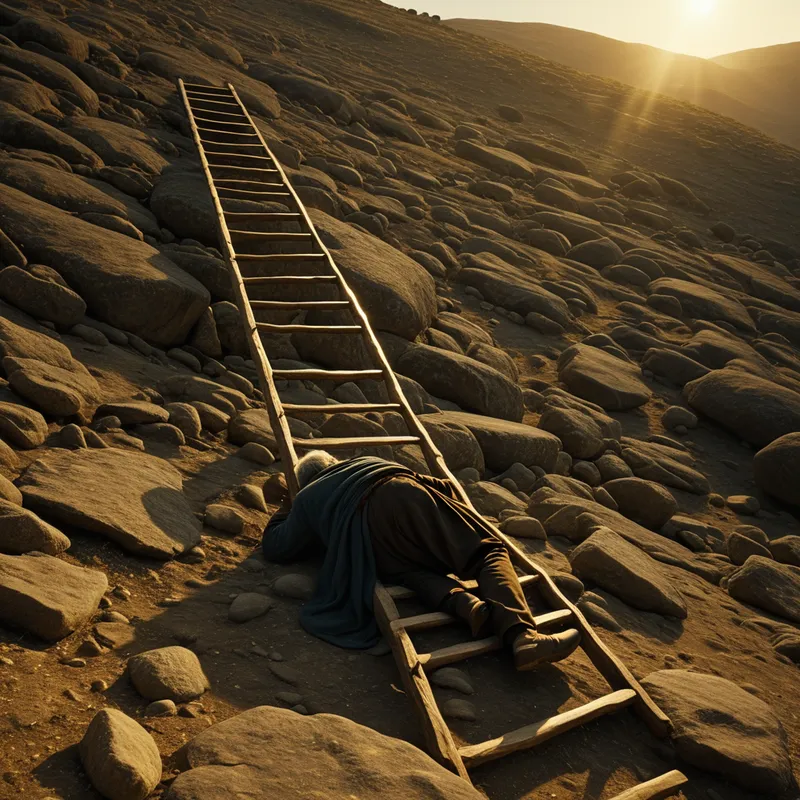
The world was a hard place, and Jacob was a man with a stone for a heart. He fled into the teeth of the wilderness, the taste of his brother Esau’s fury still bitter on his tongue. The sun, a dying ember, bled into the hills of a place called Luz. No inn, no hearth, no human voice—only the sigh of the wind through dry grass and the cold embrace of the gathering dark.
Exhaustion, that great leveler, finally pulled him down. He gathered stones from the field, not for an altar, but for a bed. One stone, smoother than the rest, he placed beneath his head. A pillow of earth’s bare bone. As he lay down, the weight of his deeds—the stolen blessing, the shattered trust—pressed upon him heavier than the rock. The heavens were a vast, black vault, punctured by indifferent stars. This was the nadir, the absolute alone.
Then, sleep came, and with it, the dream.
The stone did not soften, but the world opened. A ladder was set upon the earth, its top reaching to the very heart of the sky. It was not wood or rope, but a structure of living light and solid promise. And upon it, the messengers of God were ascending and descending, a constant, flowing river of connection between the dust and the divine. Above it all stood YHWH Himself, not in thunder, but in a voice that was the foundation of the world.
“I am YHWH, the God of Abraham your father and the God of Isaac,” the voice declared, weaving destiny into the night air. “The land on which you lie I will give to you and to your offspring. They shall be like the dust of the earth. All the families of the earth shall be blessed in you. Behold, I am with you and will keep you wherever you go.”
The dream faded with the first grey hint of dawn. Jacob awoke, but he was not the same man who had slept. A profound terror—a holy awe—gripped him. “Surely YHWH is in this place,” he whispered to the empty air, “and I did not know it.” The world was no longer barren; it was charged, a thin place where heaven touched earth. The common stone beneath his head was now a witness, a pillar of testimony.
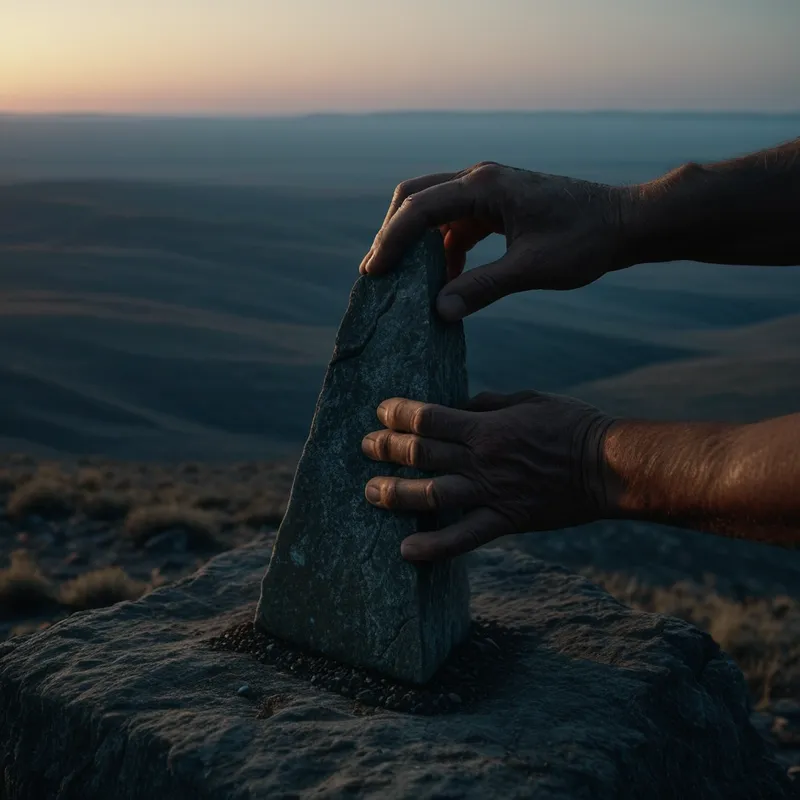
He took that stone, the pillow of his despair, and set it upright as a pillar. He poured oil upon its rough crown, anointing the common with the sacred. He renamed the place Bethel. The stone was no longer a mere support for a weary head; it was the foundation stone of a new reality, the first altar of a transformed life.
Cultural Origins & Context
This narrative is embedded in the Book of Genesis, a foundational text composed and redacted over centuries, likely during the first millennium BCE. It belongs to the cycle of patriarchal stories—tales of family, promise, and fraught inheritance passed down orally long before being committed to scroll. The story of Jacob at Bethel functions as a crucial etiological myth, explaining the sanctity of a major Israelite cultic site. But its power transcends mere origin story.
Told around fires and in tents, it served a society deeply familiar with exile, journey, and the search for divine favor. It answered a profound human question: Where is God when we are alone, afraid, and fleeing the consequences of our own actions? The myth asserts that the divine encounter does not require a temple or a purified state; it can erupt in the midst of personal failure and geographic dislocation. It democratized theophany, offering hope that the covenant was not broken by human frailty but could be reaffirmed in the very place of one’s deepest vulnerability.
Symbolic Architecture
The myth’s power lies in its stark, alchemical symbolism. Each element is a node in a psychological drama.
The Stone Pillow represents the hardened self, the weight of one’s circumstances and choices. It is uncomfortable, unyielding, a symbol of necessity and reduction to bare essence. Yet, it is upon this very point of resistance that revelation occurs.
The foundation of the new self is always the rejected stone of the old.
The Ladder (Sullam) is the symbol of coniunctio—the connection between opposites: conscious and unconscious, human and divine, earth and heaven. The traffic of angels signifies that this is not a one-time ascent but a perpetual exchange, a dynamic relationship between the psyche and the transpersonal realm.
The Dream itself is the voice of the Self, the archetypal totality of the psyche, breaking into the ego’s isolated exile. It delivers not condemnation for Jacob’s deceit, but a staggering reaffirmation of identity and purpose. The promise is granted not because he is righteous, but because he is chosen in his entirety—trickster and heir alike.
Anointing the Stone is the critical act of conscious recognition and sacralization. Jacob takes the instrument of his discomfort and actively makes it a monument. This is the moment the personal experience is translated into a lasting psychological structure—a commitment to the new awareness.

The Dreamer’s Resonance
When this myth pattern stirs in the modern soul, it often manifests in dreams of profound isolation or pivotal journeys. The dreamer may find themselves in a barren, liminal space—an empty highway, a featureless plain, a dark wood. They are fleeing something or are simply lost. The central image is often an object of stark, uncomfortable utility: a concrete block, a slab, a hard chair that becomes the focus of the dream.
The arrival of the “ladder” can take myriad forms: a sudden shaft of light, an intricate web of connections, a spiral staircase appearing in a void, or a vision of guiding figures. The somatic feeling upon waking parallels Jacob’s “holy dread”—a shaking awe, a sense of the world being fundamentally different, charged with meaning. This signals a rupture in the dreamer’s old ego-structure. The psyche is announcing that the place of their greatest alienation and discomfort is, in fact, the very site where a new orientation to life—a new “covenant” with the Self—is being offered.

Alchemical Translation
The myth of Jacob’s Pillow is a perfect map of the individuation process. It begins in the nigredo—the blackening. Jacob is in the psychological wilderness, his conscious identity (the deceitful younger son) shattered. He is reduced to his bare essence, lying on the prima materia of his own stony reality.
The dream is the albedo—the whitening, the illuminating revelation from the unconscious. The ladder is the symbol of the transcendent function, which emerges to bridge the chasm between the ego’s desperate situation and the archetypal blueprint of the Self. The divine promise represents the latent wholeness seeking realization.
The promise is not a reward for virtue, but a seed of potential buried in the rubble of the life we have made.
Awakening and anointing the stone is the rubedo—the reddening, the integration. This is the conscious, willful act of the ego. The dreamer must “set up the stone,” must actively acknowledge and honor the transformative experience. They must rename their inner landscape. The place of exile (“Luz”) becomes the “House of God” (“Bethel”). The trauma or failure is not erased; it is transmuted into the foundational pillar of a new, more authentic identity. The oil poured is the libido, the life energy, now directed toward this new center.
Thus, the myth teaches that our most profound awakenings are not found in comfort, but on the stone pillows of our exile. The path to the sacred is paved with the very rocks we once fled.
Associated Symbols
Explore related symbols from the CaleaDream lexicon: