
Jacob's Altar at Bethel Myth Meaning & Symbolism
A fugitive's dream of a ladder to heaven transforms a stony wilderness into sacred ground, marking a covenant between the divine and the human.
The Tale of Jacob's Altar at Bethel
Listen. The air is thin and sharp with the scent of dust and thyme. The sun has fled, leaving a vault of black velvet pierced by a million cold, watching eyes. Here, in this place called Luz, there is only a fugitive and a field of stones.
His name is Jacob. He is running. The taste of his brother’s betrayed rage is still bitter on his tongue, a ghost of the stew he traded for a birthright. The weight of his father’s stolen blessing hangs on his shoulders, heavier than any pack. He is alone, utterly alone, with only the hard ground for a bed and a stone, one chosen from a thousand identical brothers, for a pillow. He wraps his cloak tight, a poor shield against the desert’s exhaled chill, and sleep takes him—not as a gentle guest, but as a thief of consciousness.
And then, the world turns inside out.
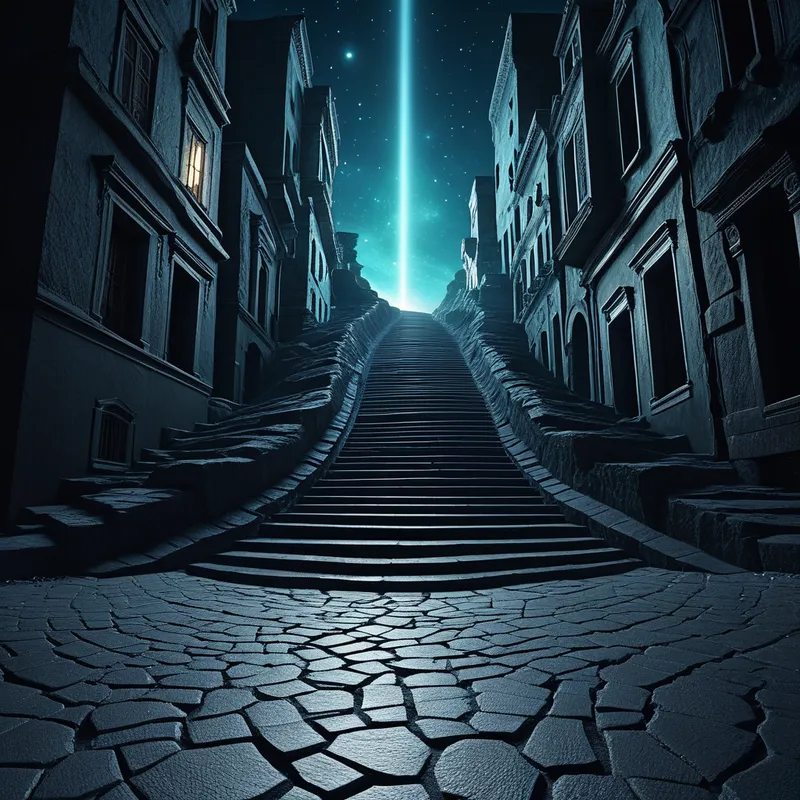
The stone beneath his head becomes the axis of the universe. From it, rooted in the very earth of his exile, a structure rises. Not built by human hands, but dreamed into being. A sullam—a ladder. Its substance is of light and promise, its rungs are the spaces between stars. And upon it, there is traffic. Beings of fire and purpose, the malakim, ascend and descend in a silent, ceaseless procession. Up from the lonely earth to the boundless heavens, and down from the boundless heavens to the lonely earth. The boundary dissolves. The fugitive’ desolate campsite is the junction box of all creation.
Then, a Voice. It does not shake the stones; it is the foundation of the stones. It is the voice of YHWH, standing above the ladder, yet speaking from within the dream, from within Jacob’s own terrified, awe-struck soul.
“I am YHWH, the God of Abraham your father and the God of Isaac. The land on which you lie I will give to you and to your offspring… Behold, I am with you and will keep you wherever you go.”
The promise unfolds like a scroll in his mind: land, descendants like the dust of the earth, a blessing for all families. Protection. Presence.
Jacob wakes. The desert is still dark, but the world is irrevocably changed. The ordinary air vibrates with a terrible holiness. “Surely YHWH is in this place,” he whispers, his voice raw with revelation, “and I did not know it.” Fear—a sacred, trembling fear—grips him. “How awesome is this place! This is none other than the house of God, and this is the gate of heaven.”
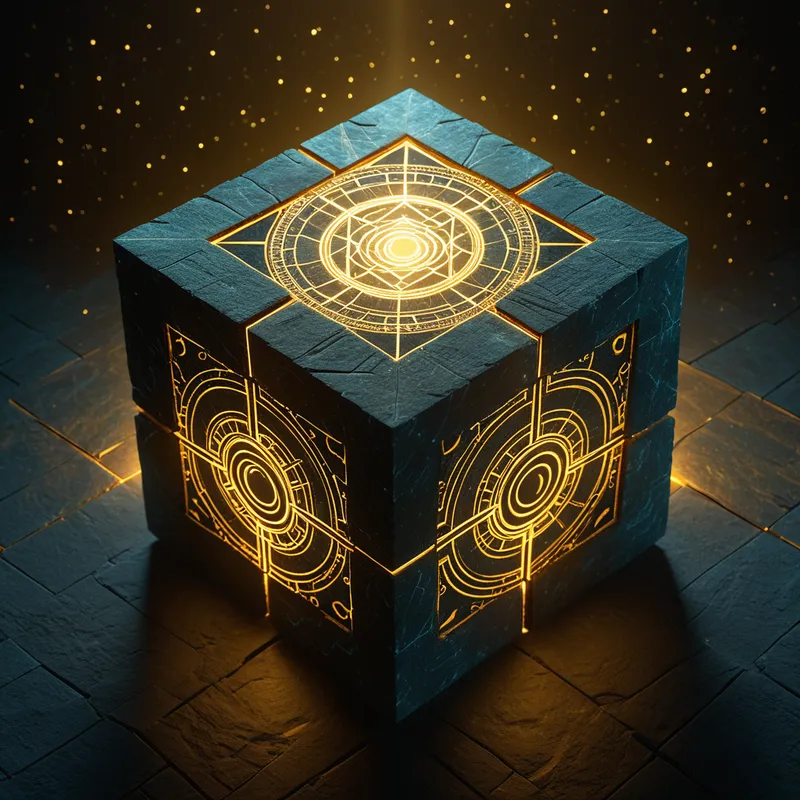
With the first grey light of dawn, he acts. The stone, his humble pillow, is no longer just a stone. It is a witness, a marker, a point of contact. He sets it upright as a matzevah. He takes oil, precious and smooth, and anoints the pillar, consecrating it, making it slick with the sign of the sacred. He renames the place. No longer Luz, a name belonging to others. Now it is Bethel. His experience names it. And he makes a vow, a conditional covenant echoing the divine one: If God will be with him, then this stone shall become God’s house.
The altar is built not of carved marble, but of memory, terror, and awe. The fugitive stands, turns his face from the sacred stone, and continues his journey. But he is no longer just a man fleeing his past. He is a man carrying a compass point, a living altar, within him.

Cultural Origins & Context
This foundational narrative is embedded in the Book of Genesis (Chapter 28). It belongs to the cycle of patriarchal stories—oral traditions refined over centuries before being codified into written scripture. These stories served as the ethnic and theological bedrock for the tribes of Israel, explaining their unique covenant with the divine and their claim to the land of Canaan.
The tellers were likely tribal elders and storytellers, passing down the account of their ancestor Jacob not merely as history, but as identity-forming myth. Its societal function was multifaceted: it explained the sanctity of the cultic site at Bethel (a major religious center in the northern kingdom of Israel), it validated the lineage of the Israelites through Jacob’s divine election, and most importantly, it established a template for the human-divine relationship. This was not a myth of gods on a distant mountain, but of a God who encounters individuals in the midst of their personal crises, in the very “non-places” of life, and transforms those places into centers of meaning. It democratized the concept of the sacred, suggesting it could be found not only in temples but at the lonely crossroads of a human life.
Symbolic Architecture
At its core, the myth maps the architecture of a transformative encounter between the limited human ego and the boundless Self. Every element is a psychic coordinate.
The Stone Pillow: The hard, uncomfortable truth of one’s situation. Jacob cannot rest on the soft illusions of his former life; he must make his bed with the reality of his actions—the “stony” consequences. This uncomfortable truth becomes the foundation for revelation.
The Ladder: The axis mundi, the connecting channel between the conscious and unconscious realms, the personal and the transpersonal. It signifies that communication is open. The divine is not remote; it is accessible, with traffic moving both ways. Insights (angels ascending) can be received, and prayers or commitments (angels descending) can be sent.
The Angels Ascending and Descending: The constant flow of psychic material between depths and surface. They represent intuitions, inspirations, fears, and memories in perpetual motion, linking our grounded reality with our spiritual or unconscious potential.
The altar is built not where we plan, but where we fall asleep in exhaustion, on the very stone of our crisis.
The Anointed Pillar (Matzevah): The act of conscious recognition and memorialization. To anoint the stone is to sacralize the experience, to mark the moment of rupture and insight so it is not lost. It is the ego erecting a monument to its own encounter with something greater, creating a fixed point of reference in the psyche—a “Bethel”—to which one can return in memory and spirit.
The Vow: The human response to grace. It is the beginning of a reciprocal relationship. The divine promise is unconditional, but the human covenant requires action. It translates the numinous experience into a framework for future living.
The Dreamer's Resonance
When this mythic pattern stirs in the modern unconscious, it often manifests in dreams of sudden, awe-inspiring connections in places of isolation or despair. One might dream of a brilliant shaft of light connecting a cluttered, mundane apartment to a starry sky; of finding a mysterious, ancient staircase in a familiar basement; or of receiving a profound, clear message while stranded in a featureless landscape.
Somatically, this can correlate with the “spine-tingling” sensation of awe—a literal feeling of energy moving up the vertebral column (the body’s own sullam). Psychologically, the dreamer is undergoing the process of numinous shock: the ego’s comfortable worldview is shattered by an influx from the Self. They are, like Jacob, in a state of transition or exile (a career change, a relational breakdown, a spiritual crisis), and the psyche is revealing that this very place of loss is the potential site of revelation and reorientation. The dream is an invitation to stop fleeing, to lie down on the stony truth, and to pay attention to the traffic between the heavens of possibility and the earth of current reality.
Alchemical Translation
The alchemical process mirrored here is the coniunctio oppositorum—the conjunction of opposites—specifically, the marrying of heaven and earth, spirit and matter, the eternal and the temporal. Jacob, the trickster-ego, is in a state of nigredo, the blackening: he is in the dark night, stained by his own shadow (deceit), and utterly dissolved from his former identity.
The dream is the albedo, the whitening. The illuminating flash that reveals the hidden structure of the world. The ladder is the alembic itself, the vessel where the high and low mix. The divine promise is the infusion of the lapis philosophorum, the philosopher’s stone—not as an object, but as the realization of intrinsic value and purpose (“the land on which you lie I will give to you”).
Individuation begins not with a quest, but with a startled awakening to the sacredness already underfoot.
The act of raising the altar is the rubedo, the reddening. It is the conscious, embodied work. The ego, having been shown its place in a vast order, must now actively participate. It takes the crude material of the experience (the stone, the memory) and anoints it—applies the aqua vitae (oil) of conscious attention and commitment. This transforms the random event into a foundational pillar of the personality. The fugitive (the orphaned ego) is not erased but is integrated into a new, larger identity: the covenant-bearing explorer, whose home is not a fixed location, but the living relationship between the divine promise and the human journey.
Thus, the myth models the entire arc of psychic transmutation: from chaotic flight, through terrifying and awe-filled revelation, to the deliberate, grounded act of building an inner sanctuary based on that revelation. We are all, in our own wildernesses, called to anoint the stones of our betrayals and exiles, and to name the Bethels where we finally understood that the divine was in this place, and we did not know it.
Associated Symbols
Explore related symbols from the CaleaDream lexicon: