
Jacob Myth Meaning & Symbolism
A patriarch's journey of deception, exile, and a divine wrestling match that forges a new identity and a nation from struggle.
The Tale of Jacob
Listen, and hear the tale of the one who grasped a heel and would not let go.
In the land of Canaan, a man named Isaac prayed for a barren wife. The prayer was heard, and twins stirred in Rebekah’s womb, warring even before birth. The first to emerge was ruddy and covered in hair, and they named him Esau. His brother followed, his small hand clutching Esau’s heel as if to pull him back, and they named him Jacob.
From the beginning, their natures clashed. Esau was a man of the field, the scent of earth and hunt upon him. Jacob was a quiet man, dwelling in tents, his mind a labyrinth of calculation. One day, Esau returned from the field famished, near to fainting. Jacob, simmering a stew of red lentils, saw his chance. “Sell me your birthright, this day, for some of that red stew,” he said. Esau, despising his spiritual inheritance, swore it away for a bowl of food. The scent of lentils and lost destiny hung in the air.
Years later, when their father Isaac was old and blind, the time came for the blessing. Rebekah, who loved Jacob, devised a scheme. She dressed Jacob in Esau’s clothes, covering his smooth hands and neck with the skins of goats. The smell of the field clung to the disguise. Jacob approached his father. “Who are you, my son?” Isaac asked, his blind hands reaching. “I am Esau, your firstborn,” Jacob lied. Isaac felt the hairy skin, smelled the false scent of the outdoors, and was deceived. He bestowed the potent, irrevocable blessing of the firstborn upon the supplanter.
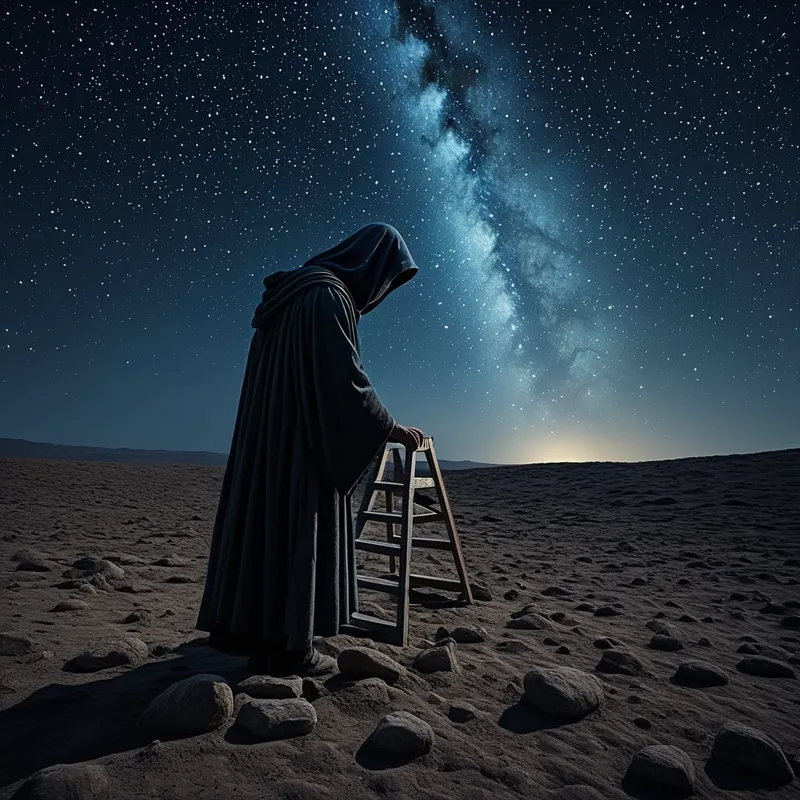
When Esau discovered the theft, his cry was a wounded animal’s roar, a vow of murder. Jacob fled, a fugitive from his brother’s wrath, into the vast, empty wilderness. Night fell upon a lonely place called Bethel. With a stone for his pillow, he slept. And he dreamed. A ladder was set upon the earth, its top reaching to heaven, and behold, the angels of God were ascending and descending on it. And the Lord stood above it and spoke promises of land and descendants. Jacob awoke in terror and awe. “Surely the Lord is in this place, and I did not know it.” He took the stone, set it up as a pillar, and poured oil upon it, marking the thin place between heaven and earth.
He journeyed on to his mother’s kin, where he labored twenty years for his uncle Laban, himself a master of deception. He was tricked in marriage, his wages changed ten times, wrestling with a man as cunning as his own reflection. He grew rich in flocks, but his soul grew weary for home. With his two wives, two maidservants, and eleven sons, he fled Laban as he had fled Esau, a man perpetually between pursuers.
And then came the night. The night of return, of reckoning. He sent his family and all his possessions across the ford of the river Jabbok, and he remained alone on the far bank. The desert was silent, the water a dark murmur. And a man came, and wrestled with him until the breaking of the dawn.
It was no ordinary struggle. It was a contest of essence, bone against spirit, breath against eternity. When the being saw that he did not prevail against Jacob, he struck the socket of Jacob’s hip, dislocating it as they wrestled. Still, Jacob would not release his grip. “I will not let you go unless you bless me,” he gasped, his body broken but his will indomitable.
“What is your name?” the being asked. “Jacob,” he answered—the Supplanter, the Heel-Grasper. “Your name shall no longer be Jacob, but Israel, for you have striven with God and with men, and have prevailed.”
Then the being blessed him there. As the sun rose upon him, Jacob limped across the ford of the Jabbok, a new man with a new name, marked by the divine and ready to face his brother, not as a fugitive, but as a patriarch forged in the night.
Cultural Origins & Context
The saga of Jacob is a foundational national epic embedded within the Torah. It belongs to the oral traditions of the ancient Israelites, stories told and retold around campfires and in tribal gatherings long before they were codified in written scripture. Its primary function was etiological—to explain the origins of the nation of Israel (literally, the “children of Israel”), its complex relationship with neighboring peoples like the Edomites, and the sacred significance of sites like Bethel.
The narrative is not a sanitized hero’s journey but a deeply human, even scandalous, family drama. It reflects a tribal society where blessing, birthright, and cunning are tangible currencies of survival and power. The storytellers did not shy from portraying their founding ancestor as a deceiver, highlighting a profound theological theme: that divine election and covenant are not rewards for moral perfection, but operate through flawed, striving humanity. The story was a mirror for a people who saw themselves as shaped in exile, struggle, and an unbreakable, wrestling relationship with the Divine.
Symbolic Architecture
At its core, the myth of Jacob is the psyche’s journey from a borrowed, tactical identity to an earned, authentic self. Jacob begins as the “man of the tent”—introverted, cerebral, operating through indirect manipulation (the heel, the disguise, the deal). He is the persona and the shadow, using cunning to obtain what he intuits is his destiny but cannot claim directly.
The blessing must be stolen before it can be earned; the false self must enact its drama before the true self can be summoned.
His flight is a necessary exile from the old order, a descent into the unconscious (the dream of the ladder at Bethel) where he first glimpses the numinous connection between his earthly struggle and a transcendent pattern. His years with Laban represent the stage of enantiodromia—where one encounters their own traits reflected back in another. Laban is Jacob’s externalized double, teaching him the bitter taste of his own medicine and forcing the development of resilience and responsibility.
The climax at the Jabbok is the ultimate symbolic event. Wrestling with the “man” who is also Elohim represents the ego’s brutal, intimate confrontation with the Self, the totality of the psyche including its divine, overwhelming otherness. The dislocated hip is the sacred wound, the permanent alteration required for transformation. It is the price of the blessing.
To receive your true name, you must be wounded by the divine. The limp is the seal of authenticity, the visible proof of a night spent in the arms of the ultimate reality.

The Dreamer's Resonance
When this myth stirs in the modern dreamscape, it signals a profound interior struggle for identity and legitimacy. To dream of wrestling an unknown, powerful figure—especially one that feels both terrifying and sacred—points to a somatic engagement with a core psychological complex or a buried aspect of the Self. The body in the dream is not metaphorical; it is the literal site of the conflict. You may awake with a sense of exhaustion or even physical soreness.
Dreams of fraudulent blessings (receiving an award under false pretenses) or of being pursued by a furious, shadowy brother (often representing rejected aspects of one’s own instinctual or passionate nature) echo Jacob’s early chapters. They speak to a life lived through a strategic persona that has outlived its usefulness and is now demanding reconciliation. The dream of a ladder or staircase connecting mundane reality to a radiant, awe-inspiring height is a direct call to acknowledge the numinous in your current “barren place,” your own Bethel. It asks the dreamer: where in your life is God present, and you do not know it?
Alchemical Translation
The alchemical process mirrored in Jacob’s saga is the individuation journey from leaden deception to golden, wounded wholeness.
Nigredo (The Blackening): The initial state is one of shadowy manipulation. Jacob, in his trickery, is in the prima materia—base, conflicted, driven by ambition and fear. The flight into the wilderness is the necessary dissolution, the feeling of being lost, alienated from the old family structure (the known psyche).
Albedo (The Whitening): The dream at Bethel is the first illumination, the albedo. The ladder is the symbolic nexus, revealing that the struggle has a vertical, transcendent dimension. It offers hope and connection but is not yet integration; it is a vision, not an embodied change.
Citrinitas (The Yellowing): The long labor for Laban is the citrinitas, the slow, often frustrating work of engaging with the world and one’s own mirrored flaws. Here, the ego develops strength, patience, and worldly competence—building the “flocks and herds” of conscious achievement—all while the longing for “home” (the Self) grows.
Rubedo (The Reddening): The Jabbok is the rubedo, the fiery, bloody climax of the opus. This is the coniunctio oppositorum enacted not in harmony, but in violent embrace. Ego (Jacob) and Self (the Divine Stranger) meet not in serene meditation but in exhausting, physical struggle. The blessing is extracted only through relentless will (“I will not let you go”). The resulting wound (the limp) and the new name (Israel) are the philosopher’s stone—the transformed personality that is both more than and less than it was before. It is no longer perfectly functional (it limps), but it is authentically itself, carrying the mark of its encounter with the ultimate.
For the modern individual, the myth dictates that our wholeness is not found in avoiding struggle or perfecting a pleasant persona. It is forged in the dark night, in the willingness to grapple directly with what ultimately defines us, and to emerge wounded, renamed, and finally, real. We do not find ourselves by staying smooth-handed in the tent. We find ourselves by limping, blessed, into the dawn.
Associated Symbols
Explore related symbols from the CaleaDream lexicon: