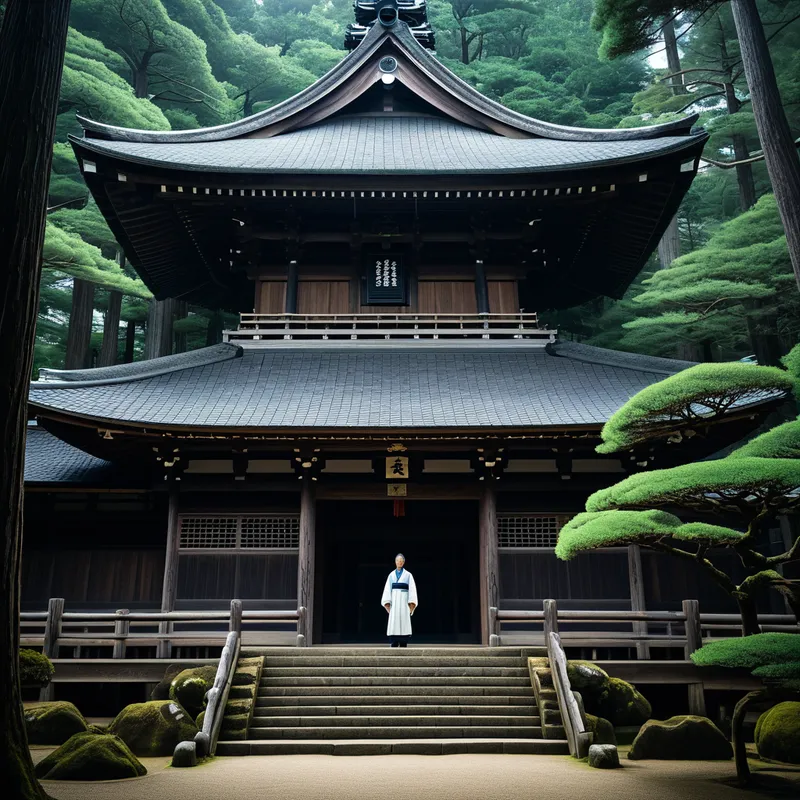
Izumo Grand Shrine Origin Myth Meaning & Symbolism
A kami cedes the visible world for a hidden realm, establishing a sacred dwelling for the invisible forces that shape human destiny and connection.
The Tale of Izumo Grand Shrine Origin
Listen, and hear the tale of how the world of the visible was made stable, and the realm of the hidden was given its due. It begins not with a bang, but with a sigh—the sigh of the earth itself, young and restless, heaving with the spirits of the land, the kami. Among them was a great lord, Okuninushi-no-Kami. He was the one who suffered, who strove, who built the world with his own hands and wisdom. He pacified the chaotic spirits, he healed the wounded land, and with the counsel of a divine visitor from beyond the sea, he established rule and brought prosperity to the reed plains, the central land.
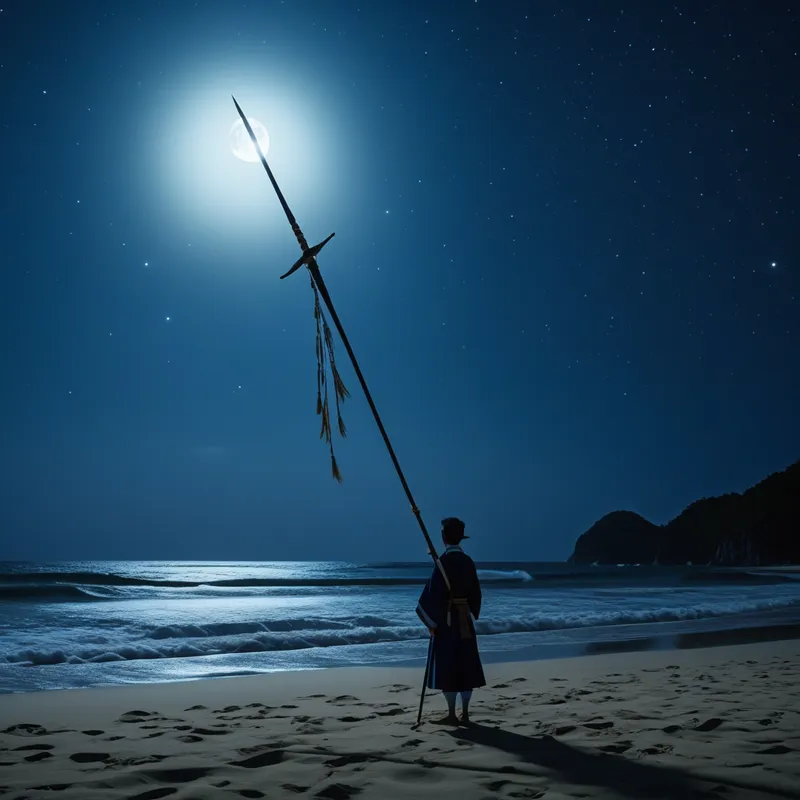
But from the high plain of heaven, Amaterasu-Ōmikami, the sun who illuminates all things, looked down. She declared that her grandson’s lineage should peacefully govern this visible, flourishing land. And so, messengers were sent—not warriors, but envoys of heavenly will. They descended to the shores of Inasa-no-Hama, where the salt wind whipped and the pine trees groaned. They stood upon the black pebbles, their divine presence a pressure in the air, and they spoke their demand to Okuninushi.
The lord of the land listened. The wind carried the scent of the sea and the deep soil he had nurtured. He felt the weight of his creation, the lives intertwined with his own. He did not rage. He did not refuse. Instead, he turned to his son, Kotoshironushi-no-Kami, a spirit of the sea and of wise counsel. And his son spoke with a voice like the deep ocean: “My father will yield this visible world.” Then, a second voice, resonant and final, echoed from the very light upon the waves—the voice of his other son, Takeminakata-no-Kami. He challenged the heavenly envoy to a test of strength, a divine sumo match. He grasped the envoy’s arm, and it turned to ice, then to a piercing sword. Defeated, he fled, and his father’s decision stood.
And so, Okuninushi, the great builder, the wise ruler, made his condition. “I will withdraw from the governance of this visible world. But build for me a dwelling, grand and magnificent, like the very heavens. Enshrine my spirit there, in the hidden world. Let that place be where the myriad kami gather, where the invisible threads of fate and connection are woven.” The heavenly envoys agreed. And with a thrust that shook the foundations of the world, they planted the heavenly spear, Ame-no-Nuboko, into the earth at the beach of Inasa. It became the sacred central pillar, the Shin-no-Mihashira, around which the first grand shrine was raised with mighty timbers and a roof that brushed the clouds. Here, Okuninushi retreated, becoming the great lord of the unseen, the master of relationships and destinies. And every year, in the tenth month known as Kannazuki everywhere else, it is the "Month With Gods" in Izumo, for all the kami of the land journey there to hold council, in the palace he was granted.
Cultural Origins & Context
This foundational myth is preserved in Japan’s oldest chronicles, the Kojiki (712 CE) and the Nihon Shoki (720 CE). These texts were not mere storybooks but political and cosmological documents, compiled to legitimize the imperial lineage descending from Amaterasu. The Izumo myth serves a critical diplomatic and theological function within this framework. It does not narrate a conquest, but a negotiated settlement—a divine abdication. This provided a powerful narrative that integrated the powerful, indigenous kami cults of the Izumo region (represented by Okuninushi) into the emerging national Shinto</abtitle="The 'Way of the Kami,' the indigenous spirituality of Japan.">Shinto cosmology centered on the heavenly kami.
The tale was likely refined and formalized by court scribes and ritualists, but its roots reach into the oral traditions of the Izumo region itself. Societally, it explained the supreme religious importance of the Izumo Grand Shrine (Izumo Taisha) as the “other” spiritual capital of Japan, parallel to the imperial shrines at Ise. It established Izumo as the administrative center for all things hidden and relational: marriage, destiny, diplomacy, and the annual gathering of the kami. The myth thus functioned as a charter for sacred geography, ritual practice, and social cohesion, acknowledging multiple centers of spiritual power within a unified cosmic order.
Symbolic Architecture
At its heart, this myth is about the conscious establishment of a hidden order. Okuninushi’s journey is not one of defeat, but of profound, strategic withdrawal. He represents the principle of earthly, experiential wisdom—the soul that has built a life through struggle, relationship, and tangible effort. His “retirement” to a hidden, enshrined state symbolizes the interiorization of that hard-won power.
The greatest power is not always in visible rule, but in becoming the unseen axis around which the world of meaning turns.
The heavenly spear, Ame-no-Nuboko, driven into the earth, is the archetypal symbol of the axis mundi. It marks the point where divine decree meets earthly reality, transforming chaotic potential into a structured sanctuary. The Grand Shrine itself, built around the invisible central pillar, is a mandala of the psyche—a sacred space where the conscious and unconscious, the visible life and the hidden soul, are held in respectful tension. Okuninushi becomes the lord of the unconscious, the keeper of the patterns and connections that underpin our visible existence.
The Dreamer's Resonance
When this myth stirs in the modern dreamer, it often signals a profound process of internal negotiation. One may dream of being asked to give up a long-held, hard-earned position or identity. There is no violent overthrow, but a solemn, inevitable request from an authoritative, perhaps impersonal, force (the “heavenly envoys”).
The somatic feeling is one of deep, resonant pressure and a potential sigh of release. Psychologically, the dreamer is at the point where the ego’s constructed world—the “kingdom” they have built through personal effort—must make room for a larger, transpersonal order. The conflict is between the pride of ownership and the wisdom of becoming a hidden foundation. To dream of a vast, empty hall or a gathering of shadowy figures can reflect this stage, where the parts of the psyche are convening to renegotiate the terms of one’s life, moving authority from the conscious persona to the deeper, guiding Self.
Alchemical Translation
The alchemical process modeled here is the sacrificium—the sacred making—of the conscious personality for the sake of the soul’s greater purpose. In Jungian terms, it is a critical movement in individuation. The “hero” Okuninushi does not fall; he consciously cedes the daylight realm of the ego to answer the call of the Self.
Individuation often requires the dignified abdication of the ego from the throne, so that the Self may be enshrined at the center.
The first half of life is often an “Okuninushi phase”: building, achieving, mastering the external world. The alchemical translation begins when the “heavenly mandate” arrives—a midlife crisis, a call to meaning, an illness, or simply a deep fatigue with outward striving. The triumph is in the negotiation. The ego does not dissolve; it is offered a sacred dwelling. It becomes the Shin-no-Mihashira, the central pillar of the personality, now serving as the stable anchor for the invisible processes of the psyche—the weaving of relationships (marriage), the recognition of fate (destiny), and the council of inner voices (the gathering kami). The individual learns to rule the visible world from the hidden shrine, their actions now guided by an authority deeper than personal will.
Associated Symbols
Explore related symbols from the CaleaDream lexicon:
- Shinto Shrine — The architectural manifestation of the hidden order, a physical space where the invisible (kami) is honored and invited to interact with the visible world.
- Origin — The myth explains the primordial origin of a specific spiritual and psychological principle: the establishment of a hidden center of authority.
- Grand — Reflects the majesty and supreme importance of the negotiated settlement and the dwelling that results; it is not just a shrine, but the Grand Shrine of the hidden realm.
- Enshrined Relic — Okuninushi himself becomes the ultimate enshrined relic, his active power transformed into a latent, foundational presence that structures reality.
- Ritual — The entire myth establishes the blueprint for the ultimate Shinto ritual: the annual gathering of the kami, a cosmic ceremony of re-weaving connections.
- Sacrifice — The core action of the myth; Okuninushi's voluntary relinquishment of visible authority for a greater, hidden role and stability.
- Order — The final product of the divine negotiation; the transformation of potential chaos (of competing rulership) into a harmonious, dual-layered cosmic order.
- Destiny — The domain over which the enshrined Okuninushi now presides; the hidden shrine is where the threads of fate are discussed and arranged.
- Axis Mundi — Represented by the heavenly spear Ame-no-Nuboko and the invisible central pillar; the vertical connector between realms that grounds spiritual power.
- Temple — In the broadest sense, the myth is about the consecration of inner space, building a temple of the soul where the deepest self resides.
- God — Represents the transpersonal, archetypal forces (both the heavenly and earthly kami) in negotiation, beyond human personality.
- Journey — The path of Okuninushi from active, earthly ruler to enshrined, hidden lord mirrors the soul's journey from external achievement to internal authority.