Ixion's Wheel Myth Meaning & Symbolism
A king's betrayal of divine hospitality leads to his eternal punishment: bound to a fiery, spinning wheel in the underworld.
The Tale of Ixion's Wheel
Hear now the tale of Ixion, a story whispered on winds that smell of smoke and iron. He was a king of the Lapiths, a man whose ambition was a fire that could not be quenched. His first crime was one of blood: he murdered his father-in-law, a guest at his own hearth, defiling the sacred law of xenia. The stain clung to him, making him an outcast, a man no city would purify.
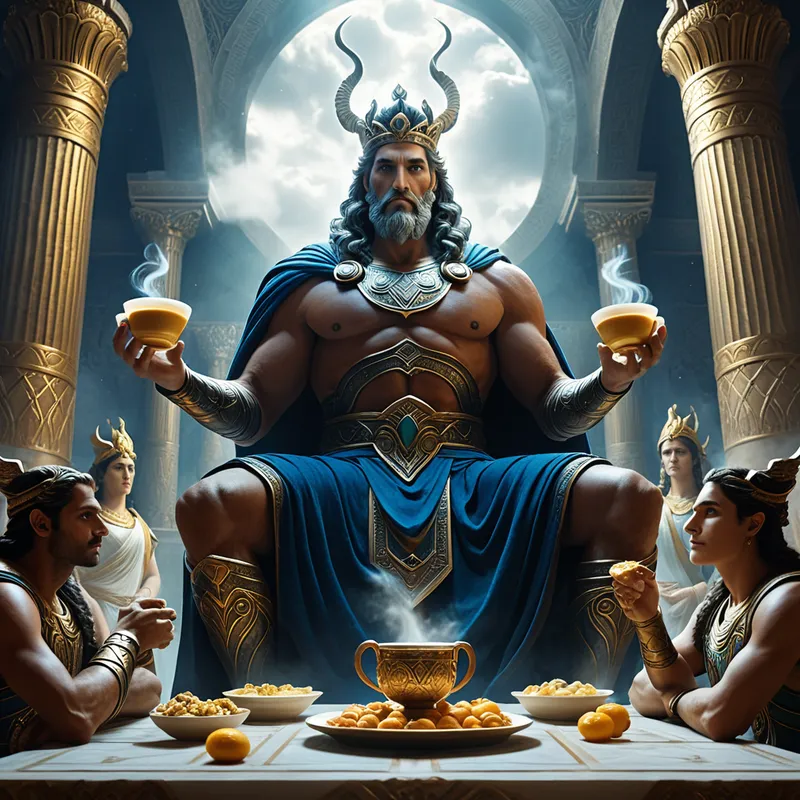
But Ixion was cunning. He looked to the sky, to the cloud-wreathe peak of Olympus. He called upon Zeus himself, lord of guests and suppliants. And Zeus, in his sovereign mercy, did what no mortal would. He invited the polluted king into the divine halls, to feast at the table of the gods, to be cleansed in the very light of heaven.
The air of Olympus was thick with the scent of ambrosia and the sound of immortal laughter. Ixion walked on floors of star-dust, drank nectar that burned like cold fire. But his eyes were not on the grace offered; they were fixed on Hera, Zeus's wife, whose beauty was a terrible, serene power. The fire of his ambition found new fuel—a mad, blasphemous desire. He began to court her, to whisper promises born of hubris.
Zeus, all-seeing, knew the king's heart. To test him, to offer a final chance at redemption, the Cloud-Gatherer fashioned a phantom from mist and light, a perfect likeness of Hera named Nephele. In the deep shadows of the palace, Ixion beheld the shimmering form. His reason shattered; his lust consumed him. He embraced the cloud, and from that unnatural union was born Centaurus, progenitor of the wild centaurs.
The offense was absolute. The betrayal of hospitality was compounded by an assault on the very pillar of the cosmic order: the marriage of the king and queen of heaven. Zeus's mercy turned to wrath, a thunderous, final judgment. No simple death would suffice.
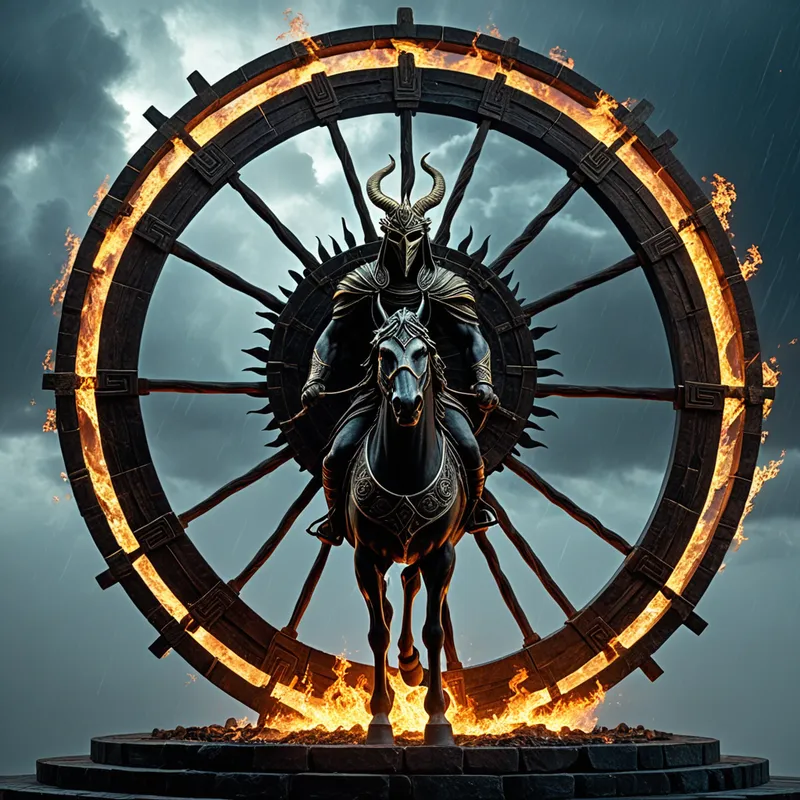
The sentence was crafted in the forges of Hephaestus. From unbreakable adamant and roaring flame, a great wheel was fashioned. Ixion was dragged, screaming, to a desolate corner of the underworld, Tartarus. There, with chains of his own guilt, he was bound fast to the rim of the blazing wheel. A great wind rose, and with a groan of tortured metal, it began to spin.
And so, Ixion turns. Forever. His cries are lost in the howl of the wind and the crackle of eternal fire. He sought to ascend to the highest station, to possess what was never his. His reward was not elevation, but a perpetual, dizzying revolution—a king made a fixture of his own punishment, a lesson written in fire against the endless dark.
Cultural Origins & Context
The myth of Ixion is a foundational cautionary tale, primarily preserved in the works of early Greek poets like Pindar and later mythographers. It functioned as a powerful social and religious narrative, reinforcing the bedrock principles of Hellenic society. The supreme law of xenia—the respectful relationship between host and guest—was not mere etiquette; it was a divine ordinance upheld by Zeus Xenios. Ixion’s first murder violated this, making him a societal poison.
His subsequent betrayal in Olympus amplified the crime to a cosmic scale. The story was likely told in symposia and by rhapsodes, serving as a stark reminder that the favor of the gods was conditional upon human adherence to sacred limits. It explained the origin of the troublesome centaurs and dramatized the consequences of hubris. In a culture deeply concerned with purity, pollution (miasma), and divine justice, Ixion’s fate was the ultimate parable: no one, not even a king, is above the fundamental laws that bind the cosmos and human community together.
Symbolic Architecture
At its heart, Ixion’s Wheel is an archetypal symbol of recursive torment and the prison of one’s own making. The wheel itself represents the closed circuit of a destructive pattern, a karma of one’s own actions that offers no exit. Ixion is not punished by an external monster, but by a perfected machine—a symbol of impersonal, inescapable consequence.
The wheel is the perfect geometric form of a fate that goes nowhere. Its endless revolution is the psyche trapped in a feedback loop of its own unresolved guilt, ambition, and betrayal.
Ixion represents the part of the psyche that believes it can outsmart the gods—the laws of nature, conscience, and relationship. His desire for Hera is not mere lust, but a craving for ultimate validation, for a power and status that is fundamentally not his nature to hold. The phantom Nephele is the ultimate trick of the Self: the illusion that our ego’s desires are touching reality, when in fact we are embracing a hollow projection, leading only to monstrous offspring (the centaurs as symbols of uncontrolled, bestial nature).
His binding is the final state: the ego utterly identified with its own catastrophic error, forever revolving around the empty center of its grandiosity.
The Dreamer's Resonance
When the symbol of Ixion’s Wheel appears in modern dreams, it rarely manifests as a literal flaming wheel. Instead, the dreamer may experience being trapped in a relentless, repetitive cycle—a spinning office chair that won’t stop, a carousel moving too fast to disembark, or simply the somatic sensation of dizzying, nauseous vertigo while stuck in one place.
Psychologically, this signals a profound encounter with a self-created prison. The dreamer is likely caught in a life pattern they intellectually know is destructive—a relationship dynamic of betrayal and forgiveness, a career ambition that consumes all humanity, a addictive behavior—but from which they feel no power to escape. The “wheel” is the behavioral loop itself. The fiery torment is the acute awareness of being the author of one’s own suffering, coupled with a feeling of divine or existential punishment. It is the psyche’s dramatic representation of burnout, moral injury, and the terrifying recognition that one is bound to the consequences of a past choice that has come to define an entire existence.

Alchemical Translation
The alchemical journey modeled by this myth is not one of triumphant heroism, but of the necessary, brutal confrontation with the shadow of one’s own grandiosity. The process of individuation requires that we meet our inner Ixion—the part that believes it is an exception to universal laws, that feels entitled to what belongs to others (be it love, status, or power), and that is willing to betray deep trusts for its own gain.
The first stage is the crime: the enactment of this hubris in our lives, which inevitably leads to a fall and a state of spiritual exile. The invitation to Olympus is the fleeting moment of grace or insight, offering a chance for purification. The embrace of the cloud-phantom is the critical failure: we mistake a complex (an unconscious, compelling pattern) for the real, nourishing connection or goal we seek.
The alchemical fire is not just punishment; it is the unbearable heat of self-awareness that finally, forcibly, stops the unconscious spin.
The transmutation begins only when we consciously acknowledge that we are bound to the wheel. This is the dark night of the soul, the nigredo. The work is to cease struggling against the binding and instead to study the mechanism. What is the exact nature of the wheel? What is its composition (guilt? shame? pride?)? What wind drives it (fear? emptiness?)?
By turning our awareness toward the structure of our prison, we begin the slow, painful process of differentiating from it. We are not the wheel; we are bound to it. The goal of this psychic alchemy is not to escape punishment, but to undergo it with full consciousness until the fire of awareness burns away the identification. The wheel may spin on, but the center—the observing Self—can find a terrible, still point within the storm. From there, the eternal return can transform from a punishment for hubris into a contemplation of the pattern itself, and perhaps, in time, the key to its unmaking.
Associated Symbols
Explore related symbols from the CaleaDream lexicon: