
Ixion Myth Meaning & Symbolism
A king's betrayal of sacred hospitality leads to divine punishment, binding him to a burning wheel—a timeless archetype of hubris and consequence.
The Tale of Ixion
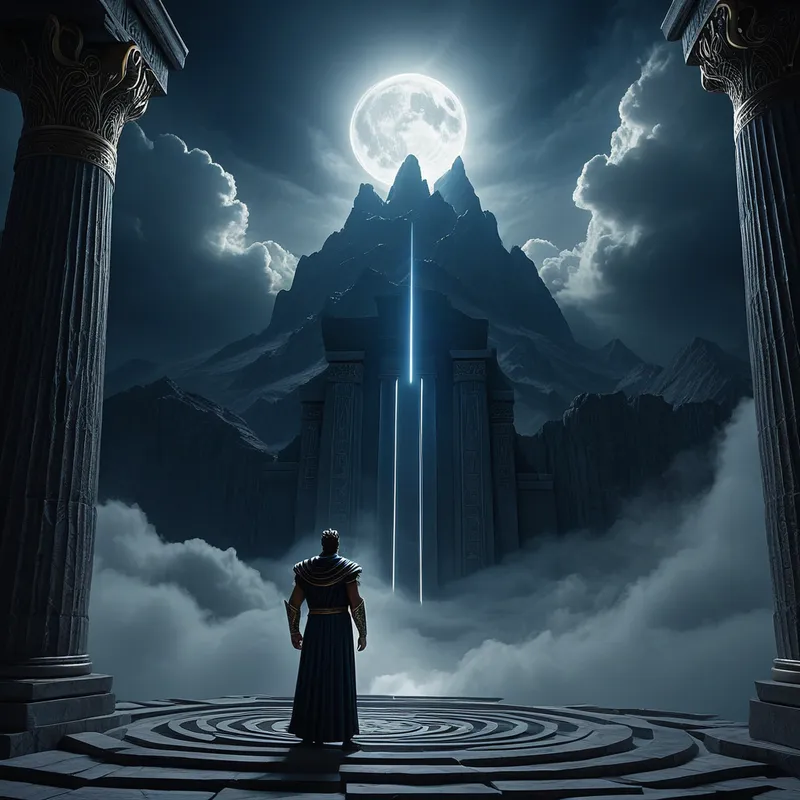
Hear now the story of Ixion, a tale whispered on winds that smell of smoke and regret. He was a king of the Lapiths, a man whose ambition was a fire that could not be quenched. His first crime was one of blood, staining the earth of his own hall: he murdered his father-in-law, Deioneus, by casting him into a pit of burning coals. This was no honorable duel, but a treacherous act of greed, a refusal to pay the bridal price owed. The stain of kin-killer clung to him, a miasma so foul that no man, no city, would cleanse him. He became a ghost among the living, shunned and wandering, the weight of his guilt a heavier crown than any he had worn.
But from the highest peak, a mercy was offered. Zeus</ab title="King of the Greek gods, god of sky and thunder">us himself, in a moment of divine compassion, took pity on the wretched king. He invited Ixion to the gleaming halls of Olympus, to sit at the table of the gods. Here was the ultimate grace: Xenia, the holy law of hospitality, extended from heaven itself. The air was thick with the scent of ambrosia; light danced on golden cups. Ixion was washed clean by this divine favor, his mortal crime absolved in the presence of the immortals.
Yet, in the heart of the king, the fire did not die; it changed its fuel. Gazing upon Hera, whose beauty was as formidable as her majesty, a new, monstrous desire was kindled. To possess the wife of the god who had saved him—this became his mad ambition. He whispered his lust to the empty air, and Zeus, whose ear hears all, heard it. To test the depth of this betrayal, the Cloud-Gatherer fashioned a phantom from a cloud, Nephele, and shaped her in the perfect likeness of the Queen.
In the shadowed gardens of Olympus, Ixion beheld the apparition and, blind with passion, believed his prize was won. He lay with the cloud, fathering a race of half-breeds, the Centaurs. At that moment of ultimate transgression, the sky cracked. Lightning revealed not a lover, but a mocking mist in his arms. The hospitality of heaven was shattered.
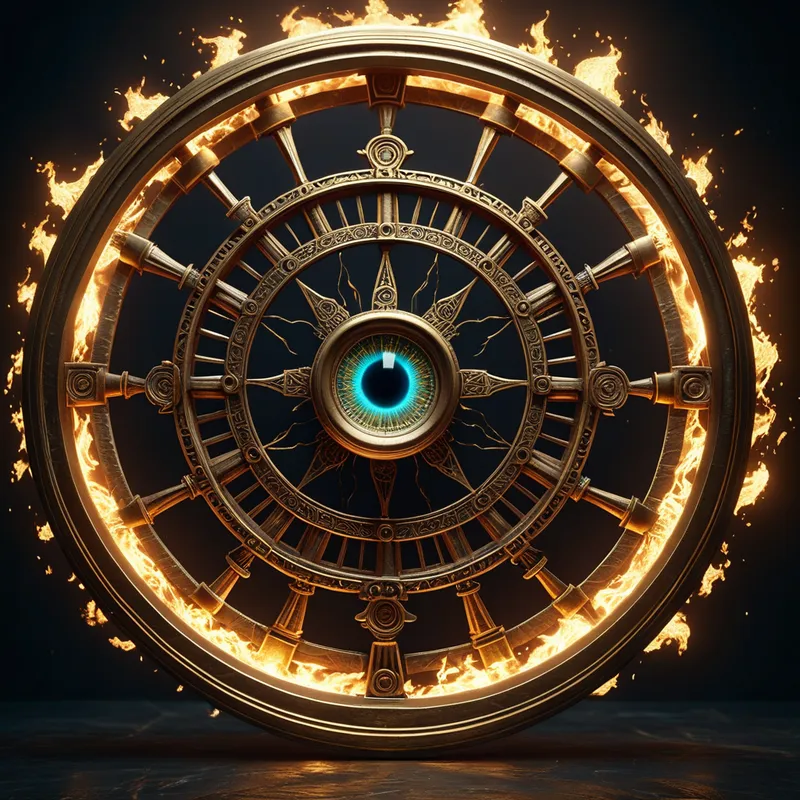
Then came the thunder of justice. Zeus did not strike him down in simple wrath. His punishment was to be an eternal testament. Hermes, the messenger, bound Ixion with unbreakable serpents to a winged, fiery wheel. A great heave, and the wheel was set spinning through the Tartarean depths, through the starless void, forever. Ixion’s cries became the wind that drives the wheel; his torment, a warning etched across the cosmos: betray the sacred trust, and you will spin, forever restless, in the prison of your own making.
Cultural Origins & Context
The myth of Ixion is a foundational cautionary tale, primarily preserved in the fragments of early Greek epic poetry and later elaborated by poets like Pindar and tragedians. It belongs to that deep stratum of myth concerned with the establishment of cosmic and social order. The storytellers—bards at feasts, playwrights in the theater of Dionysus—used his story to reinforce the bedrock principle of xenia. In a world where travel was perilous and strangers were potentially divine, the laws of hospitality were not mere etiquette; they were a sacred covenant with Zeus Xenios, the protector of guests. Ixion’s crime was thus a direct assault on the divine framework of civilization itself.
His punishment also served an etiological purpose, explaining the origin of the Centaurs, beings who embodied chaotic, untamed nature and would later famously battle the civilized Lapiths at a wedding feast—a conflict mirroring Ixion’s own disruption of social bonds. The myth functioned as a powerful social glue, teaching that the king who breaks the highest law is not merely deposed but cosmically undone, his fate a spectacle for gods and mortals alike to ensure the social contract remained inviolate.
Symbolic Architecture
Ixion is not merely a sinner; he is an archetype of the consciousness that consumes every gift and sees only another ladder for its ambition. His wheel is the perfect symbol of his psyche: a closed loop of desire, betrayal, and consequence, with no entry or exit. He is bound to the very instrument of his own cyclical torment.
The wheel is the mind that cannot escape its own pattern, the soul sentenced to endlessly rehearse its primary failure.
The key symbols are profound. The Murder of Kin represents the primal severing of human bonds for selfish gain. Divine Hospitality is the ultimate chance for redemption, a grace that lifts one into a new order of being. Ixion’s Lust for Hera symbolizes the ultimate hubris: the desire not just to break a rule, but to usurp the very source of divine order and creative power (Hera as the goddess of lawful union). His coupling with Nephele, the cloud, is the consummation with an illusion—the tragic result of a man who can no longer discern reality from the projections of his own inflated ego. The Fiery Wheel is then the inevitable result: the inflationary psyche, having burned all its bridges, becomes its own hell, a self-contained system of perpetual, futile motion.
The Dreamer's Resonance
When the pattern of Ixion spins into modern dreams, it rarely appears as a literal wheel of fire. It manifests as the somatic sensation of being trapped in a relentless, exhausting cycle. The dreamer may find themselves running late for a crucial meeting that never arrives, or stuck on a treadmill that accelerates beyond control. They may dream of betraying a profound trust or being caught in a humiliating act of overreach.
Psychologically, this is the process of the inflated ego confronting its own limits. The "Ixion complex" is active when an individual, perhaps riding a wave of success (Zeus's invitation), begins to believe the rules no longer apply to them. They make a move based on grandiose desire (the lust for Hera), only to find they have embraced an illusion (Nephele) that leads to catastrophic personal or professional ruin (the binding). The dream is the psyche's dramatic enactment of this self-created trap, a warning that one is bound to a karmic cycle of their own making, feeling the "burn" of shame, anxiety, and relentless mental churning.

Alchemical Translation
The alchemical journey for one who identifies with Ixion is not about escaping the wheel, but about understanding its construction and, ultimately, stopping its spin. The first, brutal stage is Recognition—the lightning flash of Zeus that reveals the cloud for what it is. One must see the illusion they pursued: the empty status, the destructive relationship, the belief in their own exception.
The binding serpents are not just restraints; they are symbols of the fate one has woven. To transmute this, one must consciously Embrace the Binding. This means fully accepting responsibility for the betrayal, the hubris, and the consequences, without mythologizing oneself as a victim. This is the mortificatio, the dark night of the soul, where the fiery wheel burns away the last vestiges of the inflated self.
The wheel only stops when the one bound to it ceases to struggle against the truth of their actions and begins, instead, to study the nature of the wheel itself.
Finally, there is the possibility of Integration. The wheel's endless motion represents a terrible energy. The alchemical goal is to harness that spin, to redirect that fierce, trapped libido away from cyclical self-destruction and toward a creative centering. The Centaurs, born of Ixion's illusion, were wild but also tutors of heroes like Achilles. Even from profound error, a raw, instinctual force can be born and later educated. The modern individual's triumph is to step off the wheel they built, using the heat of their shame not for perpetual motion, but for the forging of a new, humble, and grounded integrity. The punishment becomes the crucible.
Associated Symbols
Explore related symbols from the CaleaDream lexicon: