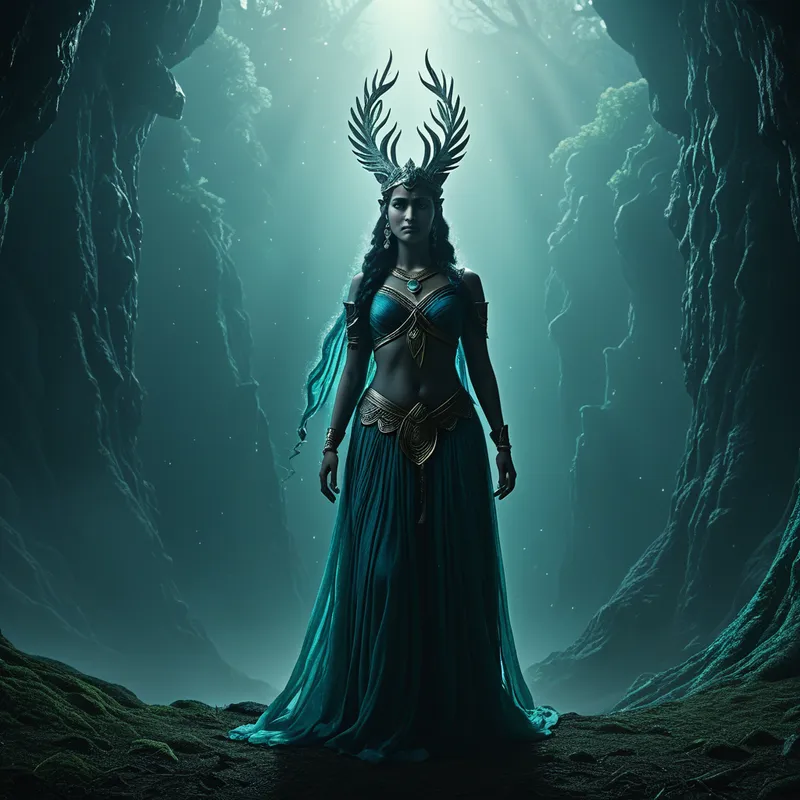
Itzpapalotl Obsidian Butterfly
A fearsome Aztec goddess of paradise and sacrifice, depicted as a skeletal butterfly with obsidian wings, embodying both creation and destruction.
The Tale of Itzpapalotl Obsidian Butterfly
In the time before [the Fifth Sun](/myths/the-fifth-sun “Myth from Aztec culture.”/), when [the world](/myths/the-world “Myth from Tarot culture.”/) was cloaked in [the star](/myths/the-star “Myth from Tarot culture.”/)-strewn mantle of night, there existed a paradise not of soft light, but of sharp, cold splendor. This was Tamoanchan, the place of descent, a celestial garden where the gods themselves were born from broken bones and divine blood. And over this paradoxical paradise reigned [Itzpapalotl](/myths/itzpapalotl “Myth from Aztec culture.”/), the Obsidian Butterfly.
Her story is not one of gentle metamorphosis, but of a shattering origin. She was one of the Tzitzimime, the star demons who wait in the darkness beyond [the sky](/myths/the-sky “Myth from Persian culture.”/), poised to descend and devour the world at the end of an age. Yet within her burned a dual flame. She was the mother of Mixcoatl, the cloud serpent and god of the hunt, linking her to the generative forces of [the wilderness](/myths/the-wilderness “Myth from Biblical culture.”/). She was a warrior queen, a ruler clad not in silks but in the jagged, volcanic glass of her own being.
Imagine her not as a insect, but as a sovereign of thresholds. Her wings were vast sheets of obsidian, not delicate membranes, but blades that caught the starlight and fractured it into a thousand cutting rays. Her body was often depicted as skeletal, a framework of bone upon which the dark miracle of her existence was hung. At her joints, sharp obsidian knives protruded; her hands were tipped with jaguar claws. This was a butterfly that did not sip nectar, but the vital essence of sacrifice, the very substance required to keep the cosmos from collapsing back into the primordial void.
Her tale is etched in conflict and guardianship. She led the Centzon Mimixcoa in a great battle, a celestial war that shaped the destinies of gods. She was both a bringer of drought and disease—the sting of the scorpion was hers to command—and the bestower of the maguey plant, the source of pulque, the sacred intoxicant that opened the door to vision and communion. To gaze upon Itzpapalotl was to gaze upon the fundamental contract of existence: from her blade-like wings came both the terror of extinction and the hard, clear promise of a defined form; from her skeletal core flowed both the curse of famine and the blessing of sacred inebriation.
Cultural Origins & Context
Itzpapalotl emerges from the deep, complex strata of Mesoamerican thought, where duality was not a philosophical concept but the bedrock of reality. She belongs primarily to the Nahua cultures, including the Aztecs (Mexica). Her identity is woven from several powerful threads.
Primarily, she is a Tzitzimitl. These beings inhabited the night sky and were particularly associated with the period of cosmic uncertainty during a solar eclipse, when the sun was devoured. They represented the ever-present threat of [chaos](/myths/chaos “Myth from Greek culture.”/) that surrounded the fragile order of the world. As a ruler of Tamoanchan, the mythic origin place, she connects to the very beginnings of life and divine order—a order born from sacrifice and struggle.
Her association with the maguay plant and pulque links her to [the earth](/myths/the-earth “Myth from Hindu culture.”/), to agriculture, and to shamanic practice. Pulque was a ritual beverage, a means of transcending ordinary consciousness to touch the divine. Thus, Itzpapalotl governs a potent threshold: the line between sobriety and vision, between mundane life and ecstatic, often terrifying, spiritual encounter.
She exists in [the pantheon](/myths/the-pantheon “Myth from Greek culture.”/) not as a minor specter, but as a foundational matriarchal and martial power. She is a goddess of the chinampas (floating gardens) and of the untamed stars, of the nurturing earth and the devouring sky. This reflects the Aztec understanding of divinity as inherently composite and paradoxical; a god of maize was also a god of famine, a god of rain also of lightning-strike fire. Itzpapalotl is this principle embodied in a singular, awe-inspiring form.
Symbolic Architecture
Itzpapalotl’s form is a perfect symbolic equation. The [butterfly](/symbols/butterfly “Symbol: Symbolizes transformation, beauty, and the ephemeral nature of life.”/), across cultures, is an almost universal [emblem](/symbols/emblem “Symbol: A symbolic design representing identity, authority, or ideals, often used in heraldry, logos, or artistic expression.”/) of the [soul](/symbols/soul “Symbol: The soul represents the essence of a person, encompassing their spirit, identity, and connection to the universe.”/) and of transformation. But here, the soul is not soft or ephemeral; it is forged in volcanic fire and hardened into [obsidian](/symbols/obsidian “Symbol: A volcanic glass symbolizing protection, transformation, and hidden truths. It represents sharp clarity and dark, reflective depths.”/). Her [metamorphosis](/symbols/metamorphosis “Symbol: A profound, often irreversible transformation of form, identity, or state, representing a complete journey from one condition to another.”/) is fixed, permanent—a transformation into a state of razor-edged, crystalline [clarity](/symbols/clarity “Symbol: A state of mental transparency and sharp focus, often representing resolution of confusion or attainment of insight.”/). She is the [soul](/symbols/soul “Symbol: The soul represents the essence of a person, encompassing their spirit, identity, and connection to the universe.”/) that has passed through the fire of [death](/symbols/death “Symbol: Symbolizes transformation, endings, and new beginnings; often associated with fear of the unknown.”/) and emerged not as a ghost, but as a sovereign of the [afterlife](/symbols/afterlife “Symbol: A symbolic journey beyond death, representing transition, the unknown, and ultimate questions about existence, purpose, and what follows life.”/) [realm](/symbols/realm “Symbol: The symbol of ‘Realm’ often signifies the boundaries of one’s consciousness, experiences, or emotional states, suggesting aspects of reality that are either explored or ignored.”/).
The [skeleton](/symbols/skeleton “Symbol: A skeleton symbolizes the foundational aspects of life and mortality, representing both the physical body and the spiritual essence of being.”/) reveals the [truth](/symbols/truth “Symbol: Truth represents authenticity, honesty, and the quest for knowledge beyond mere appearances.”/) beneath the flesh. It is the [architecture](/symbols/architecture “Symbol: Architecture in dreams often signifies structure, stability, and the framing of personal identity or life’s journey.”/) of [life](/symbols/life “Symbol: The symbol of ‘Life’ represents a journey of growth, interconnectedness, and existential meaning, encompassing both the joys and challenges that define human experience.”/), stripped of the transient. Itzpapalotl, in her skeletal form, is not merely [death](/myths/death “Myth from Tarot culture.”/), but the enduring [structure](/symbols/structure “Symbol: Structure in dreams often symbolizes stability, organization, and the framework of one’s life, reflecting how one perceives their environment and personal life.”/) of existence itself. She represents the bare, undeniable [framework](/symbols/framework “Symbol: Represents the underlying structure of one’s identity, emotions, or life. It signifies the mental or emotional scaffolding that supports or confines the self.”/) upon which the fleeting [beauty](/symbols/beauty “Symbol: This symbol embodies aesthetics, harmony, and the appreciation of life’s finer qualities.”/) and [terror](/symbols/terror “Symbol: An overwhelming, primal fear that paralyzes and signals extreme threat, often linked to survival instincts or deep psychological trauma.”/) of [life](/symbols/life “Symbol: The symbol of ‘Life’ represents a journey of growth, interconnectedness, and existential meaning, encompassing both the joys and challenges that define human experience.”/) are draped. The obsidian knives at her joints signify that this structure is active, weaponized; it is a framework that cuts, sacrifices, and defines through severance.
She is the paradox of the sacred wound: that which simultaneously lacerates and delineates the self. The obsidian blade does not merely kill; it performs the ritual surgery that separates the profane from the sacred, the mortal from the eternal.
Her dominion over Tamoanchan, a [paradise](/symbols/paradise “Symbol: A perfect, blissful place or state of being, often representing ultimate fulfillment, harmony, and transcendence beyond ordinary reality.”/), completes this architecture. She rules not a paradise of endless comfort, but one of primordial [origin](/symbols/origin “Symbol: The starting point of a journey, often representing one’s roots, source, or initial state before transformation.”/). It is a paradise that remembers its [birth](/symbols/birth “Symbol: Birth symbolizes new beginnings, transformation, and the potential for growth and development.”/) in struggle, a garden fertilized by divine sacrifice. She is the [guardian](/symbols/guardian “Symbol: A protector figure representing safety, authority, and guidance, often embodying parental, societal, or spiritual oversight.”/) of the [source](/symbols/source “Symbol: The origin point of something, often representing beginnings, nourishment, or the fundamental cause behind phenomena.”/), reminding all that even [paradise](/symbols/paradise “Symbol: A perfect, blissful place or state of being, often representing ultimate fulfillment, harmony, and transcendence beyond ordinary reality.”/) has a price, and its beauty is inseparable from the severity of its foundations.
The Dreamer’s Resonance
To encounter Itzpapalotl in the inner landscape is to confront the archetype of [the Terrible Mother](/myths/the-terrible-mother “Myth from Universal culture.”/) in her most crystalline form. She is not the nurturing womb, but [the womb](/myths/the-womb “Myth from Various culture.”/) as a crucible, the mother who demands a sacrifice for the gift of life itself. Psychologically, she represents the necessary, often painful, structures of the [psyche](/myths/psyche “Myth from Greek culture.”/)—the superego, the hard boundaries, the unconscious truths that cut away illusion.
She appears when the dreamer is called to a transformation that is not gentle growth, but a fundamental restructuring. This is the psyche’s volcanic event: a trauma, a devastating loss, a revelation that shatters previous identities. Itzpapalotl is the spirit of that shattering. She offers not comfort, but the cold, sharp truth of what remains when everything else is burned away: the core, the skeleton of [the Self](/myths/the-self “Myth from Jungian culture.”/).
Her resonance is for those navigating the “[dark night of the soul](/myths/dark-night-of-the-soul “Myth from Christian culture.”/),” where one feels devoured by stellar demons of doubt and despair. Yet, in her mythology, she is also the bestower of pulque—the intoxicant of vision. This suggests that the confrontation with this severe, cutting aspect of the unconscious, while terrifying, can grant a form of sacred inebriation: a clarity so profound it is dizzying, a vision of reality stripped of its comforting veils. She rules the paradise one finds only after accepting the obsidian truth of one’s own nature.
Alchemical Translation
In the alchemy of the soul, Itzpapalotl is the [nigredo](/myths/nigredo “Myth from Alchemical culture.”/) made sovereign. The nigredo, the blackening, is the initial stage of dissolution, putrefaction, and confrontation with [the shadow](/myths/the-shadow “Myth from Jungian culture.”/). It is the dark, chaotic, and often despairing phase where the old form is broken down. Itzpapalotl does not merely represent this stage; she is its queen. She is the conscious, ruling principle within the blackness, the one who understands that this dissolution is not an accident but a necessary, sacred process.
Her obsidian is the [prima materia](/myths/prima-materia “Myth from Alchemical culture.”/) after it has been subjected to the volcanic fires of the deep self—hard, dark, and capable of holding an edge sharper than any steel. The alchemical work she presides over is not about turning lead to gold in a sentimental sense, but about forging the soul into a vessel of cutting clarity. The sacrifice she demands is the sacrifice of the impure, the inflated, the false.
The alchemist seeks the Philosopher’s Stone, the ultimate transformative agent. Itzpapalotl suggests that this stone may not be golden, but obsidian—a tool for incision, for sacrifice, for the precise and ruthless work of separating the essential from the dross.
Her final gift is the coagula that follows the solve. After the dissolution comes the re-formation. The skeletal structure she reveals becomes the armature for a new, more authentic being. The pulque she offers is the [aqua vitae](/myths/aqua-vitae “Myth from Alchemical culture.”/), the [water](/myths/water “Myth from Chinese culture.”/) of life distilled from the fermented heart of experience, granting the vision to see the world—and oneself—reborn from the shattered pieces.
Associated Symbols
Explore related symbols from the CaleaDream lexicon:
- Obsidian — The volcanic glass of truth, mirror-like yet opaque, capable of the sharpest cut; it represents clarity born of violent transformation.
- Butterfly — The soul in its journey of metamorphosis, here hardened into a permanent, weaponized state of transcendent being.
- Sacrifice — The essential act of offering life to sustain life, the cosmic currency that maintains the balance between creation and destruction.
- Skeleton — The enduring architecture beneath the flesh, the truth of form that remains when all else is stripped away.
- Star — Her origin as a Tzitzimitl connects her to the cold, distant, and judging light of the stellar realm, and the chaos that lurks at the edges of the cosmos.
- Obsidian Knife — The ritual instrument of sacrifice, embodying the precise, severing action that separates the sacred from the profane.
- Duality Mask — The visage that contains two opposing natures in one countenance: paradise and destruction, motherhood and warfare, blessing and curse.
- Temple — Not as a place of simple worship, but as Tamoanchan, the paradisiacal yet severe place of origin over which she rules, a sanctuary built on foundational sacrifice.
- Bone — The literal and symbolic residue of life, the hard, white truth that persists, serving as both a [memento mori](/myths/memento-mori “Myth from Christian culture.”/) and a framework for new growth.
- Dream — The state accessed through her gift of pulque, where the sharp truths of the unconscious cut through the illusions of the waking world.
- Permadeath — The state she embodies; not a temporary death, but a transformation into a fixed, eternal form—the butterfly that will never again be a caterpillar.