Israfil the Angel of Trumpet
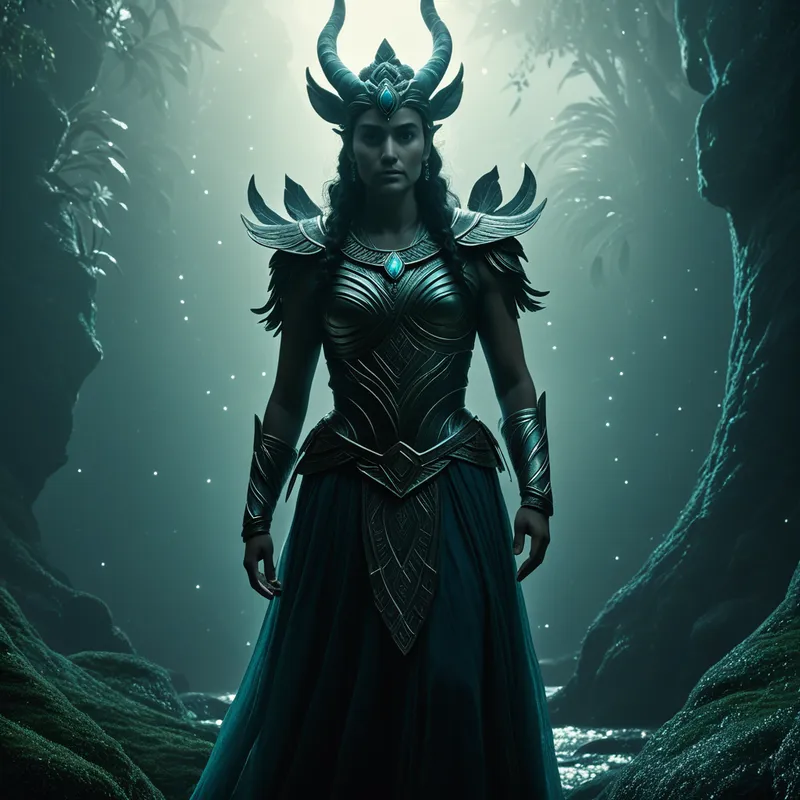
The archangel Israfil holds the trumpet that will announce the Day of Resurrection, standing at the threshold between existence and divine judgment.
The Tale of Israfil the Angel of Trumpet
In the veiled realms beyond the seven heavens, where time does not flow but gathers, stands an angel of unimaginable magnitude. His feet are planted in the foundations of the worlds, and his head pierces the canopy of the Divine Throne. This is [Israfil](/myths/israfil “Myth from Islamic culture.”/), the Bearer of the Trumpet. His being is woven from light and attentive silence, and his gaze is fixed upon the Amr of Allah, awaiting a command that will unravel the tapestry of creation.
He holds, cradled against his lips, the Sur—the Horn, the Trumpet. It is not an instrument of brass or silver, but a [thing](/myths/thing “Myth from Norse culture.”/) of primordial substance, a conduit for [the Word](/myths/the-word “Myth from Biblical culture.”/) that first spoke “Kun!” (“Be!”). His sole, eternal duty is this vigil. He does not sleep, he does not turn, for the moment of his action is the moment of all moments ending and beginning anew. It is said that between his lips and the mouthpiece of the Trumpet rests a distance no wider than a hair’s breadth, a suspense that holds the entire universe in a breath not yet drawn.
Then, the Command comes. Not as a sound, but as a knowing that floods his luminous form. Israfil draws in a breath—a breath that pulls into itself the sighs of every dying star, the final prayers of every soul, the last echoes of every story ever told. He blows the First Blast.
The sound is not a melody but an unraveling. It is the dissolution of order, the Nafkh al-Fazaʿ (the Blast of Stupefaction). Mountains are plucked like tufts of wool and scattered like dust. Stars are extinguished. The heavens are rolled up like a scroll. Every living thing perishes. All that was, ceases. For a span known only to God—traditionally held to be forty years—there is nothing but the silent, swirling dust of annihilated matter and the presence of Allah, the Ever-Living, [the Self](/myths/the-self “Myth from Jungian culture.”/)-Subsisting.
In that absolute silence, Israfil remains. He is the sole witness to the aftermath, a sentinel in [the void](/myths/the-void “Myth from Buddhist culture.”/). Then, the Second Command. He raises the Trumpet once more. This breath is one of gathering, of Nafkh al-Baʿth (the Blast of Resurrection). From the Trumpet issues the command of “Hayya ʿala al-falah!” (“Come to success!”). The scattered atoms hear and obey. Bones knit together from [the earth](/myths/the-earth “Myth from Hindu culture.”/), souls are returned to their bodies, and all of humanity, from the first to the last, rises from their graves, blinking into the terrible, clarifying light of the Yawm al-Qiyamah. Israfil’s task is complete. The [herald](/myths/herald “Myth from Greek culture.”/) of the End becomes the silent witness to the Beginning of the Final Accounting.
Cultural Origins & Context
Israfil (Arabic: إِسْرَافِيل) is identified within Islamic tradition as one of the four archangels, alongside Jibril ([Gabriel](/myths/gabriel “Myth from Biblical culture.”/)), Mikail (Michael), and Malik. His narrative is almost exclusively eschatological, embedded in the Quranic descriptions of the Hour and elaborated in the Hadith (sayings of the Prophet Muhammad) and classical exegesis (tafsir). While not mentioned by name in the Quran, his role is explicitly described in verses such as Surah Az-Zumar (39:68): “And the Horn will be blown, and whoever is in the heavens and whoever is on the earth will fall dead, except whom Allah wills. Then it will be blown again, and at once they will be standing, looking on.”
His characterization is the work of the prophetic tradition and the Islamic imaginal realm (alam al-mithal). Scholars like Al-Ghazali and Ibn Kathir detailed his immense size and perpetual readiness. He is the angel of the boundary, the liminal entity who operates at the absolute thresholds of cosmic life and [death](/myths/death “Myth from Tarot culture.”/). His existence is a constant reminder of the ākhirah (the Hereafter), making him a central pillar in the Islamic worldview where earthly life is a preparation for the accountability of the Day of Judgment. His silence before the blast is as theologically significant as the blast itself—it represents the suspended will of God, the period of testing, and the ultimate fragility of all created order before its Creator.
Symbolic Architecture
Israfil’s myth constructs a profound symbolic [architecture](/symbols/architecture “Symbol: Architecture in dreams often signifies structure, stability, and the framing of personal identity or life’s journey.”/) around [anticipation](/symbols/anticipation “Symbol: A state of excited expectation about future events, often involving hope, anxiety, or readiness for what is to come.”/), transition, and the cosmic [application](/symbols/application “Symbol: An application symbolizes engagement, integration of knowledge, or the pursuit of goals, often representing self-improvement and personal development.”/) of Divine [Word](/symbols/word “Symbol: Words in dreams often represent communication, expression, and the power of language in shaping our realities.”/).
Israfil embodies the ultimate Threshold. He is not the judge, nor the realm of judgment, but the sound that announces the crossing from one state of being to another. He is the personification of the moment between sleep and waking, applied to all of creation.
His [Trumpet](/symbols/trumpet “Symbol: The trumpet signifies power and confidence in expression, often associated with leadership and celebration.”/) (Sur) is the [instrument](/symbols/instrument “Symbol: An instrument symbolizes creativity, communication, and the means by which one expresses oneself or influences the world.”/) of transformation. The First Blast is the sound of Deconstruction—the breaking down of all forms, hierarchies, and illusions of permanence. The Second Blast is the sound of Reconstitution—not as repetition, but as a gathering for ultimate [truth](/symbols/truth “Symbol: Truth represents authenticity, honesty, and the quest for knowledge beyond mere appearances.”/). The [breath](/symbols/breath “Symbol: Breath symbolizes life, vitality, and the connection between the physical and spiritual realms.”/) that powers both is the breath of God’s command, making Israfil a living [metaphor](/symbols/metaphor “Symbol: A figure of speech where one thing represents another, often revealing hidden connections and deeper truths through symbolic comparison.”/) for the Kun fa-yakun (“Be, and it is”) principle.
The silence between the blasts is the most psychologically potent space in the myth. It is the void, the barzakh (isthmus) on a cosmic scale. This is not emptiness, but a field of pure potential, where the past is annulled and the future—the judgment—is not yet. It is the ultimate dissolution of ego, where only essence remains before God.
The Dreamer’s Resonance
To the individual [psyche](/myths/psyche “Myth from Greek culture.”/), Israfil represents the internal faculty that announces profound, irreversible change. He is the inner trumpet blast that signals the end of an era of the self—the collapse of a long-held identity, a cherished belief, or a foundational life structure. This psychological “first blast” is often experienced as crisis, breakdown, or profound disorientation, where everything one thought was solid melts into air.
The ensuing “silence” is the depressive, liminal, and terrifying space of not-knowing. It is the clinical depression after loss, the creative barrenness before inspiration, [the dark night of the soul](/myths/the-dark-night-of-the-soul “Myth from Christian Mysticism culture.”/). In this silence, the old self has died, but the new has not yet been called forth. Israfil’s vigil teaches that this silence is not abandonment, but a necessary, sacred phase of gestation.
The “second blast” is the call to reassembly—not to the old form, but to a new integrity oriented toward meaning and accountability. It is the moment of awakening to a deeper truth about oneself, the summons to stand and face what one has been and done. Thus, Israfil’s myth maps the journey of profound psychological death and rebirth, where [the ego](/myths/the-ego “Myth from Jungian culture.”/) is dismantled so the soul may be called to account before the inner tribunal of the Self.
Alchemical Translation
In the alchemy of the soul, Israfil’s narrative is the formula for the [magnum opus](/myths/magnum-opus “Myth from Alchemical culture.”/). The stages of [nigredo](/myths/nigredo “Myth from Alchemical culture.”/), [albedo](/myths/albedo “Myth from Alchemical culture.”/), and [rubedo](/myths/rubedo “Myth from Alchemical culture.”/) find their cosmic analogue in his actions.
The First Blast is the Nigredo—the blackening, the putrefactio. It is the total dissolution of the massa confusa of the worldly personality. All attachments, projections, and false complexities are reduced to their base, lifeless matter.
The forty-year silence is the Albedo—the whitening. In the void, in the silent watchfulness, the purified substance is washed. It is a state of lunar contemplation, of passive reception and purification under the gaze of the divine. Israfil, as the silent witness, is the spirit of [mercury](/myths/mercury “Myth from Roman culture.”/) facilitating this cleansing.
The Second Blast is the Rubedo—the reddening, the resurrection of a body of light. The soul, now purified and stripped of dross, is reconstituted at a higher order. It is called forth not to mundane life, but to the unio mentalis, the mental union with its own truth, preceding the final integration. The Trumpet’s call is the vox Dei, the divine voice that initiates the final coagulation of the true, incorruptible Self.
Associated Symbols
Explore related symbols from the CaleaDream lexicon:
- Trumpet — The divine instrument of annunciation and transformation, whose sound dismantles one world and calls forth another from the void.
- Cosmic Gateway — Israfil himself, standing at the juncture between cosmic cycles, his breath opening the passage from temporal existence to eternal reckoning.
- Threshold — The metaphysical space he guards, the instant of crossing where all previous states are terminated and a new, irreversible condition begins.
- Silence — The profound, pregnant void between the blasts, representing the dissolution of all noise and the pure potential of the divine will.
- Breath — The animating force from the Divine that passes through Israfil, linking the command of God with the transformation of all creation.
- Judgmental Voice — The metaphysical quality of the Trumpet’s blast, which is not mere sound but a penetrating call to absolute accountability.
- Death — The first function of the Trumpet, representing the necessary and total end that precedes any genuine rebirth or resurrection.
- Rebirth — The second function of the Trumpet, the call to reassembly not into the old form, but into a state of revealed truth.
- Cosmic Balance — The ultimate purpose of the sequence Israfil initiates, leading all of creation to a moment of perfect and final judgment.
- Angel — Israfil as the archetypal divine messenger, whose entire being is dedicated to a single, world-altering function.
- Order — The cosmic principle that is dissolved by the first blast and re-established on a wholly different, divine plane after the second.
- Bridge — Israfil’s role as the entity and the event that connects the era of trial (dunya) with the era of truth (akhirah).