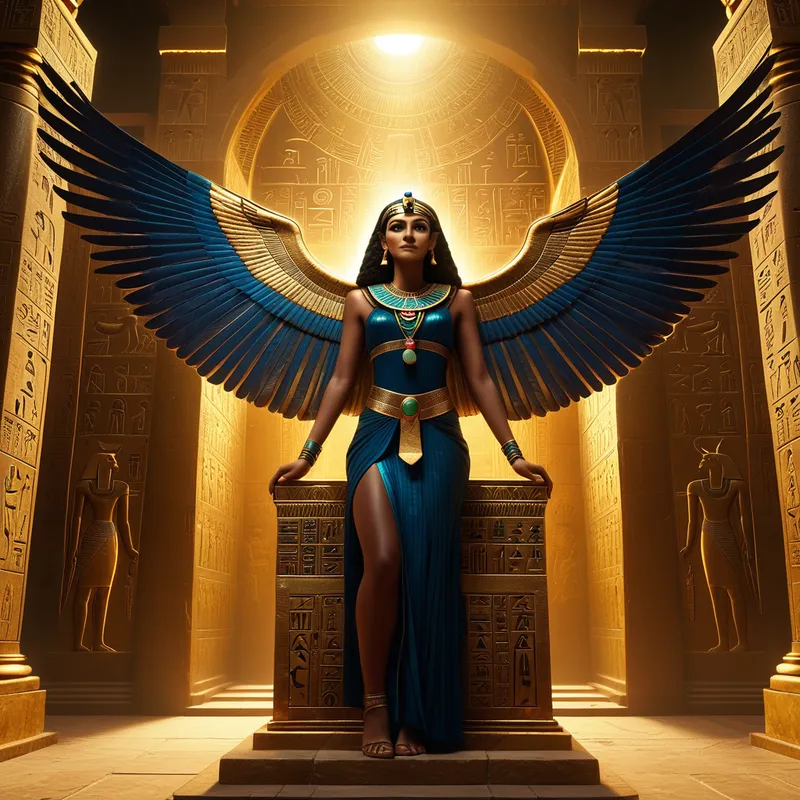
Isis Unveiled Myth Meaning & Symbolism
A goddess, through relentless love and cunning, reassembles her slain husband, unveiling the ultimate mysteries of life, death, and divine power.
The Tale of Isis Unveiled
Hear now a tale woven from the silt of the Nile and the light of distant stars. It begins not with a birth, but with a death—a death that shattered the world.
In the green, life-giving lands of Kemet, the wise king Osiris brought order and civilization. His sister-wife, Isis, was his perfect complement, her love as deep as the river, her magic as subtle as the dawn mist. But in the red, barren lands of chaos, their brother Set watched with a heart of scorching sand, consumed by envy.
With cruel cunning, Set fashioned a magnificent chest, fit for a god. At a great feast, he promised it to whoever fit within. When Osiris lay down in it, Set and his seventy-two conspirators slammed the lid shut, sealed it with molten lead, and cast it into the Nile’s treacherous currents. Isis’s world dissolved into a wail that echoed from the delta to the first cataract. Her love became her compass. She cast off her divine regalia, wrapped herself in the mourning robes of a mortal woman, and began her search, a solitary figure against the immensity of sorrow.
She wandered from village to marshland, following whispers carried by the wind. She learned the chest had been carried to the far-off land of Byblos, where it had grown into the heart of a mighty tamarisk tree, cut down to become a pillar in the king’s palace. Isis, in the guise of a nurse, entered the palace and tended to the queen’s child. By night, she placed the infant in the palace’s sacred fire to burn away its mortality, seeking to make it immortal. Discovered by the terrified queen, Isis revealed her true, radiant form. She demanded the pillar. From its fragrant wood, she pried open the chest and beheld her husband, cold and still.
Her journey was not over. Returning to the hidden marshes of the Delta to perform the rites of revival, she left Osiris’s body guarded. But Set, hunting by the light of a full moon, found it. In a frenzy of hatred, he tore the body into fourteen—some say forty-two—pieces, scattering them to the farthest corners of the land. Isis did not despair. With her sister Nephthys, she took the form of a kite and a falcon, their piercing cries mapping the desolation. Riverbank by sand dune, they searched. They recovered every part save one, which the Nile’s fish had consumed. With potent spells and tears that were incantations, Isis reassembled the body, fashioning the first phallus from gold and clay. From this union, posthumous and miraculous, the hawk-headed god Horus was conceived in the reeds.
But the final act of the drama awaited. To secure the throne for her son Horus and complete the resurrection of Osiris as Lord of the Dead, Isis needed to know the Secret Name of Ra, the source of all his power. She observed that Ra, now aged, drooled as he walked the earth. Isis gathered this spittle mixed with dust and fashioned a venomous serpent, which struck the sun god. No spell of Ra’s vast court could cure the divine poison that burned through his veins. The cosmos trembled.
Then Isis came forward. “I can heal you, Father of the Gods,” she said, her voice soft yet unyielding as granite. “But the poison is woven with your essence. To draw it out, I must speak the name that is the core of your being.” Ra, in agony, listed his many titles—Creator of Heaven, Maker of Men—but the pain only grew. Finally, as the darkness threatened to swallow the sun itself, he yielded. He whispered his true, hidden Ren into Isis’s ear. The moment the secret passed from him to her, the poison was drawn out. Ra was healed, but his ultimate power was transferred. Isis, having unveiled the sun god’s deepest mystery, stood not just as a goddess of magic, but as the keeper of the foundational word of creation itself.

Cultural Origins & Context
The myth of Isis is not a single, fixed story from one time or text. It is a living tapestry woven over millennia, from the Old Kingdom Pyramid Texts (c. 2400-2300 BCE) through the Coffin Texts and the New Kingdom’s Book of the Dead, to the lyrical narratives recorded by the Greek writer Plutarch in his De Iside et Osiride (c. 100 CE). It was performed in temple rituals, recited in funeral ceremonies to guarantee resurrection, and was central to the annual festivals of Khoiak.
This was a myth for the people. While pharaohs identified with Horus and Osiris, it was Isis—the devoted wife, the grieving widow, the protective mother—who resonated most deeply in the popular imagination. Her cult eventually spread across the Greco-Roman world, becoming one of the most widespread mystery religions, promising initiates personal salvation and intimate knowledge of the divine. The story was a societal anchor, explaining the cycle of the Nile’s flood (Osiris’s death and revival), legitimizing kingship (through Horus), and, most importantly, offering every individual a template for triumph over death through piety, magic, and unwavering love.
Symbolic Architecture
At its heart, this is a myth about the intelligence of love confronting the fact of fragmentation. Osiris represents the established order, the conscious ego, or the intact Self that is inevitably assailed by the chaotic, envious shadow forces embodied by Set. His dismemberment is the ultimate psychological trauma—the shattering of identity, meaning, and psychic wholeness.
Isis is the active, seeking principle of consciousness—not the static light of reason, but the tenacious, grieving, cunning light of the soul that refuses to accept annihilation.
Her search is the work of re-membering. Each recovered piece of Osiris is a reclaimed part of the self lost to trauma, shame, or neglect. The missing phallus, consumed by the Nile fish (creatures of the unconscious), signifies an irreparable loss that must be creatively reconstituted. The new, fashioned member symbolizes the generative power that arises not from original wholeness, but from conscious repair. The conception of Horus in the marshes—a place between water and land, life and decay—signifies the birth of a new, resilient consciousness from the ground of profound loss.
The unveiling of Ra’s name is the myth’s transcendent climax. It moves the narrative from personal restoration to cosmic authority. Ra’s secret name is the Self in its most primordial form, the source-code of being. Isis acquires it not through conquest, but through a cunning, compassionate negotiation with the aging masculine principle. She heals the father-god by taking his core power into herself, achieving a supreme integration.
The Dreamer's Resonance
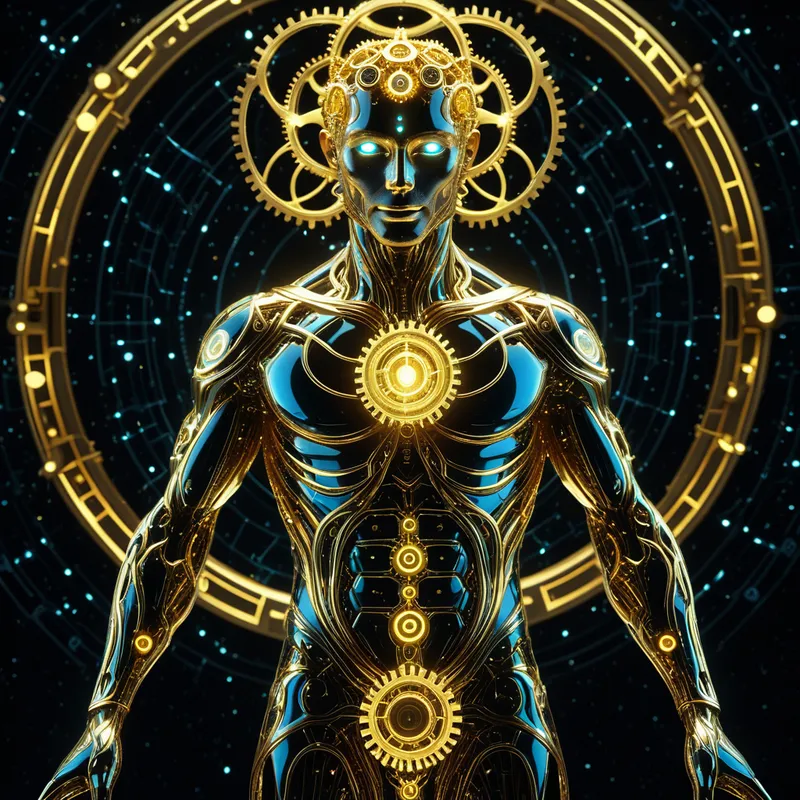
When this myth stirs in the modern dreamer, it often manifests as dreams of searching. One might dream of combing through endless attics for lost photographs, assembling a broken vase whose pieces are scattered across different cities, or following a faint, familiar scent through a labyrinthine building. The somatic sensation is one of determined focus mixed with deep, aching longing. There is a knowing that something essential is missing and must be found.
Psychologically, this signals a process of active recollection and integration. The dream-ego is in the role of Isis. The fragmented Osiris-body represents dissociated memories, neglected talents, or parts of the personality sacrificed to please others or survive trauma. The dream is not a passive replay of fracture; it is the psyche initiating its own salvage operation. If Set appears, he may manifest as a figure of sabotage in the dream, a voice of cynical despair (“It’s pointless, you’ll never find them all”), representing the internal resistance to the difficult, painful work of re-assembly. The dream is the soul’s insistence that wholeness is not a pristine, original state, but a hard-won creation.
Alchemical Translation
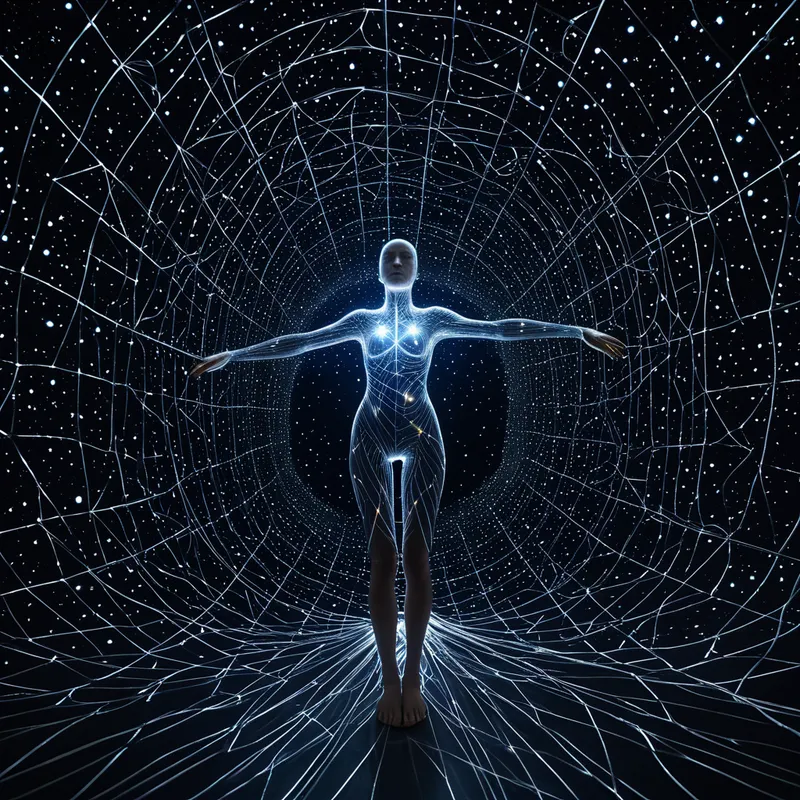
The alchemical journey mirrored in this myth is the solve et coagula—dissolve and coagulate. Osiris in the chest, cast into the Nile, is the nigredo, the descent into the watery unconscious and the darkness of despair. His dismemberment is the ultimate dissolution, the reduction of the personality to its fundamental, broken parts.
Isis’s work is the albedo. Her tears are the cleansing ablutio; her patient search is the careful sorting of the prima materia of the soul. The reassembly is not a return to the old form, but the creation of a new, sacred body—the corpus glorificatum. This is the rubedo, the achievement of the philosopher’s stone.
For the modern individual, the process is one of psychic transmutation: the conscious ego (Isis) must descend into its own history of fracture (the search for Osiris), not to blame, but to reclaim. It must perform the meticulous, loving labor of gathering all that has been lost, denied, or shattered.
The final stage—the unveiling of Ra’s name—is the integration of the transcendent function. It is the moment when the personal work of healing connects to a transpersonal source of power and meaning. The individual no longer operates from a place of compensating for wounding, but from a place of accessed, inherent authority. The secret name is the individual’s own unique and authentic self-knowledge, claimed not from others, but earned through the ordeal of loving, seeking, and piecing together one’s own fragmented truth. The myth of Isis Unveiled thus becomes a map for the ultimate human alchemy: turning the lead of loss and trauma into the gold of an integrated, sovereign, and truly revealed Self.
Associated Symbols
Explore related symbols from the CaleaDream lexicon: