Isis and Horus Myth Meaning & Symbolism
A mother's fierce love resurrects a king, and her son must reclaim his stolen throne from the god of chaos in a cosmic battle for order.
The Tale of Isis and Horus
Listen, and hear the tale written in the silt of the Nile and the eternal circuit of the sun. It begins not with a birth, but with a murder in the fragrant dusk. Osiris, the Green King, lord of order and growth, lies betrayed. His brother, Set, the red storm of envy, has sealed him in a chest and cast him adrift on the great river’s coils.
But where there is death, there is Isis. Her wail is the first wind of a seeking storm. With her sister Nephthys, she scours the world, a silhouette of grief against the bleaching sun. She finds the chest, lodged in a faraway tamarisk tree, grown into a pillar of a foreign king’s hall. Her magic is a whisper that unlocks wood, and she brings her husband’s body home to the whispering reeds of the Delta.
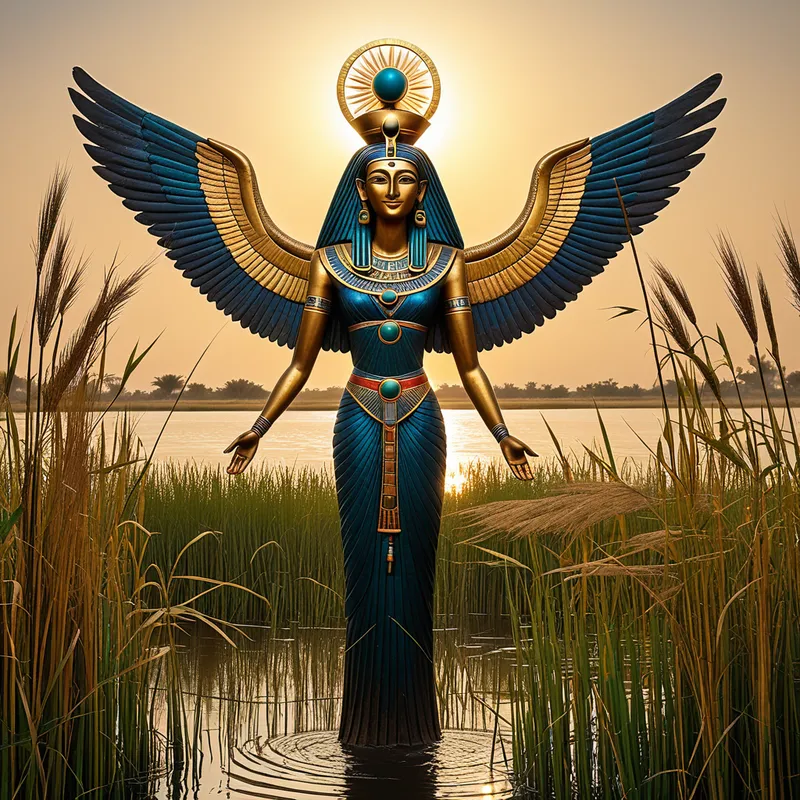
There, in the hidden places where papyrus meets sky, her magic blooms. She fans the still air with her great wings—not of feather, but of spirit—and calls upon the deepest names of power. For a fleeting night, Osiris breathes. From their union, a spark is kindled in the womb of loss: Horus.
Yet Set is not done. In a rage, he tears the body of the Green King into fourteen pieces, scattering them to the corners of the land. Isis does not despair. She becomes a fisher of fragments, a weaver of broken flesh. With her sister, she finds each piece—all but the phallus, devoured by the Nile’s oxyrhynchus fish—and binds them with linen and spell. She creates the first mummy, a vessel for a king who must now rule the Duat.
In the protective thickets of Chemmis, Horus is born. His cradle is a nest of reeds, his lullaby the hiss of serpents and the incantations of his mother. Isis is his fortress. When a venomous serpent sent by Set strikes the child, her cry pierces the heavens. The sun barque of Ra itself stops in the sky. She wrests the secret name of Ra from the aged god, a power greater than poison, and heals her son. This is her work: not just to birth a king, but to make him invincible.
Years flow like the Nile. The child in the marsh becomes the falcon in the sky, his eyes the sun and moon. He strides before the tribunal of gods at <abbr title=""City of the Pillar,” a center of worship”>Heliopolis, his claim clear: “The office of my father was taken by force. I am Horus, come to claim my own.” What follows is an epic of contention—a trial lasting eighty years. Battles rage. In one, Set tears out Horus’s left eye; in another, Horus emasculates Set. The gods are divided, the world tilts toward chaos.
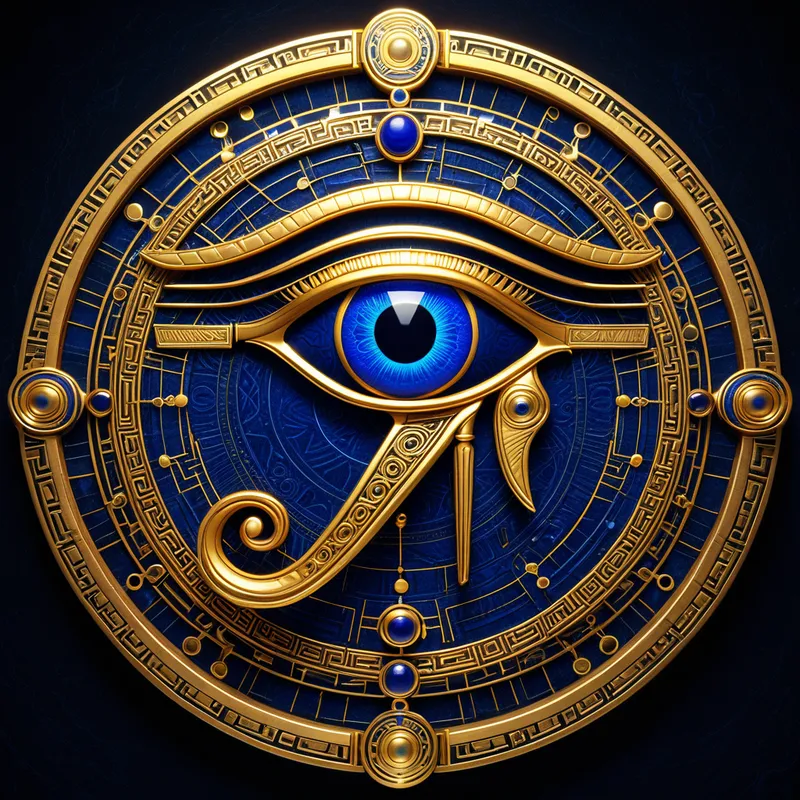
The resolution comes not from pure force, but from a deeper magic. Isis, in her cunning, intervenes. Finally, the primordial earth god Geb decrees the double crown for Horus. Order is restored. Horus, the One Far Above, takes the throne of the living. Set is bound to the roaring sky as a necessary storm, and Osiris, resurrected in the Duat, becomes king of the glorious dead. The broken eye of Horus is made whole by Thoth, becoming the Wedjat, a symbol more powerful than any weapon. The mother’s vigil is complete; the son’s destiny is fulfilled.
Cultural Origins & Context
This myth was not merely a story but the foundational political and cosmological drama of ancient Egypt. Its earliest coherent tellings are found in the <abbr title=""Pyramid Texts,” the oldest Egyptian religious texts, inscribed in pyramids”>Pyramid Texts (c. 2400-2300 BCE), where it served as a ritual map for the deceased pharaoh’s transformation into an akh in the likeness of Osiris. It evolved through the Coffin Texts and finds a vivid, though fragmented, narrative in later Greek sources like Plutarch’s De Iside et Osiride.
The myth functioned on multiple societal levels. For the monarchy, every living pharaoh was Horus, the rightful heir who had defeated chaos (Set) to assume the throne from his father (Osiris). This provided divine legitimacy for royal succession. For the populace, it explained the natural order: the annual death and rebirth of vegetation (Osiris), the protective, nurturing force of the land and magic (Isis), and the necessary, if terrifying, storms of the desert (Set). It was performed in temple rituals and festival dramas, making the cosmic struggle a tangible part of communal life, ensuring the Nile would flood, the sun would rise, and Maat—cosmic order—would prevail.
Symbolic Architecture
At its heart, this is a myth of re-membering. The scattered body of Osiris symbolizes a fragmented state of being—a psyche, a family line, a kingdom, or a soul shattered by trauma (Set). Isis’s labor to gather the pieces is the archetypal work of the Caregiver, but with a crucial, active dimension: she is the soror mystica, the magical sister who knows that wholeness must be actively reconstructed, not merely mourned.
The true magic is not in preventing the shattering, but in having the devotion to seek every last fragment and the wisdom to bind them into a new, sacred form.
Horus represents the “child of the promise,” the new consciousness born from the ashes of the old order. His long, contentious maturation mirrors the painful, non-linear process of claiming one’s rightful authority. The stolen and restored Wedjat eye is the ultimate symbol of this: it is the insight gained through suffering, the perception made whole and holy after being violently torn away. Horus does not simply defeat Set; he integrates the chaotic force. Set is not destroyed but given a role at the prow of the sun barque, acknowledging that chaos is a perpetual, necessary tension within the cosmos and the self.
The Dreamer’s Resonance
When this myth stirs in the modern unconscious, it often manifests in dreams of profound searching and protective fierceness. You may dream of gathering pieces—of a broken vase, scattered papers, bones on a shore. This is the Isis-work: the somatic feeling of a psyche attempting reintegration after a loss, betrayal, or personal “dismemberment.” The dream-ego is compelled to collect, to make whole.
Conversely, you might dream of being a hidden child in a marshy, enclosed sanctuary, aware of a dangerous presence lurking beyond the reeds. This is the Horus-state: a potent but vulnerable new potential, incubating under the protection of an inner nurturing intelligence (Isis), not yet ready to face the outer chaos. The conflict may also appear as a protracted trial or battle where the dreamer feels both justified and perpetually frustrated, unable to secure a final verdict. This mirrors the eighty-year divine tribunal—the psychological process of internally legitimizing one’s own authority, often against an inner critic or legacy of injustice (Set).

Alchemical Translation
The alchemical journey modeled here is the opus of restitution and sovereign claim. The prima materia is the scattered body of the past—our inherited traumas, abandoned potentials, and fragmented identity. Isis represents the devoted attention we must apply to this material. She is the patient, magical work of therapy, reflection, and soul-making: gathering memories, honoring grief, and reconstituting a narrative of the past that, while changed, is now sacred and whole (the Osiris-mummy).
The throne is not inherited; it is reclaimed through a battle that heals the very eye with which you see the world.
From this reconstituted foundation, the new king (Horus) is born. This is the emergent, authentic Self, conceived in darkness but destined for the light. Its initiation is the confrontation with the inner Set—the chaotic, envious, destructive patterns within. This battle is inevitable and bloody; parts of us will be lost (the eye). Yet the goal is not annihilation, but a difficult integration that grants us our full power. The final stage is the healing of the Wedjat by Thoth (the reconciling wisdom function). This signifies achieving a healed perspective, where the wound itself becomes the source of protective insight and measured power. You become the ruler of your inner landscape, the living heir to your own redeemed history, capable of holding both order and necessary chaos in balance. The mother’s work is done, for the child has become the king.
Associated Symbols
Explore related symbols from the CaleaDream lexicon: