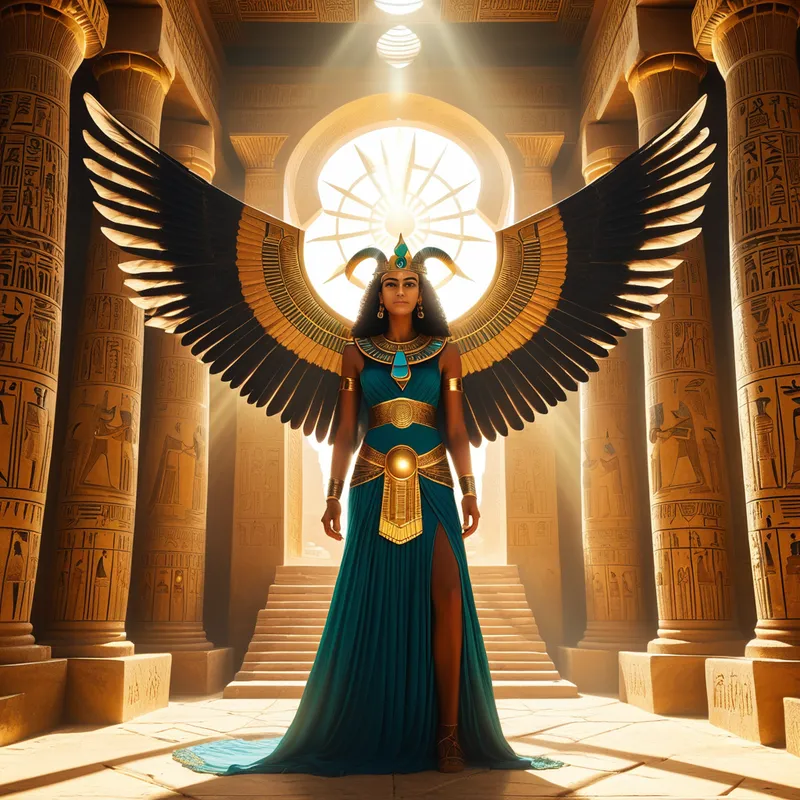
Isis Myth Meaning & Symbolism
The goddess Isis, through profound love and cunning magic, reassembles her murdered husband Osiris, embodying the eternal power of restoration against chaos.
The Tale of Isis
Listen, and hear the tale whispered by the river reeds, carried on the hot wind from the desert. In the First Time, when gods walked the black earth of Kemet, the wise and good king Osiris brought order to the world. By his side stood his sister-queen, Isis, whose love was as deep as the Nile and whose cunning mind held secrets even the sun did not know.
But a shadow grew in the heart of their brother, Set, whose envy was as barren and scorching as the red lands he ruled. With a traitor’s smile, Set hosted a great feast. He presented a magnificent chest, adorned with cedar and ebony, and proclaimed it a gift for whoever fit within it perfectly. When Osiris, trusting and noble, lay down in the coffin, Set’s seventy-two conspirators slammed the lid shut. They sealed it with molten lead and cast it into the Nile’s rushing currents. The chest became a sarcophagus, carrying the living king into the cold embrace of the sea.
A wail of grief tore from Isis’s throat, a sound that stilled birds in flight. She cut her hair, rent her robes, and began her endless search. From delta to marsh, guided by whispers from children and fishermen, she followed the trail of the casket. She found it, at last, lodged in a tamarisk tree that had grown around it in the far land of Byblos. But her triumph was brief. Set, discovering her recovery, was consumed by a second, more terrible rage. He stole the body of Osiris and, under the cover of a moonless night, hacked it into fourteen pieces, scattering them to the farthest corners of Egypt.
Isis did not despair. With her sister Nephthys, she transformed into a kite, her mournful cry piercing the sky. She scoured the land, gathering each precious fragment from the mud of the delta, the reeds of the marshes, the sands of the desert. Wherever she found a piece, a temple rose. All were found save one—the phallus, consumed by the Nile fish. Undeterred, Isis, the great magician, fashioned a replacement of gold and spoke words of such power that the very air shimmered. She fanned the pieces with her great wings, her incantations weaving flesh and spirit back together. In this sacred, temporary resurrection, she conceived a son, Horus, the avenger. Osiris, whole once more, became the Lord of the Beautiful West, the righteous king of the dead, his order restored in a new, eternal realm.

Cultural Origins & Context
The myth of Isis and Osiris is not merely a story; it was the central theological drama of ancient Egypt, a foundational narrative for kingship, fertility, and the afterlife. Its earliest complete telling comes from the Greek writer Plutarch (De Iside et Osiride, c. 100 AD), but the core elements are profoundly Egyptian, appearing in Pyramid Texts (c. 2400-2300 BCE) and Coffin Texts. It was performed in temple rituals and referenced in funerary spells, most famously in the Book of the Dead.
The myth functioned on multiple societal levels. For the pharaoh, it legitimized his rule as the living Horus, son of Osiris. For the common person, it provided a template for resurrection in the afterlife—every deceased Egyptian hoped to become "an Osiris." The annual flooding of the Nile was seen as the tears of Isis, linking the myth directly to the cycle of life, death, and agricultural renewal that sustained the civilization. Isis’s cult eventually became one of the most widespread in the ancient world, precisely because her story spoke to universal human experiences of loss, faithful searching, and the hope for restoration.
Symbolic Architecture
At its heart, the myth of Isis is a profound map of the psyche confronting fragmentation and death. Osiris represents the principle of order, structure, and conscious life that is inevitably assailed by the chaotic, disruptive, and envious forces symbolized by Set. His dismemberment is the ultimate psychic trauma—the shattering of the Self.
Isis represents the active, redeeming function of the soul that refuses to accept annihilation. She is not just a mourner; she is the archetypal seeker, the magician who knows that wholeness can be reassembled from brokenness.
Her search is the labor of consciousness gathering the scattered, often repressed or lost, parts of the personality. Each recovered fragment, enshrined in a temple, signifies the sacredness of every piece of our experience, no matter how wounded or seemingly lost. The crafted replacement for the missing phallus is a crucial alchemical symbol: it shows that what is irretrievably lost to the unconscious (consumed by the Nile creature) can be consciously re-created through spirit (gold) and intention (heka). The final product is not a return to the old, mortal life, but a transformation into a new, enduring state of being—Osiris as Lord of the Dead.
The Dreamer's Resonance
When this mythic pattern stirs in the modern dreamer, it often manifests as dreams of searching, gathering, or piecing things together. You may dream of wandering through a vast, labyrinthine space (an attic, a ruined city, a shoreline) looking for something vitally important but undefined. You may find broken objects—china, a clock, a toy—and feel a compulsive need to repair them. The somatic sensation is one of determined focus mixed with deep anxiety, a "hunt" in the liminal space of the psyche.
Psychologically, this indicates a process of recollection in the deepest sense. The ego-Self axis has been damaged by a betrayal, a loss, or a profound disillusionment (the Set function). The dream-Isis is the psyche’s own recuperative power activating, attempting to locate and reintegrate the dissociated parts of the personality that were "scattered" by the trauma. The process is seldom quick or easy; it requires patience, grief (the mournful kite), and a willingness to delve into the "marshes" and "deserts" of one’s own emotional landscape.

Alchemical Translation
The alchemical journey mirrored in this myth is the opus contra naturam—the work against nature, which here means against the finality of decay and entropy. Isis’s labor models the individuation process for anyone seeking to become whole.
The first operation is the Search (Nigredo): confronting the blackness of loss, the dissolution of a cherished structure (a relationship, identity, or belief). This is the dark night, the cutting of hair, the admission that what was whole is now gone.
Next is the Gathering (Albedo): the patient, piece-by-piece work of analysis, therapy, or introspection. This is the white stage of purification, where each recovered memory, acknowledged shadow aspect, or owned projection is cleansed in the moonlight of conscious attention. Not all parts may be found in their original form; some must be consciously fashioned anew through creative act and will.
Finally, the Animation (Rubedo): the red stage of new life. By fanning the reassembled self with the wings of spirit—through breath, ritual, or renewed commitment to life—a new synthesis is achieved. The conceived Horus is the nascent, resilient consciousness that can now engage the world. The transformed Osiris is the enduring, foundational Self, no longer identified with the mortal ego but established as the rightful ruler of the inner, eternal realm. The chaos of Set is not destroyed—chaos is an eternal force—but it is contained within a larger, restored order. The individual learns that devotion to the process of reassembly is, itself, the highest magic.
Associated Symbols
Explore related symbols from the CaleaDream lexicon: